The Latest From Our Blog

This is where you can find out more about what's new at Aloha Group Maui - new homes for sale, new condos for sale, video tours, 3D tours, price adjustments, open houses, our community involvement, podcasts, and Maui fun!


March 23, 2026

Maui Luxury Market Report ~ Week Ending 3-21-26

Aloha, all, we currently have 106 luxury homes and 77 luxury condominiums for sale. Inventory remains relatively stable, which is typical at these price points on Maui. Activity this week was still light, but weather events likely had a significant impact on showing activity and even new listing activity. 


Let’s look at the details.


Luxury Homes 


Closed

192 Halau Pl, Wailea — 3 bedrooms | 3.5 bathrooms | 3,808 sq ft | ohana: no | 0.3691 acres | Wailea Golf Estates / panoramic ocean and golf course view. Listed at $6,750,000, originally $7,495,000, and closed at $6,600,000 on 3/16/26 after 125 DOM. The home was renovated in 2022 and sits in Wailea Golf Estates overlooking the 18th fairway. This was a cash sale. 


Pending

No pending luxury properties were provided in the attached data for this week.


New Listings

519 Hana Hwy, Kuau — 3 bedrooms | 3 bathrooms | 1,309 sq ft | ohana: yes, 2 bed / 3 bath / 1,156 sq ft | 0.3483 acres | oceanfront North Shore estate.
New at $5,000,000. This is a two-home oceanfront property in Kuau with direct ocean frontage and recent updates. DOM shown as 3. The home was previously listed with another broker for $4,888,000. I guess the 8’s weren’t lucky numbers after all. 

5171 Lower Honoapiilani Rd, Napili — 3 bedrooms | 3 bathrooms | 2,723 sq ft | ohana: no | 0.1740 acres | oceanfront Napili bluff home.
New at $5,850,000. Oceanfront setting, pool, 2-car garage, and photovoltaic system. DOM shown as 5. Previously listed with the same broker at the same price without selling. Nice photos, Ray. 

936 Punakea Loop, Launiupoko — 4 bedrooms | 3.5 bathrooms | 3,957 sq ft | ohana: no | 5.4100 acres | modern Launiupoko estate with mountain/ocean views. This home built in 2017 was previously listed by the same agent at the same price of $9,900,000. It was on the market for 456 without a sale or a price change. Contemporary custom residence in Makila Plantation II on over 5 acres. DOM shown as 5. Previously listed by the same broker at the same price. 


Price Reductions

40 Pulehu Nui Rd, Kula — 5 bedrooms | 2.5 bathrooms | 3,619 sq ft | ohana: yes, 3 bed / 2 bath / 1,788 sq ft | 2.0000 acres | Upcountry estate with mountain/ocean views. Reduced from $4,749,000 to $4,499,000. Price cut: $250,000. DOM shown as 61. 

Wailea Point 2802, 4000 Wailea Alanui Dr — 2 bedrooms | 2 bathrooms | 1,808 sq ft | n/a | Wailea Point oceanfront condo | upper-floor luxury residence. Reduced from $5,200,000 to $4,900,000. Price cut: $300,000. It had been listed previously at $5.9M.  DOM shown as 188. Wailea Point’s minimum rental period is noted as having changed from 30 days to 1 year. 


Cancelled / Expired

3878 Wailea Ekolu Pl, Wailea — 4 bedrooms | 5 bathrooms | 5,638 sq ft | ohana: no | 0.3975 acres | Wailea Golf Estates ocean-view estate. This was the second time this property was listed by the same broker. It was previously list starting $12.5 million and reduced to $10,950,000 before the listing was cancelled after 230 on market. This it was cancelled at $9,950,000 after just  98 DOM. 

454 Wailau Pl, Launiupoko — 4 bedrooms | 5 bathrooms | 6,640 sq ft | ohana: no | 52.7760 acres | iconic gated Launiupoko estate. This was the 4th try for this home. Originally listed by a Wailea broker in the spring of 2024 for $16.9M. After 2 listing periods with that broker it was listed with another Wailea based broker for $11.5 million. This was cancelled at $11,000,000 after 72 DOM with the same broker.  


Condos 


Price Changes

Wailea Point 2802, 4000 Wailea Alanui Dr — 2 bedrooms | 2 bathrooms | 1,808 sq ft | n/a | Wailea Point oceanfront condo | upper-floor luxury residence. Reduced from $5,200,000 to $4,900,000. Price cut: $300,000. It had been listed previously at $5.9M.  DOM shown as 188. Wailea Point’s minimum rental period is noted as having changed from 30 days to 1 year. 


There was no other activity to report in the condo luxury segment for the week. 


Our Take

Maui has taken a pounding 2 weeks in a row by consecutive storms called low Kona’s. With monsoon like rains, mud slides, and collapsed and closed roads Maui real estate was almost closed for business for a 10 or 12 day stretch. 

Mid-March, is usually one of the hottest times for the Luxury market on Maui. As we head into the last few weeks of our traditional high buyer season, hopefully the weather forced lull will unleash some pent-up demand. 

Still this remains a market where serious sellers have to be serious. There is no shortage of beautiful properties on Maui. What is in shorter supply is urgency from buyers. Until that changes, price, presentation, and patience all matter — but price is still the one lever sellers can actually control.

Posted in Luxury Update
March 16, 2026

How to Appeal Your Maui Property Tax Assessment


A Step-by-Step Resource Guide for Maui Property Owners
When to appeal, the April 9 deadline, the 20% rule, and what to expect from the Maui County Board of Review.


Important note: This article is intended as an informational resource to help Maui property owners understand the County appeal process. For advice specific to your property or legal situation, consult the Maui County Real Property Assessment Division or a qualified professional.


Aloha Maui property owners.


Every spring, property owners across Maui open their Notice of Property Assessment and ask the same question: Is this value actually correct?


Sometimes the answer is yes. But sometimes the county’s estimate does not line up with the market, especially when values move quickly.


Fortunately, Maui County provides a formal process to challenge an assessment. It is called a Real Property Tax Appeal.


The good news is that the process is fairly straightforward. The bad news is that timing matters. Miss the deadline and you generally need to wait another year.


The Two Things That Matter Most

Key Rule

Why It Matters

Timing

Appeals for the 2026 tax year must be filed by April 9, 2026. If mailed, they must be postmarked by that date. If delivered in person, they must arrive by 4:00 p.m.

The 20% Rule

For a valuation appeal, the main issue is whether the county’s assessed value exceeds market value by more than 20%. In practical terms, the taxpayer generally needs to show the property value is less than 80% of the total assessment.


Maui Property Tax Appeal Timeline

The appeal window opens shortly after assessment notices are mailed each year, and the filing period is relatively short.

Date

Event

January 1

Property values established

Around March 15

Assessment notices mailed

April 9

Deadline to file appeal

Summer / Fall

Board of Review hearings

60–90 days after hearing

Written decision typically mailed

For the 2026 tax year, the appeal must be filed no later than April 9, 2026. If mailed, it must be U.S. postmarked on or before April 9. If delivered in person, it must be received by 4:00 p.m. that day.


Who Can File an Appeal?

Eligible Appellant

Typical Example

Property owner

Most common situation

Authorized representative

Attorney, consultant, or other representative with written authorization

Person contractually obligated to pay the property tax

Some leasehold or other contractual arrangements

If someone files on your behalf, a letter of authorization should be included with the appeal package.


Understanding the 20% Rule

The most common basis for appealing a Maui property tax assessment is the 20% rule.

The county materials explain this as a situation where the assessment exceeds by more than 20% the market value used by the County as the tax base. The hearing overview also states that the taxpayer needs to show the property value is less than 80% of the total assessment.

Example Scenario

Amount

Takeaway

County assessed value

$1,000,000


Estimated market value

$800,000


Difference

25%

A difference greater than 20% may support a valuation appeal

That does not automatically mean every disagreement wins. It means the taxpayer should be prepared to support a lower market value with solid evidence.


Other Valid Grounds for Appeal

Ground for Appeal

Explanation

Assessment exceeds market value by more than 20%

The most common appeal ground

Lack of uniformity or inequality

The methods used were applied incorrectly or produced an unequal result

Denied exemption

For example, a homeowner or other exemption was denied

Incorrect classification

The property was placed in the wrong tax category

Illegality

The methods used violate law, ordinance, or constitutional requirements

Denied circuit breaker tax credit

Applicable when a qualified taxpayer was denied the credit


How to File a Maui Property Tax Appeal

Step 1: Complete Form DFT-595

Property owners must complete the County’s appeal form, Taxpayer’s Notice and Receipt of Real Property Tax Appeal (Form DFT-595). The form asks for the TMK, classification, owner contact information, the county’s assessed value, your opinion of value if you are appealing valuation, and the legal ground or grounds for the appeal.

Step 2: Gather Supporting Evidence

Two complete sets of your appeal form and evidence should be provided. Common supporting materials include comparable sales, a professional appraisal, photographs or documentation of physical condition issues, repair estimates, or a comparative market analysis.

Step 3: Pay the Filing Fee

Each appeal requires a $75 filing fee. The County instructions state that if the filing fee is not included, the appeal will not be accepted.

Step 4: Submit the Appeal

The appeal may be submitted online through the Maui property tax website, by mail to the Board of Review in Kahului, or in person at the Real Property Assessment Division.

Evidence Type

Example

Comparable sales

Recent sales of similar properties

Professional appraisal

Independent opinion of value

Property condition documentation

Photos, repair estimates, or deferred maintenance

Comparative market analysis

Broker or Realtor market analysis


Mailing address: Board of Review, 110 ‘Ala‘ihi Street, Suite 110, Kahului, HI 96732


What Happens After You File

Once the appeal is accepted, the matter goes to the Maui County Board of Review. The Board is made up of five county residents who serve as impartial decision-makers between the taxpayer and the assessor.

The County states that a hearing notice will be mailed at least 15 days in advance.


What to Expect at the Hearing

Step

What Happens

Case introduction

The County summarizes the appeal

Taxpayer presentation

You present your evidence and explain your position

County response

The assessor or County representative presents their analysis

Board questions

Board members may ask questions of either side

Decision

The Board may announce it later in writing after deliberation

The hearing materials state that the taxpayer is typically given about five minutes to present the case, although additional time may be allowed when reasonably necessary.


Important Things to Expect

  • You still must pay property taxes by the normal due dates, even if an appeal is pending.
  • If you prevail, any overpayment will be refunded as the County processes refunds.
  • The Board decides the correct assessment based on the evidence presented. It cannot reduce taxes simply because the owner cannot afford them, and it does not set tax rates.
  • If you disagree with the Board’s written decision, an appeal to the Tax Appeal Court generally must be filed within 30 days.


Common Misunderstandings

Misunderstanding

Reality

“My assessment went up a lot, so I should automatically win.”

A large increase by itself is not the legal test. The question is whether the current assessment is too high under the allowed grounds for appeal.

“I filed an appeal, so I can wait to pay my taxes.”

No. Taxes must still be paid by the due dates to avoid penalties and interest.

“The Board will compare me to my neighbor’s tax bill.”

The materials say assessed values of other property, the amount of the tax bill, prior year assessments, and year-over-year increases are generally inadmissible as evidence of value.


Maui Property Tax Appeal Resources

Resource

Details

Real Property Assessment Division

(808) 270-7297

Board of Review

110 ‘Ala‘ihi Street, Suite 110, Kahului, HI 96732

Email

RPA.BOR@co.maui.hi.us

Appeal Form

DFT-595 – Taxpayer’s Notice and Receipt of Real Property Tax Appeal


Final Thought

The Maui property tax appeal process is not something most owners deal with every day, but the core ideas are simple: watch the timeline, understand the 20% rule, gather solid evidence, and file on time if an appeal appears warranted.


The most important date to remember is April 9. Miss that filing deadline and you will usually have to wait until the next cycle.


*Informational Disclaimer

This article is provided for informational purposes only to help Maui property owners understand the Maui County property tax assessment appeal process. It should not be considered legal, tax, or financial advice. Property owners should consult directly with the Maui County Real Property Assessment Division or a qualified professional regarding their specific situation.

March 12, 2026

Why Maui Condo Property Tax Assessments May Still Be High in 2026 (Even After Prices Dropped)


Understanding how Maui County calculates condo property tax assessments and why the system often lags real estate market changes by 9-18 months.


Aloha fellow Maui property owners.

It’s that time of year again.

What time is that?

Keep an eye on your mailbox for your property tax assessment notice.

If you own a condo on Maui, you may want to sit down before opening it.

Maui Property Taxes — At a Glance

Topic

Key Point

Assessment date

January 1 each year

Tax year

July 1 – June 30

Data used

Prior year sales (July – June)

Market lag

Typically 9–18 months

Appeal window

After notices are mailed in March


The Good News...and the Bad News

Let's start with the market.

In 2023, the median selling price for a Maui condo increased 7.4%.

In 2024, it increased another 8.3%.


Year

Maui Median Condo Price

Change

2023

~$830,000

+7.4%

2024

~$900,000

+8.3%


The good news?

Your investment was appreciating nicely.

The bad news? 

Your property taxes were appreciating right along with it.

Especially for short-term rental owners, where the tax rate is already...let's say...enthusiastic. 


Then 2025 Happened

After those nice increases, 2025 gave a lot of it back.

In fact, it gave all of it back.

The median condo price dropped from about $900,000 in 2024 to roughly $693,000 at the end of 2025.

Year

Median Condo Price

Change

2024

$900,000

2025

$693,000

–23%

So the bad news is:

A lot of owners lost equity.

The good news?

Well…

There isn’t any.

Because that’s not how property tax assessments work.


How Maui County Property Taxes Actually Work

Here’s where things get a little confusing.

Maui County property taxes run on a fiscal year from July 1 to June 30.

So the taxes you just paid last month apply to:

July 1, 2025 June 30, 2026

Tax Year

Period Covered

2025–2026

July 1, 2025 – June 30, 2026

So far so good?

Now comes the part that makes people’s heads hurt.


The Property Tax Timeline

Your assessed value isn’t based on what the market is doing today.

Instead, it’s based on sales from the prior year.

Here’s the simplified, yeah right, real simple, Lee, timeline Maui County follows.

Date

Event

What It Means

January 1

Valuation Date

Property values established for the upcoming tax year

March 15 (approx.)

Assessment notices mailed

Owners receive their new assessed value

April 9

Appeal deadline

Owners may challenge incorrect values

July 1

New tax year begins

Taxes apply for the upcoming fiscal year

August 20

First payment due

First half of property taxes due

February 20

Second payment due

Second half of property taxes due


The Important Part Most Owners Miss

Your January 1, 2026 assessment is based primarily on sales that occurred between:

July 1, 2024 – June 30, 2025

Assessment Date

Sales Data Used

January 1, 2026

July 1, 2024 – June 30, 2025

That means the county is typically running 9–18 months behind the real market.

So what does that mean this year?

The county’s model captures:

• The big price increases in late 2024
• Only part of the price decline in 2025

Which means…

Your assessment most certainly reflects prices that no longer exist.


How Maui County Calculates Property Values

Another thing that surprises property owners is how the county actually calculates value.

They are not individually appraising every condo and house every year.

That would be impossible.

Instead, Maui County uses something called mass appraisal.

Think of it as a statistical model that estimates property values based on recent sales.

The model analyzes factors such as:

• Recent closed sales
• Square footage
• Location
• View quality
• Bedroom count
• Property type
• Building or complex

Once the model determines a value range, it applies that estimate to all similar properties.

Example:

If several condos in a complex sell around $700,000, the county may estimate similar units in the building at roughly the same value.


Condo Assessments Work a Little Differently

For single-family homes, Maui County separates the assessment into two components.

Component

Description

Land Value

Value of the underlying land

Improvement Value

Value of the building

But condominiums are typically valued as a single unit based on comparable sales.

Typical factors include:

Factor

Impact

Floor level

Higher floors may command higher values

Ocean vs garden view

View premiums often apply

Square footage

Larger units typically valued higher

Bedroom count

Major driver of price


Why Your Assessment May Look Wrong

Mass appraisal works reasonably well when estimating thousands of properties.

But it’s not perfect.

Here are the most common reasons assessments differ from real market value.

Market Timing

Because the county uses prior-year sales data, assessments often lag the market.

In falling markets, assessments may be too high.


Limited Sales Data

Some condo complexes have very few recent sales, forcing the county to rely on older transactions.


Interior Condition

The county does not inspect interiors every year.

So two units may receive identical assessments even if they look very different.

Unit A

Unit B

Fully renovated

Original 1970 interior

Same tax value

Same tax value


Key Takeaways for Maui Condo Owners (2026 Property Tax Edition)

If you own a condominium on Maui, here are the most important things to understand about your 2026 property tax assessment.

Key Point

What It Means

Assessments lag the market

Maui County values properties using sales data from roughly 9–18 months ago

Your Jan 1 value determines future taxes

The value set on January 1, 2026 determines taxes for the July 1, 2026 – June 30, 2027 tax year

2026 assessments include part of the 2024 price surge

Some of the 2025 decline may not be fully reflected yet

Condo values rely heavily on comparable sales

The county estimates values using sales in your complex or similar properties

Interior condition is rarely considered

Renovated and original units often receive similar assessments

Owners can appeal

Property owners may file an appeal after notices arrive in March


Common Questions Maui Condo Owners Ask About Property Taxes

Why is my Maui property tax assessment higher than current market value?

Maui County assessments are based on prior-year sales data. Because of this, assessments often reflect market activity from 9–18 months earlier, which can make them appear too high during a declining market.


What sales does Maui County use to calculate condo assessments?

The county typically analyzes recent comparable sales within the same complex or similar complexes using a mass appraisal model.


Are Maui property tax assessments based on interior condition?

Generally, no. Maui County does not inspect interiors annually, so renovated and original units often receive similar assessments.


When are Maui property tax assessments determined?

Assessed values are established each year as of January 1, and those values determine taxes for the next fiscal year beginning July 1.


Can I appeal my Maui property tax assessment?

Yes. Property owners may appeal after assessment notices are mailed in March, typically by early April.

Appeals are usually supported by recent comparable sales showing a lower market value.


Final Thought

When your assessment notice arrives this spring, remember:

The county is looking in the rear-view mirror.

Your tax value is based largely on what the market looked like a year ago, not necessarily what buyers are willing to pay today.

Before you panic—or celebrate—compare the assessment with recent sales in your complex.

You may discover the county’s estimate is surprisingly accurate.

Or you may discover it’s time to consider filing an appeal.

Either way, at least now you understand how the system actually works.


Related Maui Real Estate Resources

If you want to learn more about the Maui real estate market, you may also find these helpful:

Maui Condo Market Report
Maui Luxury Home Market Update
• Investing in Short-Term Rental Condos on Maui
Maui Real Estate Advisor Podcast

March 3, 2026

Maui Real Estate Advisor ~ Maui Bill 9 Update: What Condo Owners and Buyers Should Know About the STR Phase-Out


Bill 9 phases out short-term rentals in apartment-zoned condos beginning in 2029 in West Maui and 2031 elsewhere. Here’s what property owners and buyers should understand now.


Quick Answer: What Does Bill 9 Mean for Maui Condo Owners?

Bill 9 phases out the legal right for apartment-zoned condominium complexes on Maui to operate as short-term rentals.

The phase-out timeline is:

West Maui: January 1, 2029
South Maui and the rest of Maui County: January 1, 2031

The law does not affect hotel-zoned properties, and several lawsuits challenging Bill 9 have already been filed.

Because the legal and political situation is still evolving, owners and buyers should evaluate decisions based on:

• remaining STR income potential
• possible court outcomes
• potential financing constraints
• market pricing of regulatory risk


Bill 9 Impact Snapshot

At a glance, here’s how Bill 9 affects Maui condominium owners today:

Topic

What Bill 9 Does

What Owners Should Know

Short-Term Rentals

Phases out STR use in apartment-zoned condos

Hotel-zoned properties are not affected

Timeline

West Maui: Jan 1, 2029South Maui & elsewhere: Jan 1, 2031

Roughly 3 years left in West Maui and 5 years in South Maui

Legal Status Today

STR use is still legal today in affected complexes

Owners can continue operating while the law and lawsuits play out

Lawsuits

Multiple lawsuits have already been filed

Court rulings could delay, modify, or overturn parts of the law

Financing Risk

Lenders may avoid buildings involved in litigation

Some transactions could become cash-only

Housing Impact

Bill 9 does not directly create affordable housing programs

Conversion to long-term housing depends on market economics

Political Factors

2026 is an election year for mayor and council

Policy adjustments remain possible

Market Impact

Buyers are pricing policy and legal risk

Remaining STR income still has economic value


Bill 9 Strategy Guide: What Owners and Buyers Should Be Thinking About Now

Most of the conversation around Bill 9 has focused on politics.

But for the people who actually own — or are considering buying — these properties, the real question is much simpler:

What should I do now?

Bill 9 removes the long-standing legal right for apartment-zoned condominiums to operate as short-term rentals beginning in 2029 in West Maui and 2031 elsewhere, including South Maui.

At the same time:

  • The Maui Planning Commission has rejected proposed hotel zoning districts
  • Lawsuits challenging Bill 9 have already been filed
  • The Maui County Council could still change course
  • Mortgage lenders may become cautious if litigation expands

In other words, the situation is still evolving.

For owners and buyers, the key is understanding the possible paths forward and the risks associated with each one.


Bill 9 Timeline for Maui STR Condos

The phase-out does not happen tomorrow, but the clock is ticking.

The law currently states:

West Maui STR phase-out: January 1, 2029
Elsewhere in Maui County (including South Maui): January 1, 2031

That means owners potentially have roughly:

West Maui: about 3 years of remaining STR use
South Maui: about 5 years

Those remaining years of legal rental use have real economic value — but that window is gradually closing.


Option 1: Hold and See What Happens

Many owners are considering simply holding their property and watching how things unfold.

There are several reasons this strategy may make sense.

Lawsuits Could Change the Outcome

Multiple lawsuits have already been filed arguing that removing a long-standing legal use constitutes a regulatory taking.

Court decisions could potentially:

  • delay implementation
  • modify the law
  • require compensation
  • overturn portions of the policy

Legal challenges of this scale often take several years to resolve.


Political Changes Are Possible

Another factor worth watching is that 2026 is an election year for both the mayor and members of the Maui County Council.

Major policy decisions often evolve during election cycles as candidates respond to economic conditions, voter concerns, and legal developments.

While it’s impossible to predict political outcomes, elections can create opportunities for policy adjustments, delays, or alternative approaches.


STR Income Still Exists Today

Under the current law, these units remain legal short-term rentals for several more years.

That means owners still have:

  • rental income
  • tax deductions
  • appreciation potential

Holding may allow owners to continue benefiting from the property while waiting for more clarity.


Option 2: Convert to Long-Term Rental

Some owners are exploring conversion to long-term residential rental.

This option may offer:

  • stable tenant income
  • reduced management complexity
  • compliance with future zoning rules

However, current market conditions suggest that conversion may not be simple.

According to one Maui rental manager I recently spoke with, there are more than 400 long-term rental units currently being advertised, and many are struggling to find tenants.

This suggests that a rapid influx of additional units could place further pressure on rental rates.

In addition, many of the buildings affected by Bill 9 were originally designed for visitor accommodations, not traditional residential living.

Factors owners should consider include:

  • building layouts
  • limited parking
  • minimal storage
  • resort-style infrastructure
  • maintenance costs in aging oceanfront buildings

These factors may influence how well certain complexes perform as long-term residential housing.


Option 3: Sell Before the Market Fully Adjusts

Some owners may decide to sell earlier rather than carry the policy risk.

This strategy removes uncertainty but also raises the question of how much discount the market will apply.


What Risk Discount Might Buyers Expect?

There is no perfect formula, but investors typically price regulatory risk using income horizon and uncertainty.

Remaining STR income window

Owners still potentially have:

West Maui: about 3 years of STR income remaining
South Maui: about 5 years

That income stream has real value and will influence pricing.

Policy uncertainty

Investors will discount value based on the probability of:

  • zoning changes
  • legal outcomes
  • enforcement timing

Financing limitations

If condominium associations become involved in litigation against the county, lenders may stop financing purchases in those complexes.

Mortgage lenders typically avoid buildings with active lawsuits.

If that happens, transactions could become cash-only, reducing the buyer pool and potentially placing downward pressure on values.


Three Scenarios for Bill 9: Worst Case, Middle Case, Best Case

Because the future is uncertain, it can be helpful to think about several possible outcomes rather than assuming only one.

Worst Case Scenario

  • Bill 9 proceeds exactly as written
  • Courts uphold the law
  • Hotel zoning proposals fail
  • STR use ends in 2029/2031
  • Financing becomes more limited

Values would likely shift toward long-term residential economics rather than visitor rental income.


Middle Scenario

A more moderate outcome may be the most realistic.

  • Lawsuits delay or modify implementation
  • Some complexes receive hotel zoning
  • Others transition to residential use
  • The market adjusts gradually

Values may experience moderate adjustments rather than dramatic declines.


Best Case Scenario

  • Courts determine removing a long-standing legal use requires compensation or modification
  • Hotel zoning expands
  • STR use continues in some form

Under this outcome, values could stabilize or recover.


The Market Is Already Pricing the Risk

Today’s market is already evaluating these possibilities.

Buyers, sellers, lenders, and investors are all asking the same question:

What is the probability of each scenario?

That’s why pricing may feel uncertain right now.


Which Condo Complexes Are Affected by Bill 9?

Bill 9 applies to apartment-zoned condominium complexes that have historically had the legal right to operate as short-term rentals.

It does not apply to hotel-zoned properties.

Because zoning designations are often misunderstood, owners and buyers should verify the zoning status of any property before making decisions.

If you’re unsure whether a condo is apartment-zoned or hotel-zoned, we’re happy to help review:

  • zoning designation
  • STR eligibility
  • potential financing implications
  • resale considerations

Reach out to Aloha Group Maui, and we’ll help you understand how the current rules apply to your specific property.

We are also preparing a companion article that will include a verified list of condominium complexes affected by Bill 9.


Final Thoughts

These condominiums were not illegal rentals.

For decades they operated under a legally recognized framework allowing short-term rental use.

Bill 9 changes that.

But the final outcome will likely be shaped not just by legislation — but by courts, economics, elections, and time.

For some owners, patience may prove to be a strategy.

For some buyers, opportunity may exist.

But both should approach the situation with a clear understanding of the risks.


Aloha Group Maui Perspective

If you own one of these properties — or are considering buying one — the right decision will depend on your timeline, financial goals, and tolerance for uncertainty.

This is not a one-size-fits-all situation, and the landscape continues to evolve.

We will continue monitoring the legal, political, and market developments closely.


Disclaimer

This article is intended for general informational purposes only and reflects current understanding of Bill 9 and related developments at the time of publication. It should not be considered legal advice. Property owners and buyers should consult qualified legal counsel and rely on verified zoning records when making decisions regarding specific properties.

March 2, 2026

Luxury Update - March 2, 2026


Aloha, All,

Starting with this report, we’re expanding the lens a bit. We’ll now be covering both luxury homes and luxury condominiums, using $4 million as the entry point for each.

They’re very different property types, of course. But when you step back and look at how buyers and sellers operate at this level — and how capital moves in this segment of the market — there’s significant overlap. Viewing them together gives us a more complete picture of what’s really happening at the top end.


Luxury Homes

Closed Sales

Olowalu Mauka | Olowalu

320 Luawai St

5 bd | 6 ba | 4,212 sf | ohana: no | 5.53 ac CPR (2.08 ac portion) | ocean view

Sold Price: $5,000,000 | Original: $8,973,000 | DOM: 108

Auction sale. Cash transaction. This property, which is stunning, was previously on the market at $9,995,000. The price was reduced 3 times and listing eventually expired after 372 days on market. 

It was relisted with a different broker for $8,793,000. 2 months later, it went to auction with a recalibrated asking price of $5 million. 

Click Here to View Listings


Pending Sales

The Ridge at Wailea | Wailea/Makena

14 Halapa Pl

4 bd | 4.5 ba | 5,126 sf | ohana: no | 0.51 ac | ocean view

List Price: $11,998,000 | DOM: 255

This is the 3rd time out with the same broker for this home which is technically a condo. In 2023 it was first listed for $15 million as new build. When that listing expired it was relisted at $13.5. 


Kula | Lower Kimo Drive

730 Lower Kimo Dr

3 bd | 4 ba | 7,102 sf | ohana: no | 5.28 ac | bi-coastal view

List Price: $9,875,000 | DOM: 332

This is the 2nd time out for this home which was originally listed for $12M in 2023. This time it started at $11M. The price was reduce to the current asking and went under contract after 332 days on market. 

Click Here to View Listings


New Listings

Lanikeha | Kaanapali

104 Anapuni Loop

3 bd | 4.5 ba | 5,901 sf | 0.94 ac | ocean/golf view

List Price: $7,400,000

Nice front row location. 


100 Woodrose Pl. 

3 bd | 4.5 ba | 5,901 sf | 0.94 ac | ocean/golf view

List Price: $5,900,000

Very good view over some low rooftops. It was built in 2005, it may have some renovations. 


Makena | Poolenalena Beach

4584 Makena Rd

2 bd | 3.5 ba | 2,760 sf | 1.15 ac | beachfront

List Price: $9,000,000

This is technically a beachfront location. However, the beachfront is only a small slice of a point on a wedge-shaped lot. It appears to be quite dated and has been on the market previously. 


Peahi | Haiku

400 Mehana Rd

3 bd | 3.5 ba | 5,403 sf + cottage | 20.5 ac | oceanfront

List Price: $11,900,000


Honolua Ridge | Kapalua

222 Ke’oawa St

4 bd | 4.5 ba | 4,574 sf | 6.67 ac | ocean view

List Price: $13,999,000

Ag zoned in Honolua Ridge


Price Reductions

Keawakapu Beach | Kihei

3254 S Kihei Rd

5 bd | 5 ba + 2 half | 7,244 sf | 0.55 ac | beachfront

Current Price: $24,500,000 (from $27,000,000)


Paia Bay | Spreckelsville/Paia

33 Hana Hwy

4 bd | 3 ba + cottage | 0.64 ac | beachfront

Current Price: $7,700,000 (from $8,800,000)

Listing notes say it was appraised at $12.1M. This is its 4th price reduction. 


Wailea Golf Estates | Wailea

3977 Wailea Ekolu Pl

4 bd | 6 ba | 4,079 sf | 0.32 ac | ocean/mountain view

Current Price: $6,950,000 (from $7,200,000)

Nicely updated home, great views and an odd layout. 


Cancelled / Expired

Papohaku Ranchlands | Molokai

35 Hulimoku Pl

4 bd | 3.5 ba | 5,257 sf | 5.73 ac

Last Price: $4,150,000

This is the 4 time out since 2022. It looks like it’s tough to sell a $4M home on Molokai. 


Makila Plantation II | Launiupoko

936 Punakea Loop

3 bd | 3.5 ba | 3,957 sf | 5.41 ac

Last Price: $9,900,000

This was cancelled after 456 days on market with no price changes. 


Maalaea Oceanfront

210 Hauoli St

2 bd | 2 ba | 2,154 sf | 0.84 ac | oceanfront

Last Price: $7,900,000

Expired after 366 DOM with 1 price reduction. This is the second time out for this listing. 


Luxury Condominiums

Closed Sales

None this period.

Pending Sales

Terraces Manele Bay IV 12D | Lanai

3 bd | 3.5 ba | 3,385 sf | ocean view

List Price: $4,990,000


Makena Surf A103 | Makena

3 bd | 3.5 ba | 3,415 sf | beachfront

List Price: $10,000,000

Short term rental is allowed


New Listings

Ho'olei 21-4 | Wailea

3 bd | 3.5 ba | 2,619 sf | hotel zoned | ocean view

List Price: $4,890,000

Short term rental is allowed


Kapalua Ironwoods 52 | Kapalua

3 bd | 3 ba | 2,336 sf | oceanfront bluff

List Price: $5,950,000

No short term rental allowed


Price Reductions

Montage Residences | Kapalua

Approx. 3 bd | ocean view

Current Price: $5,950,000 (from $6,450,000)

Short term rental allowed 


Wailea Beach Villas | Wailea

Approx. 3 bd | ocean view

Current Price: $4,995,000 (from $5,400,000)

Short term rental allowed 


Cancelled / Expired

Ho'olei 21-4 | Wailea

3 bd | 3.5 ba | 2,619 sf

Last Price: $4,890,000


Andaz Residences 803(F4) | Wailea

3 bd | 3.5 ba | 2,814 sf | beachfront

Last Price: $12,995,000


Our Take

Luxury inventory continues to build across both homes and condominiums, but the defining theme remains discipline.

Buyers are active but patient. Extended DOM, strategic price adjustments, and selective contract activity suggest normalization rather than contraction.

This market reflects recalibration — not collapse.

Feb. 17, 2026

Maui Real Estate Market Update - February 2026 | Condos, Homes & Inventory Trends

Is the Maui Real Estate Market Catching Fire?

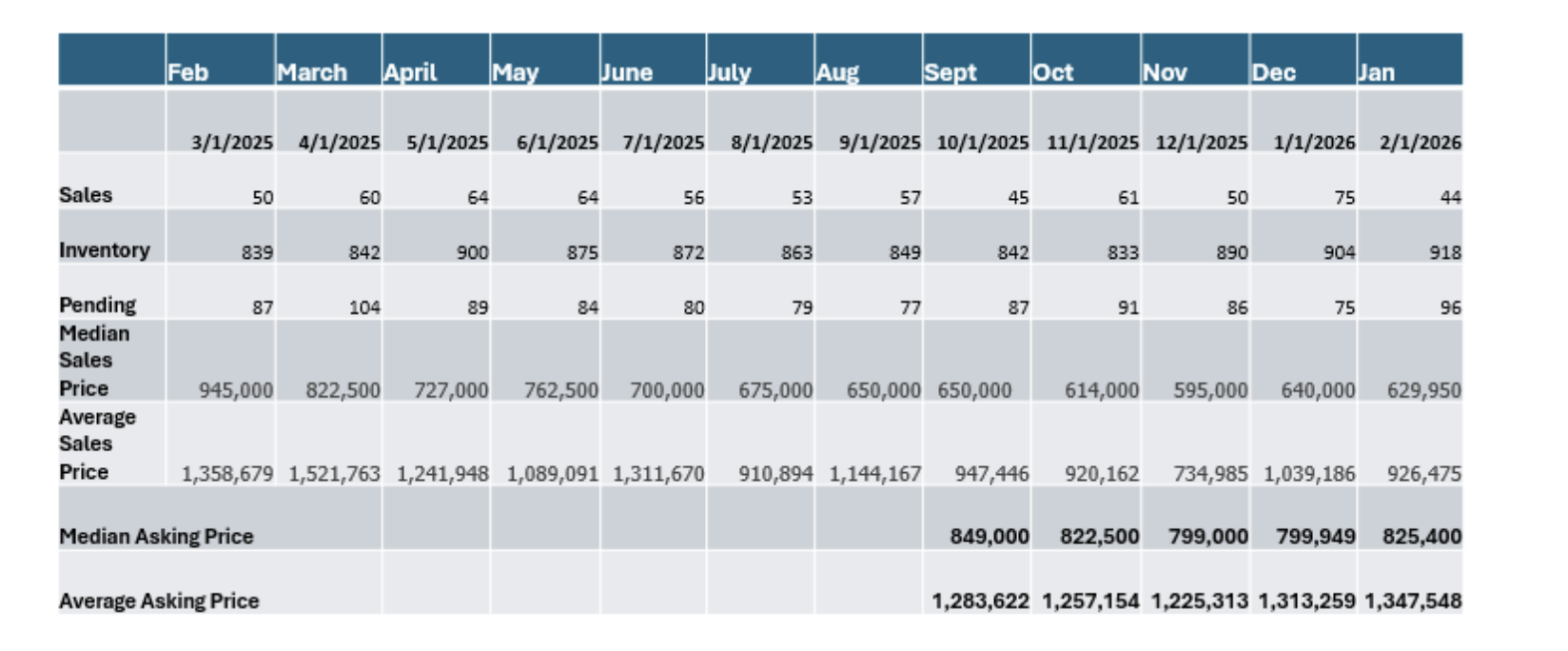
The February 2026 Maui real estate market update shows a sharp divergence between closed sales and pending activity. Condo sales remain historically low, while single-family home pendings are rising. Inventory levels remain elevated at nearly 21 months of supply in the condo market. Here's what the latest Maui housing data reveals about pricing, demand, and where the market may be headed. 

February 2026  Maui Market - Key Takeaways

  • Condo sales remain historically low
  • Condo pendings jumped 28% in January
  • 918 condos currently for sale (=21 months of inventory)
  • Majority of STR pendings are in apartment-zoned complexes
  • Single-family home pendings rose 25%
  • Median home prices rising for 3 consecutive months
  • Market showing stabilization

At first glamnce, January didn't look very exciting. 

If you just scan the closed sales numbers, you might even think this market may never turn around.

But when you slow down and really look at what's happening - especially pendings - there's a bit more life in the market than the headlines suggest.

As always, let's start with condos. 

___________________________________________________

Condos: Rough Closings...But Something is Shifting

I'm not going to sugarcoat it.

Condo sales in January were dismal. We haven't seen this kind of ugly since the early days of the Great Recession. That was when the whole world was going into the financial tank and condo prices were falling faster than a Led Zeppelin.

Even before seeing the final numbers we knew sales might be soft. There were only 75 condos under contract at the beginning of the month, so the pipeline was thin at best. Still, the final sales numbers were grim.

(See inventory table below - this is where the real story lives.)

And yet...

Pending sales jumped 28% in January to 96 under contract.

Now 96 isn't a huge number. But it's the third highest pending total we've seen since June of 2024 - which is about when the Maui condo market really started to take a nosedive.

So, while closings were ugly, buyers were slowly beginning to write contracts that were getting accepted.

AND - That - is a good thing.

___________________________________________________

What Are Buyers Buying?

It's a bit of a head scratcher, but it's definitely saying something.

Of the condos currently pending:

About 60% are in complexes that allow short-term rentals. About 40% are in non-STR complexes. That split is actually pretty normal historically.

But dig one layer deeper.

Of the STR pendings, the majority are in apartment-zoned complexes - the ones considered "at risk" under Bill 9 - not the hotel-zoned, Bill 9 proof properties. 

I know what you're thinking. There was probably a big price difference between the hotel-zoned and the apartment-zoned. Nope, the median asking price difference between hotel-zoned and apartment-zoned units in escrow? Only about fifteen thousand dollars. On roughly a $750,000 purchase, that's not much in the scheme of things.

So why are buyers stepping into apartment-zoned STRs?

Maybe they, and their agents, optimistically believe the new hotel zoning pathway ultimately gives those properties a future. And, with any luck, the bill and the zoning process will get passed and done before the amortization period runs out.

On the other hand, maybe these buyers are financially strong enough that if STR rights go away, they're comfortable using the property as a second home. 

Or maybe they just see value.

It is not panic buying - or selling. It feels more like selective buying and both buyers and sellers are fed up with waiting for Maui county to make decisions.

___________________________________________________

Maui Inventory & Months of Supply

The Supply Reality

Putting more future sales in the pipeline feels great, but, supply and demand is still a thing.

Condo inventory inched up again - not dramatically, just about 1% - bringing us to 918 units for sale. On its own, that number doesn't sound alarming.

However, since sales have been so light for several months, that inventory translates into just under 21 months of supply. In most markets, six months is considered balanced. Twenty-one months tells you buyers still have options - and plenty of them.

(Check out the stats in the table below.)

When you look at what makes up that inventory, it's even more telling. More than 60% of the condos currently listed are hotel-zoned, and a large share of the apartment-zoned inventory still allows short-term rental. In other words, there is no shortage of STR-capable product available right now.

That abundance is exactly why pricing softened last year. When supply outweighs demand for an extended period, prices adjust. We saw that play out through 2025, with both the median and average condo prices falling roughly 20% from 2024. November felt like the low-water mark, particularly when the median dipped below $600,000 before stabilizing as we moved into the new year.

That's not pessimism. It's just math.

The good news is this: markets don't need fireworks to turn. They need steady absorption. If buyers continue stepping in at this pace, even gradually, the balance will shift.

We're not there yet - but we may be starting the process.

___________________________________________________

Quiet Closings, Loud Pendings

Now let's talk homes.

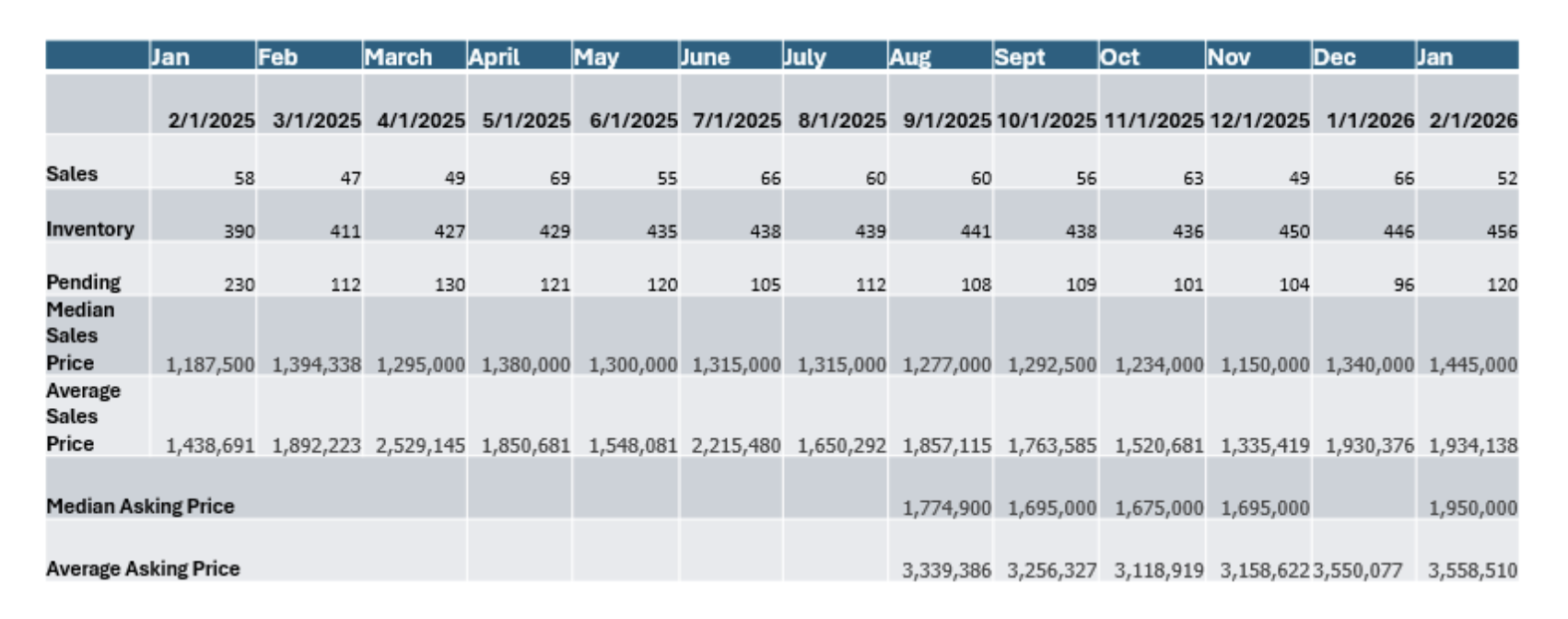
January closing were unimpressive - only 52 single-family homes sold. That's down from December, and the 3rd lowest month in the last 12. But here's the part that made me lean forward a little.

Pending sales jumped 25% from 96 to 120. And by mid-February, we were already seeing strong contract activity continuing.

That doesn't really feel like a one-month blip, it's feeling a little like momentum. It feels like buyers who have been sitting on the sidelines are finally moving. 

Inventory ticked up slightly - nothing dramatic - just a slow steady climb that we've been watching for over a year.

And prices?

The average selling price in the low $1.9M range was basically flat month-to-month, but that is still substantially higher than the $1.3 range just 2 months ago.

The median has risen three months in a row. That tells me the mix of what's selling has shifted slightly higher.

There were five sales over $4 million in January. That's a pretty average luxury month on Maui, but a little disappointing for what I think of as our high season.

Geographically, no big surprises. Central and South Maui led the way with 27 new pendings each. Upcountry had 18, followed by North Shore, Haiku/Sprecklesville/Paiai; only Hana had fewer new pendings, zero, than West Maui with only 9.

What stands out isn't explosive growth.

It's improving momentum.

___________________________________________________

So...What's Really Happening?

I wouldn't say the market is taking off. And I wouldn't say it's struggling either.

What I see is a market trying to find its footing.

Condo closings were rough - but contracts picked up.

Home sales were soft - but pendings jumped in a meaningful way.

Prices aren't surging. They're not falling off a cliff either. They feel like they're searching for balance.

This doesn't feel anything like 2021. And it doesn't feel like the Great Recession.

If feels like buyers who've been cautious are starting to test the water again.

That doesn't flip the supply-and-demand equation overnight. We still inventory to work through. But momentum doesn't start with headlines - it starts quietly, with contracts.

If this pace of pendings continues for another month or two, then we're looking at a different conversation as we head into spring.

For now, I'd call it measured improvement.

And after the past couple of years Maui has had, measured improvement is something I'll take.

Every property reacts differently in a shifting market. If you'd like to understand how your specific condo or home fits into these trends, let's have a conversation.

Email: Lee@AlohaPotts.com

808-276-8772

LahainaLee.com


*Data sourced from the Realtor Association of Maui (RAM) monthly statistics.

Feb. 4, 2026

Luxury Update ~ February 3, 2026

Is the Maui Luxury Market Crashing?

Lately, I’ve been hearing a lot of chatter — from observers, some realtors, reporters, and the usual market pundits — asking whether luxury real estate on Maui is crashing. In fact I heard this week when I was touring a $6M listing.

That question makes sense if your reference point is 2021.

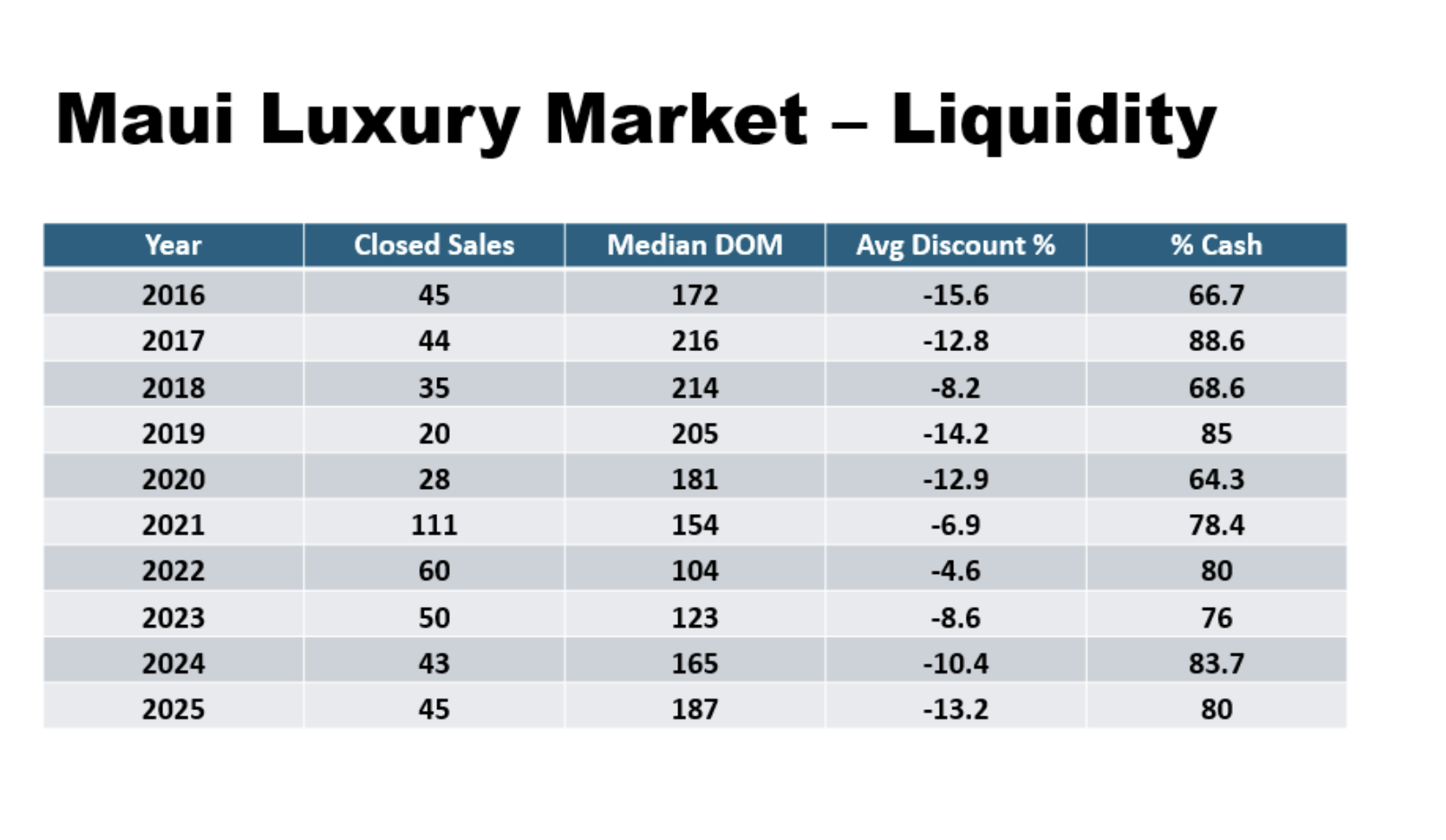
But 2021 was an extraordinary outlier. Sales volume more than doubled long-term norms. Days on market collapsed. Discounting nearly disappeared. Buyers moved quickly, often with very little hesitation.

When you compare today’s market to that one year, everything since can feel like a crash.

But when you step back and look at the full 10-year history, a very different picture emerges. Today’s market looks far more like 2016–2019 in structure — just at higher price levels and with higher carrying costs.

If this were a true crash, we’d expect to see sharp and sustained price declines, forced selling, and maybe a sharp reduction in cash purchases. That’s not what the data shows.

And if you like data, this might be for you.

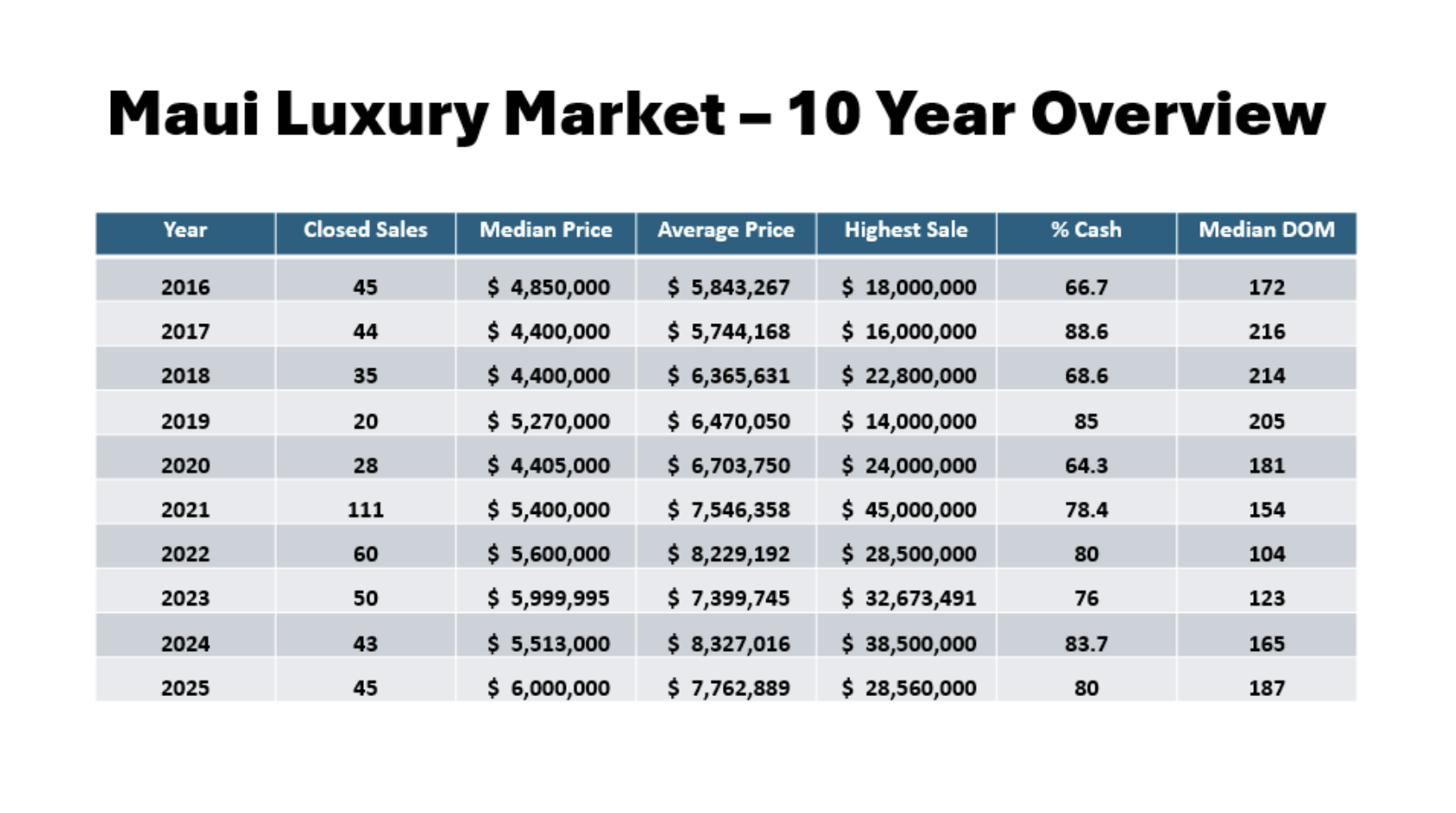
The Big Picture: A 10-Year View of Luxury Home Sales 

Let’s start with the overview.

In 2016, luxury single-family home sales volume on Maui was in the mid-40s. Fast-forward to 2024 and 2025, and we’re back in the mid-40s.

What happened in between is what distorts perception.

In 2021, sales spiked dramatically, peaking at over 110 luxury home sales — more than double long-term norms. That surge was driven by a unique convergence of factors: financial stimulus, asset inflation, and remote work (anyone remember Covid) resulting in a sudden re-prioritization of lifestyle.

Since then, we’ve seen a sharp decline from that peak, followed by a flattening in 2024 and 2025.

When you zoom out, what looks like a crash on a short timeline looks much more like a return to historical norms.

Why Price Bands Matter (and Why Headlines Miss This)

Breaking luxury homes into price bands helps explain why perception and reality often diverge.

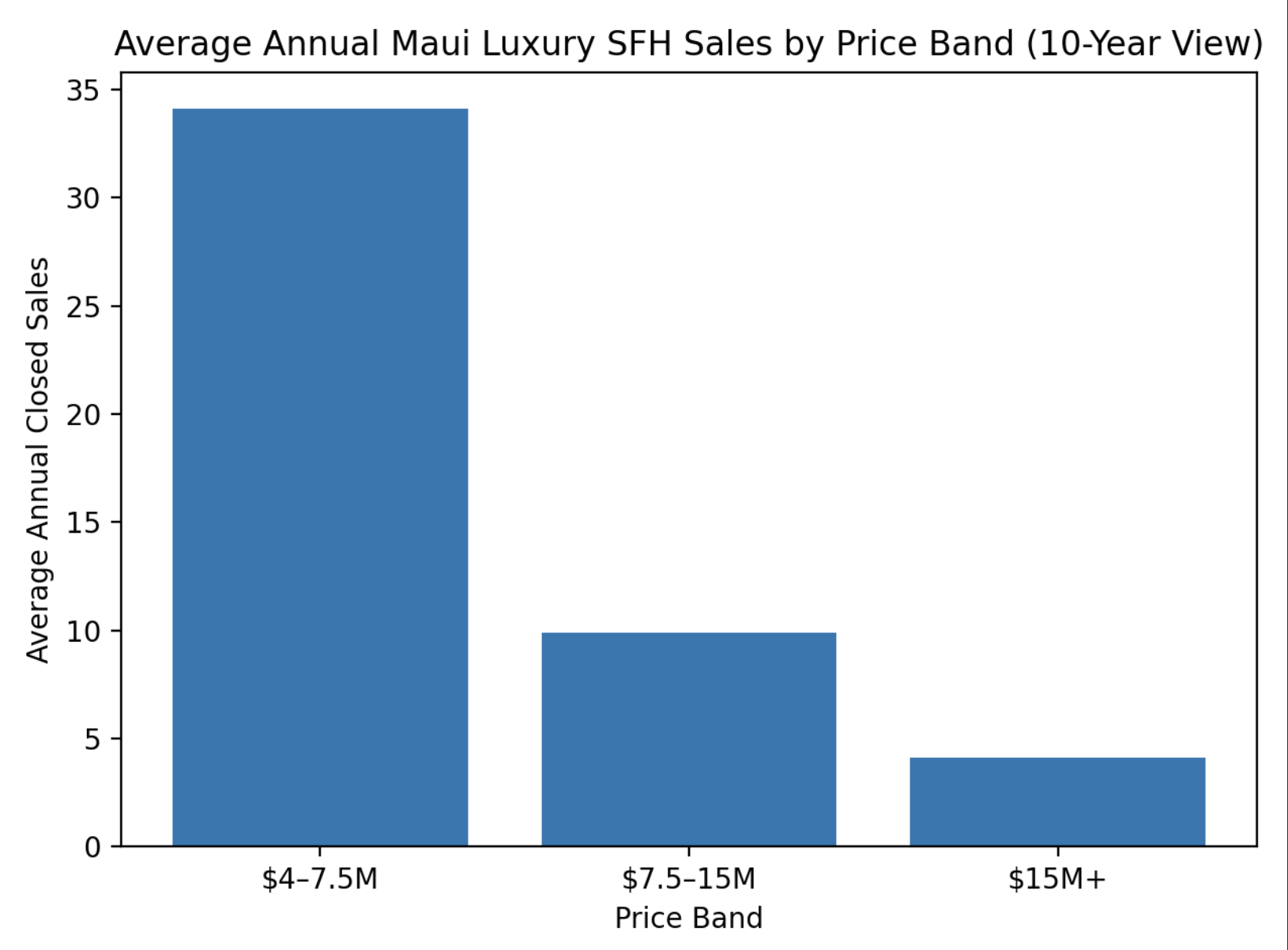
In a normal market year like 2018, most luxury activity was concentrated in the $4–7.5 million range. That band is the engine of the luxury market and largely determines how the market feels.

In 2021, activity surged across all price bands, but especially in that $4–7.5 million segment. When that band accelerates, the entire market feels hot.

By 2024 and 2025, activity in the $4–7.5 million range slowed back toward historical norms. Higher price bands — $7.5–15M and $15M+ — continued to trade, but at their usual, thinner pace.

When the core price band slows, the market feels dramatically different, even if prices remain relatively stable.

Liquidity: What’s Really Adjusting

Liquidity is one of the most misunderstood concepts in luxury real estate.

When we talk about liquidity, we’re not talking about price. We’re talking about how easily a seller can turn an asset, the home, into cash by selling it without a huge price and making major concessions.

Luxury markets almost always adjust through fewer transactions, longer days on market, and wider negotiation before they adjust through price.

That’s exactly what the data shows today.

What This Means for Sellers

If you’re a luxury home seller, you’re not in a collapsing market — but you are in a very selective one.

Buyers are patient, well informed, and comparing options carefully. Homes that are well-priced, well-prepared, and clearly positioned are still trading.

What’s being punished is probably your patience and maybe optimism without a strategy.

What This Means for Buyers

For buyers, this market looks very different than 2021. 

Selection is better. Pressure is lower. Negotiation has returned. That doesn’t mean prices are falling across the board, and sellers are not desperate, but it does mean buyers can be more deliberate and more selective.

Patience has become an advantage again.

Our Take

The Maui luxury single-family home market isn’t crashing. It’s recalibrating after an extraordinary outlier year.

And historically, those recalibration periods — not the frenzies — are where the best long-term decisions tend to be made.

If you’re thinking about selling, buying, or just trying to understand where you sit in this market, we’re always happy to talk story and walk through the data with you.

Feb. 1, 2026

Luxury Market Report ~ January 31, 2026

Aloha, All,


We’re starting a new month with about 100 luxury-class homes for sale on Maui, beginning around $4M and topping out near $38M. There are only four pending sales in that entire range, and the average days on market is 156 days.

So there’s no shortage of options for ready, willing, and able buyers.


Closed Sales


Kaanapali | Lanikeha
467 Anapuni Loop
4 bd | 5 ba | 3,846 sf | ohana: no | 0.71 ac | mountain/ocean view
Sold Price: $5,500,000 – Owner Carry (PMM) | List Price: $5,995,000

This was the third time this property came to market. It went under contract at $5,995,000 after 46 days and ultimately closed at about 8% below list price.


Kihei | Kamaole Beach I
2274 S Kihei Rd
6 bd | 6 ba | 3,025 sf | ohana: no | 0.19 ac | beachfront
Sold Price: $5,700,000 – Cash | List Price: $6,900,000 | Original: $7,500,000

This direct beachfront home closed as a cash transaction after a substantial price adjustment. It appears a significant renovation was anticipated and priced into the deal.


Pending Sales


None this week.

Buyers are active, but they are taking their time and being selective.


Price Reductions


Wailea Golf Estates | Wailea
192 Halau Pl
3 bd | 3.5 ba | 3,808 sf | ohana: no | 0.37 ac | mountain/ocean view
Current Price: $6,750,000 | Original: $7,495,000

This is the first price reduction for this extensively renovated home and it was a major one. At the new price, it now sits squarely in the middle of the active Wailea Golf Estates listings.


Molokai | Papohaku
3036 Kalua Koi Rd
2 bd | 2.5 ba | 3,794 sf | ohana: yes (2/2, 960 sf) | 5.9 ac | beachfront/ocean view
Current Price: $4,350,000 | Original: $4,780,000

This is the first price reduction and the second time on the market for this Molokai west side beachfront home. It features photovoltaic power and a saline pool and has been on the market about 89 days.


New Listings


Spreckelsville
462 Laulea Pl
2 bd | 2 ba | 1,165 sf | ohana: yes (1/1 cottage) | 0.23 ac | ocean view
List Price: $4,888,000

A smaller home with a cottage on a gated quarter-acre lot. Photos look dated, but the property appears to have upside.


Wailea
3943 Wailea Ekolu Pl
3 bd | 4 ba | 4,325 sf | ohana: no | 0.3 ac | ocean view
List Price: $5,425,000

First time on the market since its 2014 sale at $3.15M.


Kapalua
300 Mahana Ridge St
4 bd | 4.5 ba | 3,156 sf | ohana: no | 1.3 ac | ocean view
List Price: $5,950,000

Built in 2021 and located in Kapalua’s newest neighborhood. Previously listed as high as $8.5M without selling.


Wailea Golf Estates
3977 Wailea Ekolu Pl
4 bd | 6 ba | 4,079 sf | ohana: no | 0.3 ac | ocean view
List Price: $7,200,000

Completely reimagined in 2022. Last sold in 2024 for $7,559,000 and briefly remarketed in late 2025.


Cancelled / Expired Listings


Launiupoko | Makila Ranch
147 Haniu St (“Blue Makai”)
8 bd | 7.5 ba | 5,476 sf | ohana: no | 8.0 ac | ocean view
Last List Price: $5,750,000

Offered via online auction after a dramatic repricing from $11.5M. The auction reserve was reportedly met, making the cancellation somewhat puzzling.


Olowalu Makai
11499 Honoapiilani Hwy
3 bd | 3 ba | 3,030 sf | ohana: no | 5.9 ac | oceanfront
List Price: $16,900,000

Cancelled after just 45 days on market. An exceptional six-acre oceanfront setting with development potential.


Our Take


This was an interesting week. Two solid sales are encouraging, but the lack of new pendings tempers that optimism. Most sellers don’t appear to be in a hurry to adjust pricing.
It’s still early in the season. We’ll be watching days on market and price reductions closely as we move through February.

Posted in Luxury Update
Jan. 27, 2026

Lahaina Recovery Update ~ January 2026

Talk story from the ground, with the details that matter

As we turn the page into 2026, the story of Lahaina recovery continues to be one of steady progress layered with uncertainty, hard decisions, and a lot of waiting. This update pulls together what was shared most recently at the community level — drawing both from official county briefings and reporting by the Hawaiʻi Journalism Initiative, which has been closely tracking the human and policy dimensions of the rebuild. This is not about headlines, but about the practical realities families, property owners, and businesses are navigating right now.


FEMA Temporary Housing: The Clock is Still Ticking

As of January 14, 946 households are still being supported through FEMA’s Direct Lease Rental Assistance program. This update was delivered directly by the Mayor of Maui, who provided the most recent status on FEMA housing during the latest briefing.

Temporary housing was never intended to be permanent. It began as an 18-month program, was extended once for an additional year, and is now once again at a critical decision point. FEMA has issued a short 18-day interim extension, moving the current deadline to February 28, 2026. A request for a longer extension has been formally transmitted and is currently sitting on the desk of the Secretary of Homeland Security awaiting a final determination.

If FEMA denies the extension, the county and state say contingency plans are in place. In the meantime, affected households are being strongly encouraged to pursue available rental or purchase options now, rather than waiting for certainty that may not come.

Still unresolved is what ultimately happens to the FEMA housing units themselves — whether they are removed, sold, or transferred to the state or county. A no-cost transfer has been requested, but the final decision remains with FEMA.


Debris Cleanup & TDS Monitoring: One Chapter Closed

One quiet but important milestone was reached with the final Temporary Debris Storage monitoring report. After a 90-day monitoring period required by County Council Bill 120, officials reported no air quality readings or leachate levels that approached thresholds of concern.

Low rainfall resulted in minimal leachate, which was tested, reused for dust control, and showed no analyses of concern. Groundwater monitoring from two temporary wells — upstream and downstream — also detected no issues. The wells have since been removed, and the Army Corps restoration returned the site contours close to their original condition.

A cultural pule was conducted on January 5, marking not just the technical end of this phase, but a symbolic one as well. This is one part of the recovery where the data provided a measure of closure.


Housing Recovery: Progress, With Context

On the permanent housing front, the numbers show motion — even if it doesn’t always feel that way on the ground. 116 permits have been completed, 339 are currently in process, and roughly 300 homes are under construction.

It’s important to pause here and put those numbers in perspective. Approximately 2,200 structures were destroyed in the Lahaina wildfire. The progress is real, but it also underscores the scale of what was lost and why so many families are still waiting for a clear path home.

Several HUD-funded and county-administered programs are now active, including reconstruction and first-time homebuyer initiatives prioritized for wildfire survivors. The first First-Time Homebuyer closing occurred just before Christmas, with 26 households now holding shopping letters and roughly 1,100 applications still under eligibility review. The program ultimately has capacity for up to 150 recipients, meaning difficult prioritization decisions still lie ahead.


Front Street & Lahaina Harbor: Access Without Normalcy

Along Front Street, the ocean-side railing project is mostly complete near the water, with stylistic changes and native plant replacements now underway. The project is scheduled for completion around May, but Front Street itself remains closed.

Lahaina Harbor continues to operate under restricted conditions — open from 8 a.m. to 6 p.m., no through traffic, escorted access from Shaw Street, and a 10-mph speed limit in drivable areas. Large sections remain fenced off, reinforcing the reality that access does not yet equal normalcy.


Makai Front Street: A Necessary Question About Process and Fairness

As a real estate broker, I do feel compelled to raise an uncomfortable but legitimate question around the makai Front Street properties. Maui County plays an important — though not final — role in shaping the regulatory and permitting environment that will determine whether these property owners are realistically able to rebuild. At the same time, the county is reaching out to many of those same owners with potential purchase offers. Even if every conversation is happening in good faith, that overlap creates an obvious conflict of interest, or at minimum the appearance of one.

For property owners caught in the middle, time is not neutral. Waiting for the county to finalize rules, guidelines, and processes isn’t just an abstract delay — it translates directly into real money, carrying costs, lost income, professional fees, and ongoing uncertainty. When it comes to time and money, that lever is largely on the county’s side, while owners are being asked to hold, wait, and decide without firm answers. That imbalance makes already difficult decisions even harder, and it underscores why transparency, clear timelines, and predictable rules are so critical right now.


Closing Reflection

When you step back and look at the full picture, the tension becomes clear. Nearly a thousand families are still waiting on FEMA decisions that may come down to a signature and a calendar date. Front Street property owners are being asked to make life-altering choices without final rules, firm timelines, or full clarity on what rebuilding will realistically look like. And while hundreds of permits are moving through the system, they sit against the backdrop of 2,200 structures lost — a reminder of the scale of what Lahaina is trying to recover from. Progress is happening, but it’s uneven, emotional, and slow by necessity. The months ahead will matter — not just for policy and programs, but for whether people can finally stop waiting and start rebuilding their lives with confidence.

If you want this next converted into teleprompter format or lightly tightened for spoken delivery, I can do that without stripping out the detail.

Posted in Lahaina Recovery
Jan. 16, 2026

2025 Year-End Maui Real Estate Market Report


A Talk Story About What Actually Happened

Every year when we put together the year-end market report, I remind myself why this matters.

These aren’t just stats for the moment. These are the official numbers. They’re what appraisers, attorneys, economists, buyers, sellers, and future policymakers are going to come back to years from now and ask, “What was really going on in the Maui real estate market in 2025?”

That’s why, for this report, we lean on Maui MLS data. It’s the most defensible snapshot we have. And 2025 was a year where the market didn’t collapse — but it didn’t cooperate either.

Lawrence Yun from the National Association of Realtors described the national market as “stagnant but not broken.” That actually feels pretty accurate for single-family homes here on Maui.

The condo market, though? That one’s a little more broken. A little confused. And definitely chaotic.

And as the saying goes, confusion creates chaos…and chaos creates opportunity.

Let’s start with single-family homes, because on the surface, that part of the market looked far calmer than it actually felt.

_________________________________________________

SIngle-Family Homes: A Market Split RIght Down the Middle
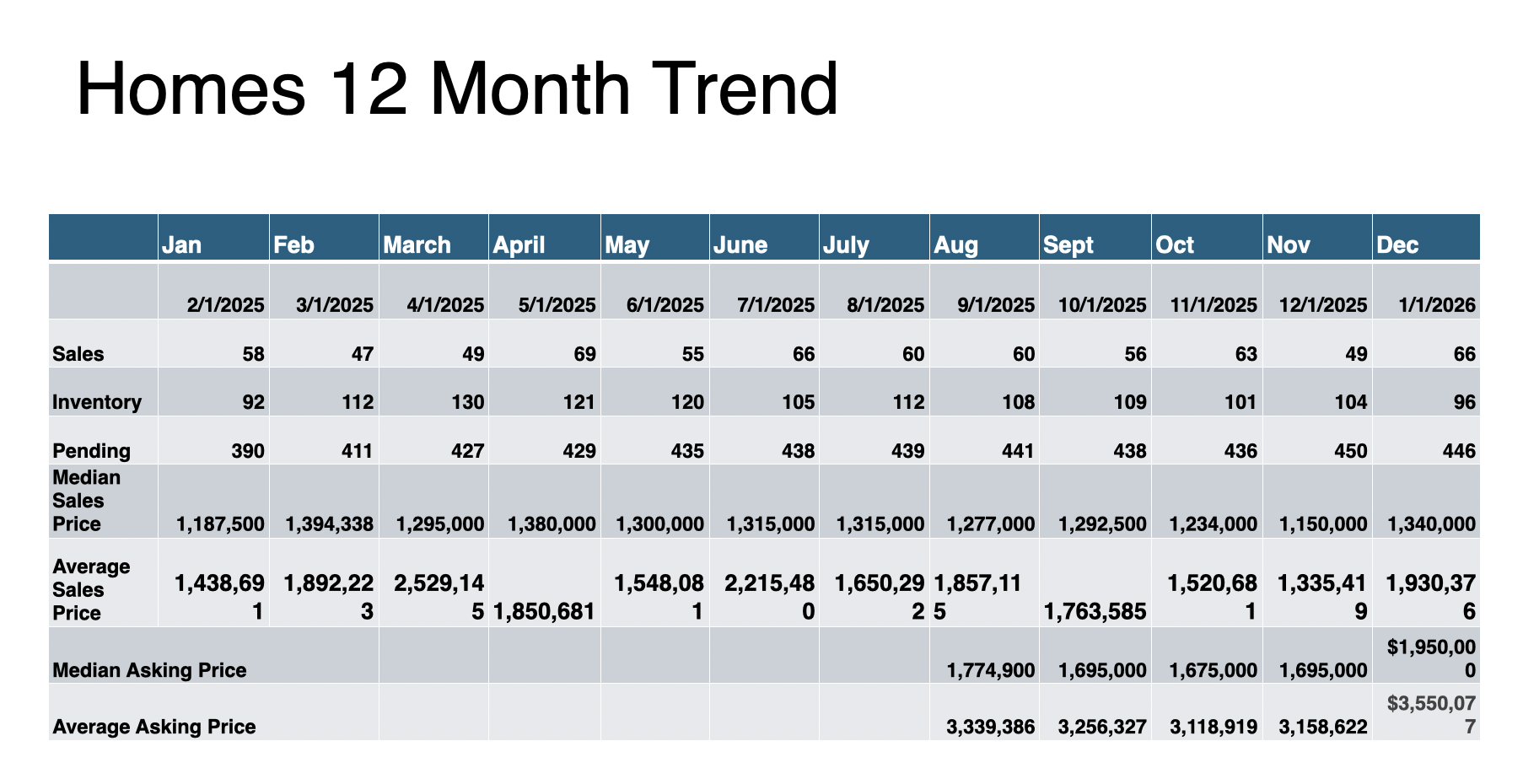
 

If you just glance at the year-end numbers for single-family homes, you might walk away thinking, “Well, that wasn’t so bad.” And in some ways, that’s true.

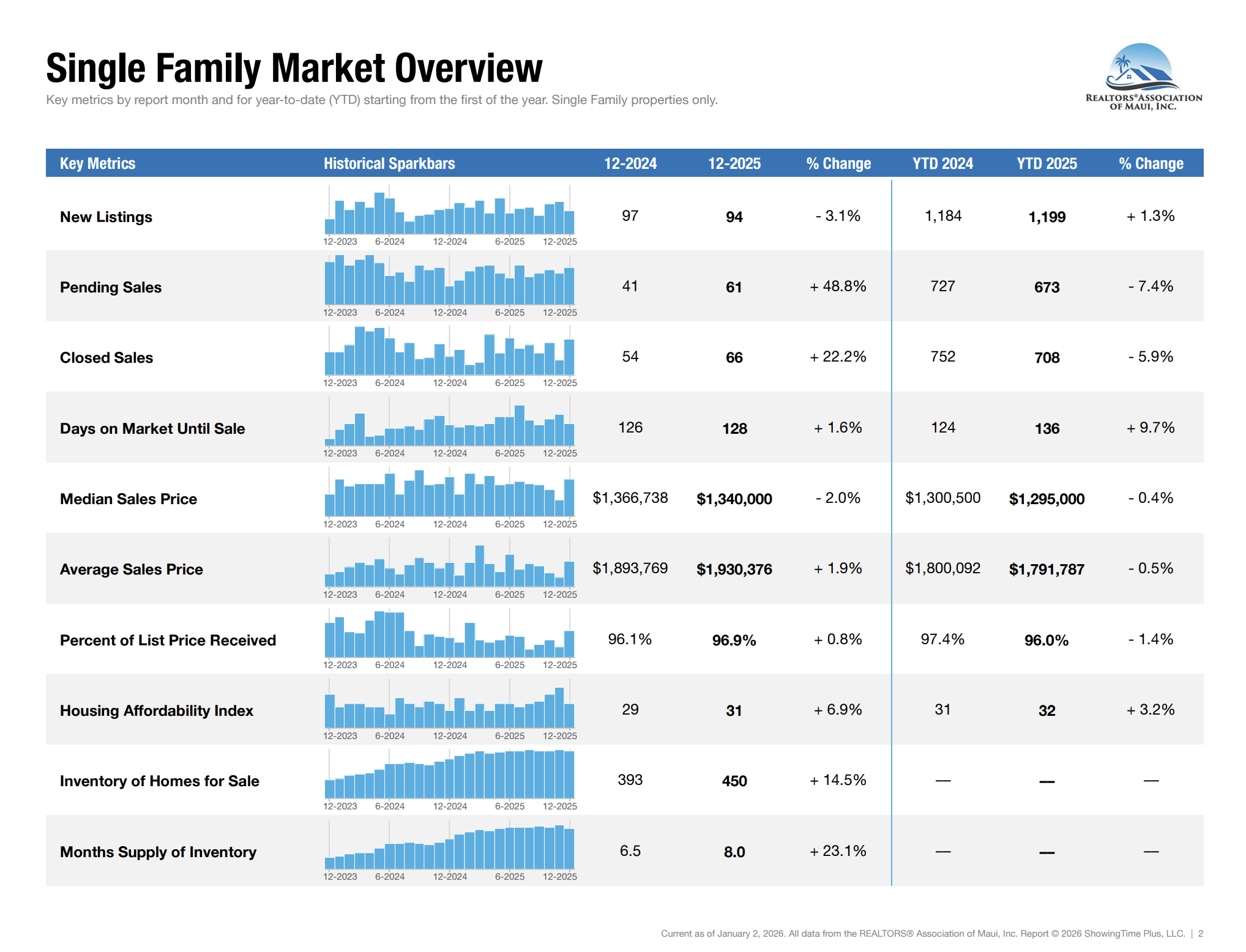
After a slight increase in sales in 2024, single-family home sales fell about six percent in 2025. Inventory grew only modestly, up just over one percent year over year, which left us ending the year with roughly six and three-quarter months of inventory. From thirty thousand feet, that looks like a fairly balanced market.

But that balance may not hold.

Pending sales — which are still our best leading indicator of where the market is headed — declined by just over seven percent. If supply holds steady while demand continues to soften, that balance will start to tilt.

At the same time, both the median and average selling prices finished the year essentially flat. The median came in at $1,295,000, down less than half a percent for the year. The average selling price ended just under $1.8 million, off by about half a point.

On paper, 2025 looks uneventful.

But once you step inside the data, the story gets more interesting.

For most of the year, the single-family home market on Maui wasn’t one market at all. It was two very different markets operating at the same time.

Homes priced at or below the median — roughly that one-point-three-million-dollar range — behaved very differently from everything above it. In Central Maui especially, where there’s simply more inventory in that price band, demand held up surprisingly well. In those neighborhoods, it often still felt like a seller’s market, or at least a balanced one.

Once you moved above that threshold, the tone changed.

In West Maui, South Maui, Upcountry, and particularly in the higher-end and luxury segments, buyers had the leverage. Homes took longer to sell, negotiations became the norm, and pricing discipline mattered again.

That split showed up clearly in the numbers. Days on market increased close to ten percent, and sellers, on average, received about ninety-six percent of their asking price.

That doesn’t sound dramatic until you unpack it. In many cases, buyers were negotiating roughly four percent off a list price that had already been reduced from the original asking. The adjustment happened quietly, but it happened.

The median selling price really brings this story into focus. For about eighteen months, it hovered right around $1.3 million. That number became a psychological ceiling as much as a statistical one. In late summer and early fall, the median finally dipped below that level, briefly touching the low $1.1 million range, before popping back above $1.3 million in December.

That December bounce doesn’t necessarily signal a new upward trend. It may simply reflect the higher-end sales we often see as we head into peak season. What it does tell us is that the market is still searching for equilibrium — and hasn’t quite found it yet.

Affordability technically improved in 2025. The housing affordability index rose modestly, which sounds encouraging. But when the median home still costs around $1.3 million, affordability remains an unrealistic concept for many Maui families.

That reality isn’t new. What is new is the scale of intervention that followed the Kula and Lahaina fires. With the help of substantial federal funding, Maui County moved forward with aggressive down-payment assistance programs. In some cases, the assistance offered would have been unthinkable just a few years ago, and for certain first-time buyers, it can be truly transformative.

But it comes with strings.

Those strings include deed restrictions designed to preserve affordability long-term. The intent is good. The trade-offs are significant. These restrictions limit resale options, cap appreciation, and make it very difficult to build generational wealth through housing. For some buyers, that trade-off is worth it. For others, it’s not. Either way, it’s something that needs to be understood clearly before moving forward.

By the end of the year, sales activity picked up somewhat. More homes sold in the second half of 2025 than in the first, and average prices climbed toward the two-million-dollar mark as higher-end sales re-entered the mix. At the same time, pending sales softened again in December, which adds a note of uncertainty heading into 2026.

So where does that leave the single-family home market?

Somewhere between stable and unsettled. Balanced on paper, segmented in reality, and highly dependent on price point and location.
_________________________________________________

Condos: The Year the Market Reset

If single-family homes quietly adjusted in 2025, condos did something very different.

They reset.

Prices hit a wall. Sales hit a wall. And for many owners, that came with real pain.

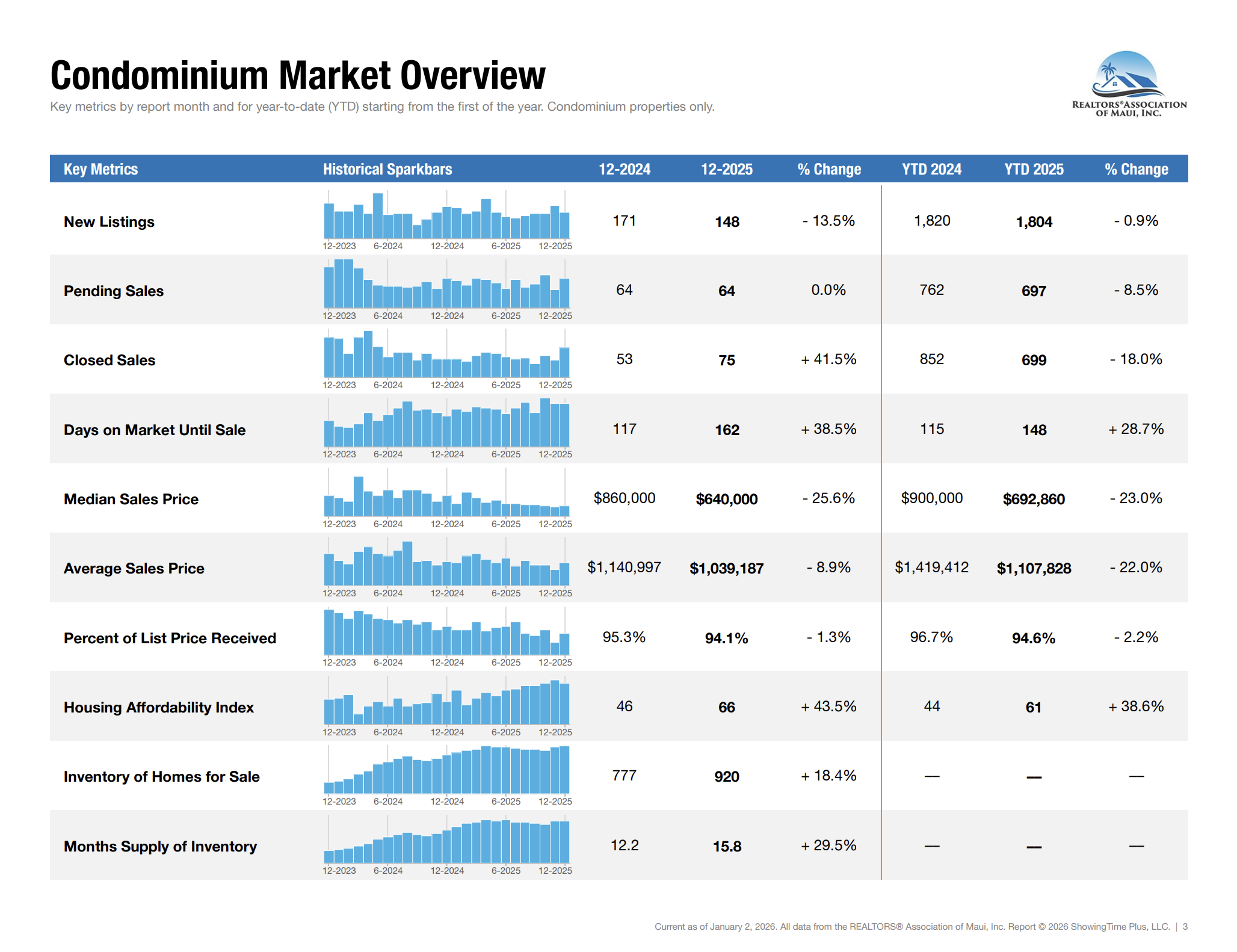
When I say the condo market “hit the wall,” it’s important to add some context. This wasn’t sudden. It’s been skidding to a stop since 2023. That year ended with closed sales down more than thirty-six percent. In 2024, sales fell another twelve percent, which felt like maybe things were slowing down. But 2025 proved otherwise, with sales dropping another eighteen percent.

Over that period, the median condo price declined from roughly $832,500 in 2023 to about $692,860 in 2025.

That’s the backdrop for how 2025 unfolded.
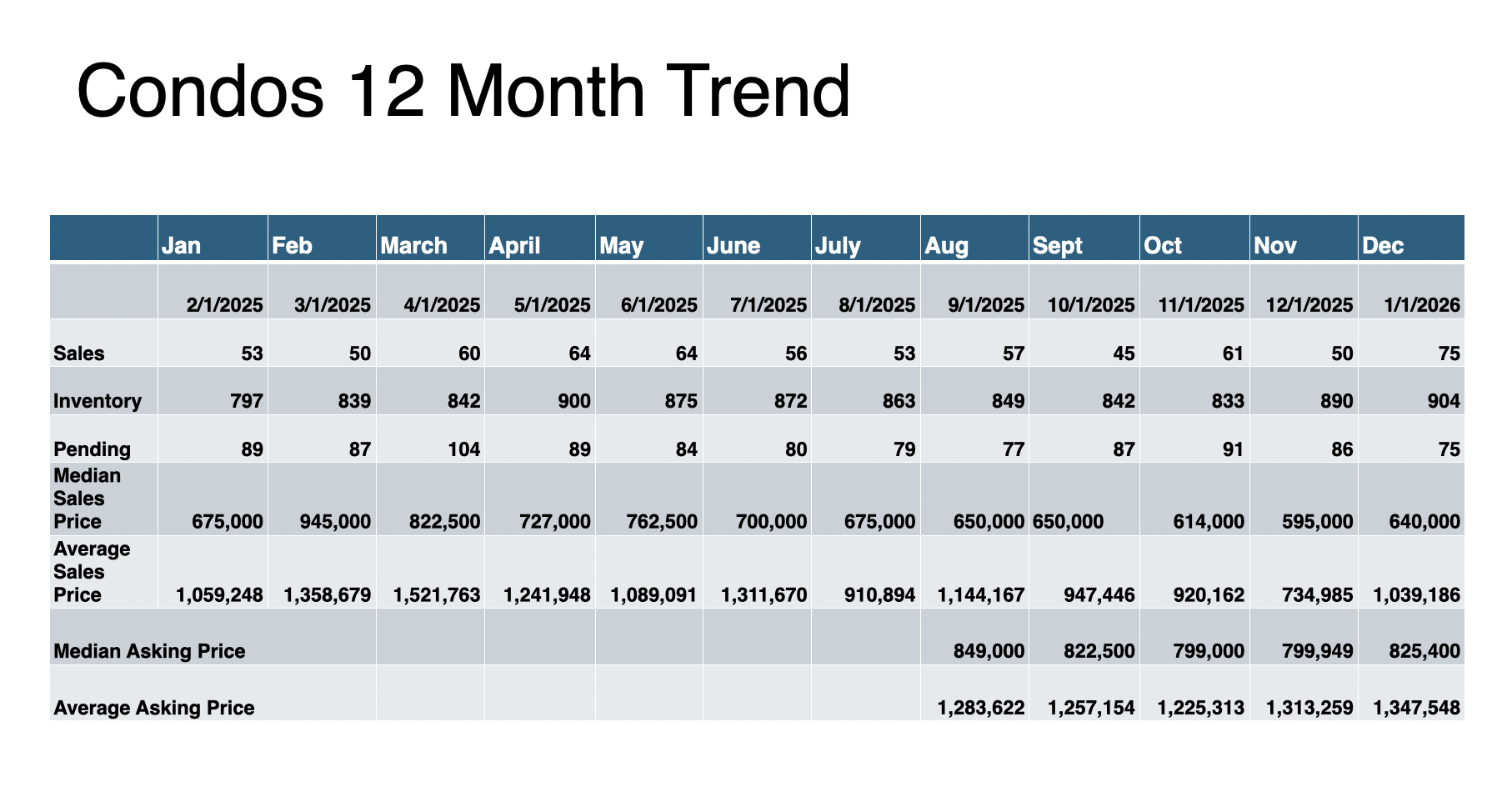
The year started with cautious optimism. Sales in January were modest, but as we moved into spring, it looked like momentum might be building. That optimism didn’t last. Summer turned into a letdown, and by November, condo sales had fallen to their lowest monthly total of the year.

December brought a strong rebound, with the highest number of condo sales we’d seen in about a year and a half. On its own, that sounds encouraging. But when you step back, it’s hard to ignore the weight that inventory and pricing exerted on the market all year long.

Inventory climbed quickly early in the year, eased for a bit, then surged again toward the end. By December, we were back above nine hundred condos for sale, which translates to roughly twelve months of inventory. In any textbook, that’s a buyer’s market.

And yet buyers remained cautious.

Even as prices fell — and they fell hard — pending sales never surged the way you’d expect in a classic buyer’s market. Throughout most of the year, condos under contract hovered in a relatively narrow range. We ended the year with fewer pending sales than you’d normally want to see heading into peak season.

Pricing tells the most sobering part of the story. The median condo price started the year near $945,000. By late spring, it dropped into the $700,000s. By mid-summer, it fell into the $600,000s. In November, it bottomed out just under $600,000 before ticking up slightly in December.

That decline isn’t theoretical. It represents real equity loss for real people.

The average selling price followed a similar path, falling from well over $1.5 million early in the year to the mid-$700,000s by November, before rebounding at the very end of the year as a handful of higher-priced condos closed.

Sellers, on average, received just under ninety-five percent of their asking price. But that figure hides the reality that many condos had already been repriced once — or several times — before they ever sold.

What we saw in 2025 wasn’t panic selling. It was something more controlled, but no less significant: a market slowly accepting a new reality.

It ain’t 2022 anymore.
_________________________________________________

Looking Ahead: What 2025 Means for 2026

If there’s one lesson 2025 delivered clearly, it’s this: Maui real estate is no longer coasting.

Buyers are careful. Sellers are being forced to price for the market we’re in, not the post-COVID rebound market. Policy decisions, insurance costs, HOA budgets, and financing constraints are now front-and-center in almost every transaction.

Single-family homes found a fragile balance. Condos went through a reset that may not be fully finished yet.

As we move into 2026, the real question isn’t whether Maui real estate will recover. It’s how uneven that recovery will be — and who will be positioned to take advantage of it.

The people who understand what actually happened in 2025 — not just the headlines, but the details — will be the ones best prepared for what comes next.

And that’s exactly why we do this report every year.