The Latest From Our Blog

This is where you can find out more about what's new at Aloha Group Maui - new homes for sale, new condos for sale, video tours, 3D tours, price adjustments, open houses, our community involvement, podcasts, and Maui fun!


Aug. 13, 2026

Maui Real Estate Market Update: August 2026 | Maui Real Estate Advisor

By Lahaina Lee, Aloha Group Maui | July 2026 market data

Last month we made two calls. First: the condo buyers who had been circling all spring finally landed, and June's 88 closings, the most in over two years, were the proof. Second: with home pendings sitting at a twelve-month low, July home closings would cool back toward the low sixties. Well. Condos did not cool. They booked 81 more closings and nudged the median up a second straight month, to $685,000. And homes? They settled at 54, just about exactly where we predicted. Here is what the data shows, what it means, and where we hedge all over again.


August 2026 Key Takeaways

Condo closings: 81 in July, the second-best month of the past year behind June's 88. The buyers who showed up in June came back for seconds.(?)

Condo prices: Median sold price rose to $685,000, a second straight monthly gain off the May low and the highest reading since February. The average crossed back over a million, to about $1.01M.

Condo inventory: 870 active listings, down from 913 and the leanest since last October. Roughly 10.7 to 14 months of supply depending on which sales pace you use. Still a buyer's market, but tightening.

Home sales: 54 closings, down from June's 78 and right in line with the cooldown we forecast a month ago.

Home prices: Median sold price fell to $1,165,000, the lowest since November, as June's luxury mix stepped back. One month's median is not your home's value.

Home supply: Inventory ticked to a fresh 12-month high of 465, but that is exactly one more home than June. Pendings rebounded to 112 from June's low of 96.


Last month we told you the pending condo sales were the real tell, that buyers were writing offers even while the closing column looked sleepy, and that the pipeline would keep feeding closings. June proved it with 88. July backed it up with 81. Two months, 169 closed condo sales. In this market, that is a parade.

Let's do the numbers. Condos first, as always.

Condos


Aug '25

Sep '25

Oct '25

Nov '25

Dec '25

Jan '26

Feb '26

Mar '26

Apr '26

May '26

Jun '26

Jul '26

Sales

57

45

61

50

75

44

64

74

70

51

88

81

Inventory

849

842

833

890

904

918

909

911

931

902

913

870

Pending Sales

77

87

91

86

75

96

118

107

100

121

114

107

Median Sales Price

$650K

$650K

$614K

$595K

$640K

$630K

$848K

$675K

$651K

$597K

$625K

$685K

Avg Sales Price

$1.14M

$947K

$920K

$735K

$1.04M

$926K

$1.15M

$1.19M

$972K

$890K

$854K

$1.01M

Median Asking Price

$849K

$823K

$799K

$800K

$825K

$849K

$839K

$825K

$799K

$799K

$790K

$784K

Avg Asking Price

$1.28M

$1.26M

$1.23M

$1.31M

$1.35M

$1.37M

$1.33M

$1.31M

$1.27M

$1.26M

$1.22M

$1.23M

Days on Mkt (active)

154

154

154

153

154

160

166

172

170

170

170

179

Days on Mkt (sold)

167

125

180

155

162

166

138

148

168

153

171

154

Withdrawals

68

72

71

48

41

54

43

47

53

60

55

56


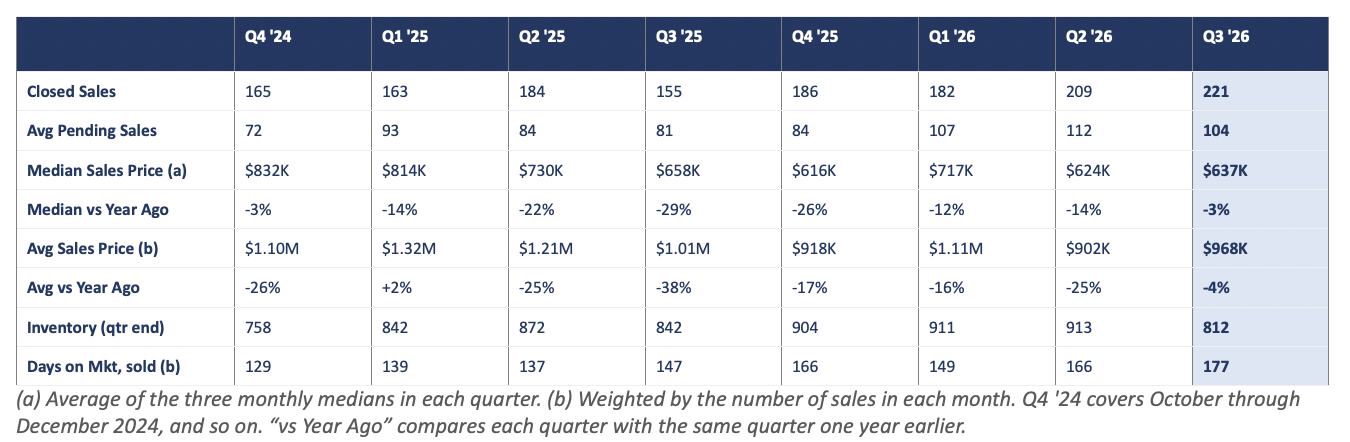
The pipeline still has water in it. Pending sales came in at 107, down from June's 114 and May's 121, but comfortably above the twelve-month average of about 98. Not another 88 sales in the tank, probably, but nothing that looks like a market rolling over either.

The number that caught my eye, though, was not sales. It was price. The median condo selling price climbed to $685,000, up from June's $625,000 and May's $597,000. Now, before anybody plants a flag: prices actually fell from April to May before they turned, so this is two months of gains off the May low, not some unbroken march higher. And I am not going to stand here and call $597,000 the bottom. We have been doing this too long to pretend anyone spots a bottom in real time. But something has shifted. Two months ago we had heavy inventory, soft closings, and a median under $600,000. Today we have back-to-back strong sales months, a median $88,000 above that low and the highest since February, and 43 fewer condos on the market than a month ago. That is not proof of a new bull market.

It is evidence that buyers have found prices they are willing to act on.

The average agrees. It jumped to $1,014,496, the first reading over a million since March, after three months parked in the $850,000 to $970,000 range. When the median and the average move up together, that is usually demand broadening across the price ladder, not one lucky penthouse dragging the math around.

Here is the part I find most interesting. As the median sold price rose, the median asking price went the other way, slipping to $783,500, another step down off the $799,000 shelf sellers camped on all year. So the gap between what sellers ask and what buyers pay narrowed to about $98,500, down from roughly $165,000 last month. For most of the past year, buyers and sellers stood on opposite sides of the room, each waiting for the other one to move. Sellers moved. Buyers appear to have answered. That is what price discovery actually looks like: not a bell ringing at the bottom, but enough sellers deciding what they will really take, and enough buyers deciding that number is worth it.

Inventory finally moved the right way, too. Active condo listings fell to 870, down from 913, a nearly 5% drop and the leanest count since last October. At July's sales pace that pencils out to about 10.7 months of supply, but let me be honest about that number, because 81 was a hot month. Use a three-month pace and it is closer to 12 months. Use the trailing year and it is about 14. So let's not kid ourselves: this is still a buyer's market, with plenty of condos for sale and buyers who still hold the choices. But two months ago that same figure was up near 18 months, and now inventory is falling while sales stay elevated. The buyer's market is not over. The capital B just got a little smaller again.

One more wrinkle. The condos that sold in July averaged 154 days on market, down from 171 in June, while the condos still sitting on the market averaged 179 days, a new high for the table. I would not read that as buyers sprinting after every fresh listing. But it does say something useful: the properties that are finding buyers are moving faster than the inventory left behind. For sellers, that is close to the whole ballgame. There is no shortage of buyers for the right condo. There may be a shortage of buyers for the wrong price, and price is the one thing a seller can actually fix.

As for the zoning question humming under all of this: Bill 88 is now law, and in early July the county's first rezoning resolutions for a batch of Kihei and West Maui properties started moving through committee. Nothing is finally rezoned, and no owner's rental clock has changed yet. We already walked through what that does and does not mean for condo owners; the a list doesn't mean rezoned distinction was covered in a recent blog and podcast, so we will not re-litigate it here.

Bottom line on condos: two strong months of closings, inventory at its leanest since October, a median up two months running, and the ask/sold gap cut nearly in half. Still a buyer's market, no question. But the number I will be watching next month is not price. It is inventory. If listings keep falling while sales hold anywhere near here, we stop talking about a two-month bounce and start talking about the early makings of a trend.

* Data collected on the 1st of the following month. July figures were collected August 1, 2026.

* Asking price data unavailable prior to August 2025.


Key Takeaways: Condos

81 condo closings in July, the second-highest of the past year behind June's 88, and about 28% above the normal monthly pace. Two strong months back to back.

Pending sales at 107, above the twelve-month average. The August pipeline stays respectable.

Median selling price: $685,000, a second straight monthly gain off the May low and the highest since February. The average crossed back over $1M.

870 condos for sale, the leanest since October. Roughly 10.7 to 14 months of supply depending on the pace used. Still a buyer's market, still tightening.

Median asking slipped to $784K while the median sold rose, narrowing the ask/sold gap to about $98,500 from $165,000.

Watch inventory next month. Falling listings plus steady sales would turn a two-month bounce into a trend.


Single-Family Homes


Aug '25

Sep '25

Oct '25

Nov '25

Dec '25

Jan '26

Feb '26

Mar '26

Apr '26

May '26

Jun '26

Jul '26

Sales

60

56

63

49

66

52

46

76

49

58

78

54

Inventory

441

438

436

450

446

456

448

436

437

444

464

465

Pending Sales

108

109

101

104

96

120

134

110

119

108

96

112

Median Sales Price

$1.28M

$1.29M

$1.23M

$1.15M

$1.34M

$1.45M

$1.25M

$1.20M

$1.29M

$1.17M

$1.36M

$1.17M

Avg Sales Price

$1.86M

$1.76M

$1.52M

$1.34M

$1.93M

$1.93M

$1.37M

$1.49M

$1.51M

$1.48M

$1.85M

$1.60M

Median Asking Price

$1.77M

$1.70M

$1.68M

$1.70M

n/a

$1.95M

$2.00M

$1.95M

$1.85M

$1.85M

$1.84M

$1.80M

Avg Asking Price

$3.34M

$3.26M

$3.12M

$3.16M

$3.55M

$3.56M

$3.70M

$3.71M

$3.48M

$3.49M

$3.52M

$3.63M

Days on Mkt (active)

141

141

138

138

140

136

144

147

153

158

156

160

Days on Mkt (sold)

193

187

135

199

162

232

208

142

160

150

145

155

Withdrawals

37

28

45

36

33

28

25

41

25

35

31

26


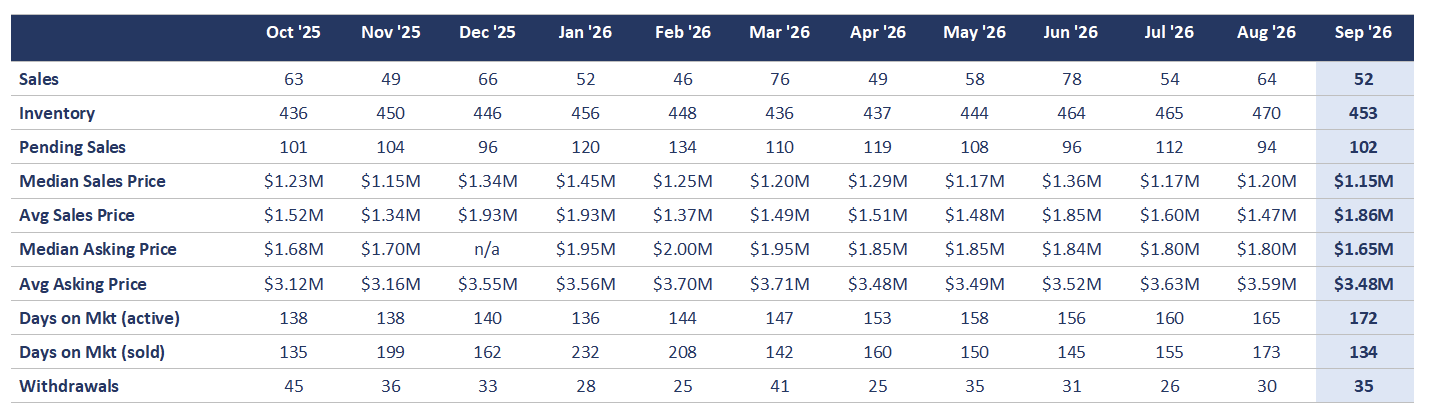
Now homes -  where almost everything I just said about condos needs flipping over. Last month we hedged, the way we always do, and said that with home pendings at a twelve-month low of 96, July closings would cool back toward the historical norm around 60. We do not get to say this often, so indulge us: we nailed it. July delivered 54 closed home sales, down from June's 78 and right in the neighborhood we called. The best sales month of the year, followed by one of the quieter ones. That is Maui's thin market doing what it does, lurching rather than gliding.

The price line whipsawed right along with it. June's median jumped to $1,356,975 on a wave of luxury closings. July's fell to $1,165,000, the lowest since November. That is a drop of almost $192,000 in a single month, roughly 14%. So did Maui homes shed 14% of their value in thirty days? Of course not, and this is exactly why I keep begging people not to price their house off one month's median. Maui is a small market. Change the mix of what sells, especially at the top, and the median lurches with it. June probably made homes look stronger than they were. July probably makes them look weaker. The truth sits somewhere in the middle. The average told the same story, easing to $1,600,625 from June's $1.85 million.

The supply number needs that same context. At 465 active listings, home inventory ticked to a fresh twelve-month high, and at July's slower pace that works out to about 8.6 months of supply, up from June's tidy 5.9. Before anyone panics, look underneath it. Inventory went from 464 to 465. One house. The supply number jumped because closings fell, not because listings flooded in. Normalize the pace and it reads a lot calmer: about 7.3 months on a three-month basis, 7.9 on the year. Those probably describe the real market better than either June's 5.9 or July's 8.6 taken alone.

And then there are the pendings, which is where it gets interesting. They had slipped to 96 in June, which is why we expected July to cool. It did. But in July they bounced right back to 112, a hair above the twelve-month average of about 110. If July had handed us 54 closings and another drop in pendings, I would be a good deal more worried. Instead this reads like a thin market being a thin market: one strong month, one soft one, with the property mix doing the rest. I am not going to promise you August roars back, because pendings are a preview, not a receipt. But 112 is not the shape of a market rolling over.

Days on market for active home listings crept to 160, a new high, and days for solds ticked to 155. On the asking side, the median eased to $1.80 million and the average firmed to $3.63 million, the luxury end still doing its slow, unhurried dance, the way luxury does everything except drop its price. None of it changes the shape of the market. It just confirms July took a breather.

Bottom line on homes: June overstated the strength, July probably understates it, and the honest read sits between the two. Closings cooled exactly as we warned, the median gave back June's luxury bump, and supply looks softer mostly because sales fell. But with pendings back to 112, this looks more like a pause than a pivot. Let's see what those 112 do.


* Data collected on the 1st of the following month. July figures were collected August 1, 2026.

* Asking price data unavailable prior to August 2025; December '25 median asking price unavailable.


Key Takeaways: Homes

54 home closings in July, down from June's 78 and right in line with the cooldown we forecast.

Median selling price: $1,165,000, the lowest since November, a drop of about $192,000 (roughly 14%) as June's luxury closings stepped back. One month's median is not your home's value.

Inventory at a fresh 12-month high of 465, but that is one more home than June. Normalized supply is closer to 7.3 to 7.9 months than July's headline 8.6.

Pending sales rebounded to 112 from June's low of 96, a hair above the twelve-month average. Not the shape of a market rolling over.

Days on market for active listings rose to 160, a new high for the year.


A Quick Word on Land

Seven vacant-land parcels closed in July against 209 active listings, which ties April for the most all year. The median sale price leapt from June's $309,000 all the way to $628,300. Did Maui land double in value in thirty days? No. Seven sales happened. That is land, where the median goes wherever the handful of closings happen to send it. It stays what it always is: a thin, patient market you measure in seasons, not months. Buyers with vision and a long fuse will still find sellers out there ready to talk story, but do not try to draw a trend line through numbers this small.


Our Take

July was the month the condo and home markets swapped roles.

For most of the past year, homes were the steady part of this market and condos carried the uncertainty. This month the direction of travel flipped. Condos gave us two unusually strong sales months, falling inventory, a median up for a second month, and, maybe most telling, asking prices still drifting down while selling prices climbed. That is buyers and sellers inching toward agreement on what these things are worth. Homes handed us the opposite lesson. June's monster month and $1.36 million median looked powerful; July's 54 sales and $1.165 million median looked weak. Neither month tells the whole story, and that is exactly the point.

Which brings me to the thing I say every month, because it never stops being true. There is no single "Maui real estate market." Homes and condos are moving in different directions right now. West Maui is not South Maui. A vacation-rental condo is not a long-term residential one. And inside the very same building, the well-priced unit and the one still priced for a market that left town are having completely different summers. Our job is not to tell you whether "the Maui market" is up or down. It is to help you read the small slice of it that actually touches you.

So: condo buyers still have choices and real leverage, but two months of firming prices are a fair reminder that a good opportunity does not necessarily get better forever. Condo sellers, the market is rewarding realism, so bring some. Home buyers and sellers, do not let June or July's headline number fool you in either direction. This is a thin market where the mix can make one month look nothing like the next.

For condos, it is still a buyer's market, but the numbers leaned the same way two months running; prices do not rise while inventory falls purely by luck at the same time the ask/sold gap closes. For homes, we are between innings, waiting on 112 pendings to tell us which way August breaks. Either way, the same thing we said last month still holds: the most expensive thing you can do in a market like this is wait without information.


Let's Talk Story

If you have questions about your property's value, what these numbers mean for your situation, or whether this market is your moment to make a move, reach out anytime. We're here as a resource for the Lahaina and Maui community, whether you're ready to act or just trying to make sense of the headlines. No pressure, no agenda, just a conversation.

And if you or someone you know is thinking about buying, selling, or simply keeping track of Maui's real estate market, we've got a fabulous team of seasoned, well-trained agents standing by to help.

You can search every property listed for sale at www.AlohaGroupMaui.com, or email me directly at lee@alohapotts.com. I answer every one.

From the greatest island on Earth, I'm Lahaina Lee, saying ALOHA.


Aug. 4, 2026

Maui Real Estate Advisor | August 4, 2026 | On the List Doesn't Mean Rezoned

MAUI REAL ESTATE ADVISOR

A companion explainer to The Town That Waits  ·  July 2026


On A List Is Not Rezoned

Your building was named in Resolution 26-110 or 26-111. Here is exactly what that does, what it does not do, and the seven steps still ahead.

By Lahaina Lee   ·   Aloha Group Maui


On July 24, 2026, the Maui County Council voted 7 to 1, twice, to advance two resolutions that could move roughly 2,056 apartment-district vacation rental units into the county’s new hotel zoning. If you own in one of the named buildings, your phone probably started ringing that afternoon, and the message was some version of the same thing: your building is getting rezoned.

It is not. Not yet. You still have a way to go.

I want to walk through what actually happened, because the gap between what people think happened and what really happened is wide, and decisions worth hundreds of thousands of dollars are being made inside that gap. I am a real estate broker, not an attorney, and nothing here is legal advice. What follows is the process, drawn from the County Charter, the Maui County Code, and the resolutions themselves, with the primary documents linked so you can read them yourself.


The one sentence to take away

Resolutions 26-110 and 26-111 are procedural referrals, not rezoning approvals. They start a formal review process. They do not change the zoning of a single property. Your existing zoning stays in effect until an entirely separate ordinance is passed, months from now at the earliest.


First, what these two resolutions actually are

The two resolutions divide the first wave of properties into two groups, based on the way the County thinks they qualify for hotel zoning.

Resolution 26-110 covers apartment-district properties with timeshare, leasehold, single-ownership, or variance status. It is the broader, more mixed category.

Resolution 26-111 covers properties the County says already function like hotels: 24-hour front desks, property-wide housekeeping, multiple and often unionized staff. This is the narrower, and legally simpler, category, because the argument is essentially “rezone it to match what it already is.”

You can and should read them. These are the amended CD1 versions the Council advanced in late July:

  Resolution 26-110 CD1 (timeshare, leasehold, single-ownership, variance)

  Resolution 26-111 CD1 (properties that operate like hotels)

Both links go to the County’s own Legistar system. If your building is named, it is named there. If a neighbor or a Facebook post says your building is on the list, verify it against these documents, because the lists have already been amended more than once.

The road from resolution to rezoning

Here is the full path a Council-initiated rezoning has to travel. As of late July 2026, this process is at the start of Step 3.

STEP 1   Bill 88 created the H-3 and H-4 districts.  DONE.

Ordinance 6008, effective June 22, 2026, created two hotel zoning classifications that did not exist before: H-3 and H-4. This step built the containers. It rezoned nothing. That distinction is the whole reason the rest of this process exists.

STEP 2   The Council selected the first properties and referred them.  DONE.

Resolutions 26-110 and 26-111 identify the first group of properties and formally refer them to the Maui Planning Commission as proposed change-in-zoning ordinances. Referral is required because the Charter does not let the Council adopt a Council-initiated land use change without Planning Commission review first. That vote completed this step.

STEP 3   Maui Planning Commission review.  THIS IS WHERE WE ARE NOW.

The Commission now holds public hearings, takes testimony, reviews the proposed zoning changes, evaluates consistency with the General Plan and the relevant community plans, makes findings, and sends recommendations back to the Council. As of late July, no firm Commission hearing date had been published. This is the step to watch.

STEP 4   The Commission makes recommendations.  NOT YET.

The Commission does not enact zoning. It recommends. Its recommendation can be approval, approval with modifications, denial, removal of individual properties, or additional conditions and findings. On Council-initiated land use ordinances, the Commission is advisory. Which means a building named today can still be recommended out.

STEP 5   The Council considers the recommendations.  NOT YET.

The matter returns to the full Council, which decides whether to adopt, amend, reject, or defer the community plan amendments and the change-in-zoning ordinances. The Council is the body that actually passes zoning ordinances. The Commission only advises.

STEP 6   The Mayor.  NOT YET.

Once the Council adopts the ordinances, they follow the normal path: to the Mayor for signature or veto, or to become law by the lapse of the period for mayoral action under the Charter.

STEP 7   Effective date.  NOT YET.

Only when those ordinances take effect does a property’s zoning actually change to H-3 or H-4. Until that day, the existing apartment-district zoning remains in force, and so does everything that comes with it, including Bill 9’s phase-out clock.


So where does that leave you today?

If your building is named in 26-110 or 26-111, you have completed Steps 1 and 2. You are at the front door of Step 3, with five steps still ahead of you. Nothing about your zoning has changed. Nothing about your zoning will change for months. The Commission’s own rough estimate for the zoning process, once it gets going, has been about four to six months.


How long could this take, and one thing owners keep getting wrong

Two questions come up more than any others: how long is this going to take, and is it all or nothing. Here is what the record actually says about each.

1. The timeline, as the Commission itself described it.

When the Planning Commission discussed the H-3 and H-4 framework in early 2026, commissioners indicated the zoning process could be completed in roughly four to six months once initiated, and characterized it as relatively straightforward. Treat that as an expectation, not a promise. It assumes the applications are complete, the hearings stay on schedule, and nothing sends a property back for more work. But it is the closest thing to an official timeline estimate on the record, and it points to months, not years. As of late July 2026, no firm Commission hearing date had yet been published, so the clock on that four-to-six-month window had not visibly started.

2. It is not all or nothing. The Commission reviews properties individually.

There is a persistent worry among owners that this is an all-or-nothing vote: that if the Planning Commission has doubts about any one property in a resolution, it has to reject the entire resolution, taking every building down with it. At the July 24 Council session, a testifier made exactly that argument, that it was all or nothing. Council members corrected him directly. That is not how it works, several of them said. The Commission is not forced to swallow or reject a resolution whole.

Why this matters to you: the Commission can recommend approval for one building and removal or modification for another, on the specific facts of each. One vulnerable property in a resolution does not doom the strong ones alongside it, and one strong property is not automatically carried across the finish line by the resolution it happens to share. Each building rises or falls substantially on its own merits. So the practical question for any single owner is not “will the whole resolution pass,” but “how does my specific building look on its own,” which is exactly the question to take to your AOAO board and a land use attorney.


What this means for you, with my broker hat on

None of this is legal advice, and your specific building needs your AOAO board and a land use attorney, not a blog post. With that said, here is how I read it.

Being named is not a verdict. It is an invitation to a process that has five more steps still ahead of it. If your building is in Resolution 26-111, the one for properties that already operate like hotels, you are standing on firmer ground than a building in 26-110, because the argument is simpler and harder to contest. If you are in neither resolution, you have not necessarily been forgotten; you may be in a later wave, and the criteria being signaled for those waves are affordability and sea-level-rise exposure.

And through all of it, the Bill 9 clock keeps running. West Maui phases out on January 1, 2029. The rest of the county, January 1, 2031. The rezoning is the exception some owners are trying to qualify for before that deadline arrives. The process I just described is how you find out whether you make it.


Three things worth doing while this moves

Read the actual resolution your building is named in, at the Legistar links above. Not a summary. The document.

Ask your AOAO board two written questions: is our building in the current version of the resolution, and what, if anything, have we budgeted for the studies a rezoning application requires?

Assemble your documentation of transient vacation rental use prior to September 24, 2020. That verification requirement does not change no matter which wave you are in.


The bottom line

On a list is not rezoned. It is the first two steps of a seven-step process, with real hearings, real testimony, and real chances for the outcome to change still ahead. That is not a reason to relax, and it is not a reason to panic. It is a reason to read the primary documents, ask your board the right questions, and watch the Planning Commission calendar.

I will keep tracking this wave by wave, and I will keep pointing you back to the record instead of asking you to take my word for it. If I have any of this wrong, tell me, and I will publish the correction.


From the greatest island on earth, this is Lahaina Lee, saying aloha.

Questions about how Bill 9 or Bill 88 affects a specific property? Reach out directly. I answer every message.

Lahaina Lee  ·  Aloha Group Maui  ·  AlohaGroupMaui.com

Sources

This explainer relies on primary County documents and on reporting of the late July 2026 Council session. Readers should verify current status directly, since the process and the property lists are both still moving.

1.Late July 2026 Council action. At its late July 2026 session (July 24), the Maui County Council voted 7-1 twice to advance Resolutions 26-110 CD1 and 26-111 CD1 to the Maui Planning Commission, affecting roughly 2,056 units; Council Member Rawlins-Fernandez and the Office of Hawaiian Affairs opposed. An amendment to strip Luana Kai and Mahina Surf from 26-111 failed 2-6. Reported by Maui Now, July 28, 2026. (The meeting date and the reporting date differ; verify the meeting date against the County agenda.)

2.The two resolutions. Resolution 26-110 CD1 and Resolution 26-111 CD1, Maui County Legistar (linked in the body of this post). The recital text of each confirms that Ordinance 6008, effective June 22, 2026, established the H-3 and H-4 Hotel Districts, and that each resolution refers a community plan amendment and a change-in-zoning bill to the Maui Planning Commission.

3.The referral and review process. County Charter and Maui County Code Chapter 19.510, which govern Council-initiated changes in zoning, including the requirement of Planning Commission review and recommendation before Council adoption.

4.On the all-or-nothing question. At the July 24, 2026 Council session, a member of the public testified that the rezoning was effectively all or nothing, arguing that if the Planning Commission were unsure about a single property it would have to reject the entire resolution. Council members responded on the record that this is not the case. The author is describing this exchange as heard from the meeting; readers wishing to quote it precisely should confirm the wording against the County’s official meeting video before relying on it.

5.Commission timeline estimate. In its February 24, 2026 discussion of the proposed H-3/H-4 framework, and in related 2025 sessions, Maui Planning Commission members indicated the hotel-zoning process could be completed in roughly four to six months once initiated and described it as relatively straightforward. Reported in contemporaneous coverage of the Commission proceedings. Presented here as an on-the-record expectation, not a guarantee.

6.Bill 9 phase-out dates and verification. Ordinance 5909 (Bill 9): West Maui phase-out January 1, 2029; remainder of the county January 1, 2031. Bill 88 requires Planning Department confirmation of transient vacation rental use prior to September 24, 2020.

7.A note on method. I am a licensed real estate broker, not an attorney. This post explains a public process and does not constitute legal advice. For any decision about a specific property, consult your AOAO board and a qualified land use attorney. Corrections are welcome and will be published.

Posted in Lahaina Recovery
July 15, 2026

Lahaina Recovery Special Report


THE TOWN THAT WAITS

Three years after the fire, Lahaina has 232 finished buildings, five commercial permits as of July 2, and a beautiful new sidewalk. A special report on what the numbers actually say, and the questions government still has not answered.


BY LAHAINA LEE   ·   ALOHA GROUP MAUI

All permitting and debris figures are from the County of Maui Rebuild Dashboard, updated July 6, 2026. Sources are listed in the endnotes.

I  A Blessing for a Sidewalk

On the afternoon of July 1, about 150 people gathered on the 700 block of Front Street to bless a sidewalk.

That is not sarcasm. It was a real ceremony for real work: roughly 1,450 feet of repaired sidewalk, some 700 feet of new stainless-steel railing capped with ipe wood, twelve light poles, fifteen benches, five bike racks, eight planters, thirteen milo trees. The County’s Department of ʻŌiwi Resources led the blessing. The Mayor spoke. People applauded. Shuttle buses ran up from the Lahaina Aquatic Center, because that block of Front Street is still closed to through traffic.

That last detail is the whole story.

I have walked that block more times than I can count. I have shown property on it. I have had coffee on it. But I was not there on July 1. I was off island, staying with friends who also lost property in Lahaina, and we watched the blessing the way most of Lahaina watched it: in pieces, on Facebook, from somewhere else. I want to be honest about what that room felt like. Not cynical. Not ungrateful. Frustrated. Because what was being presented to us as progress was a sidewalk, and every person in that room had lost a house.

Stand at the new railing and look out, and Lahaina is as beautiful as it has ever been. Turn around, and you are looking at block after block of cleared, empty, silent lots where a town used to be. The sidewalk is finished. The town is not.

I want to be careful here, because it would be easy to read this report as an attack on the people doing the work. It is not. The debris is gone: all 1,390 residential lots, all 148 commercial and public lots. The sewer system is back to one hundred percent. Two hundred thirty-two buildings in Lahaina have passed final inspection, and behind every one of those numbers is a family that stopped waiting. That is not nothing. That is people’s lives.

But there is a difference between making progress and making enough progress. And three years on, with the numbers finally clear enough to be honest about, somebody has to say the second part out loud.

So let me say the thing this whole report is really about, and then spend the rest of it proving the point.

We have gotten comfortable calling things open that are not open, and paid that are not paid.

The harbor is “open.” It is not. A handful of operators are back under restricted hours and controlled access, with large sections still fenced. Front Street is “open.” It is not. They ran shuttles to the July 1 blessing because the block is closed to traffic. The settlement money is “flowing.” It is not. A first batch of offers went out and nobody has been paid. Bill 88 is “awaiting the Mayor’s signature.” It is not. It has been law since June 22, and almost nobody on this island knows it.

Every one of those sentences is defensible, sourced, and in this report. Together they describe a habit. And that habit is how three years pass.

The sidewalk is finished. The town is not.

Lahaina lost approximately 2,200 structures on August 8, 2023. One hundred two people died. More than 12,000 residents were displaced, the overwhelming majority of them renters.

As of the County’s own dashboard on July 6, 2026, thirty-five months later, Lahaina has completed 232 buildings.

And as the County itself reported on July 2, 2026: five commercial permits have been issued for Lahaina town. One is under construction.

One.

II  Recovery by the Numbers

Every figure below comes from the County of Maui’s official Rebuild Dashboard, updated July 6, 2026, with permitting data supplied by 4Leaf Inc. the County’s contracted permit administrator.

Permitting in Lahaina

Status

Total

Residential

Non-residential

Being processed

348

158

190

Issued

562

532

30

Completed

232

220

12


Permitting in the countywide burn zones (Lahaina and Kula)

Status

Total

Residential

Non-residential

Being processed

348

158

190

Issued

574

544

30

Completed

236

224

12

Homes under construction

315

n/a

n/a


Debris removal: complete

Category

Lots

Status

Residential

1,390 of 1,390

Complete: Sept. 11, 2024

Commercial / public

148 of 148

Complete: Feb. 26, 2025

Historic structures shored & braced

6 of 6

Complete


The commercial core, as reported by the County on July 2, 2026

Metric (as of July 2, 2026)

Count

Commercial permits issued, Lahaina town

5

Commercial projects under construction

1

Commercial properties in permitting

2

Commercial properties in pre-application consultation

12+

Makai-side commercial properties on complicated paths

10

The five permitted properties, named by the County: 612, 632, 714, 724 and 744 Front Street, all on the mauka side. 612 is the former Six Fathoms building; 632 is the site longtime visitors knew as Paia Fish Market; 744 is Fleetwood’s, which the County has called the most complicated permit currently in its queue.


Two things about the permitting table deserve more attention than they usually get.

First, read the “non-residential” column carefully. There are 190 non-residential permits in process, a number the County can point to as evidence that a commercial wave is coming. But the dashboard’s own footnote defines “non-residential” to include properties with four or more dwelling units and all Puamana permits. In other words, a large share of that 190 is housing. It is not Front Street. Five was the Front Street number on July 2. Five.

Second, look at the direction of travel on completions. In January 2026 the County reported 112 completed permits. By early July it reported 236. Completions roughly doubled in six months, and they are still accelerating. That is genuinely good news and I will not pretend otherwise.

But hold both facts at once. At roughly 220 completed homes against approximately 2,200 structures lost, Lahaina is about ten percent of the way back, in three years.

Ten percent is an abstraction. Try it this way instead.

Nine out of every ten structures Lahaina lost are still waiting.

Walk down your own street and count the houses. Now imagine that one of them has come back, and the other nine are bare dirt or covered in crushed rock. That is Lahaina in July 2026.

Even at the improved rate of the last six months, simple arithmetic puts full residential recovery years away. And commercial recovery, measured by permits actually issued for Lahaina town, is not slow. It is virtually nonexistent.

A number that does not reconcile

At the July 2 press conference announcing ʻUlu o Lele, Mayor Bissen was asked how recovery timelines compare with expectations from three years ago. As reported by Maui Now, he said more than 500 homes have been built in Lahaina, with about 700 residential permits issued and another 700-plus pending approval.

The County’s own dashboard, four days later, reported 220 completed residential permits in Lahaina.

Those two statements can be reconciled, and I want to be fair about how. Add Lahaina’s 220 completed permits to the 315 homes the dashboard lists as under construction and you get 535, “more than 500.” That is almost certainly the arithmetic behind the Mayor’s number, and it is not dishonest arithmetic.

But a house under construction is not a house that has been built. A family cannot live in it. It has not passed final inspection. The County maintains a public dashboard whose entire purpose is to distinguish between issued, under construction and completed, and then its chief executive, standing in front of cameras, collapsed that distinction into a single word.

I would ask the County to reconcile the figures publicly. Not as a gotcha. Because the difference between 220 families home and 500 families home is 280 families, and they are the ones who would notice.

At roughly 220 completed homes against 2,200 structures lost, Lahaina is about ten percent of the way back, in three years.

III  Three Years: A Lahaina Timeline

Every entry below is sourced to a primary document, a County of Maui release or dashboard, a FEMA or Governor’s Office announcement, a court record, or wire-service reporting. Where the exact day could not be confirmed, the month is given instead.

Aug. 8, 2023The Lahaina wildfire burns roughly 2,170 acres and destroys approximately 2,200 structures. One hundred two people are killed. The Associated Press reports more than 12,000 residents displaced, roughly 89 percent of them renters at the time of the fires.

Oct. 28, 2023FEMA brings in the U.S. Army Corps of Engineers to prepare a 34-acre state-owned site off Fleming Road for temporary group housing, the project that becomes Kilohana.

Jan. 2024Residential debris removal begins.

Feb. 2024Debris removal expands to commercial and public properties.

Apr. 29, 2024The County opens the Recovery Permit Center in Kahului, launching expedited Disaster Recovery Building Permits, with 4LEAF Inc. contracted to administer them.

May 2024Mayor Richard Bissen proposes phasing out transient vacation rentals in apartment-zoned districts, the proposal that becomes Bill 9. That same month, the Recovery Permit Center issues its first rebuilding permit, to a Lahaina couple on Komo Mai Street.

Aug. 2, 2024Gov. Josh Green announces a $4.037 billion global settlement in principle with Hawaiian Electric, the State of Hawaiʻi, Maui County, Kamehameha Schools and other defendants. It remains contingent on resolving insurers’ claims.

Aug. 9, 2024First residents move into Ka Laʻi Ola, the State’s interim housing village on 57 acres, planned for up to 450 units, ultimately built with 432.

Sept. 11, 2024Residential debris removal complete, 1,390 of 1,390 properties.

Late Nov. 2024The first rebuilt homes in the burn zones are completed.

Feb. 10, 2025The Hawaiʻi Supreme Court rules unanimously that insurers cannot bring independent subrogation actions against the settling defendants, the decision that rescues the global settlement. The formal opinion follows on March 17.

Feb. 2025FEMA completes Kilohana, a 167-unit temporary group housing site, in roughly 13 months. Commercial and public debris removal is also completed, 148 of 148 properties, bringing the total cleared to 1,538.

Apr. 16, 2025The County announces Lahaina’s sewer system is 100 percent active. All 3,526 sewered lots in West Maui are back in service.

June 2, 2025Notice to proceed on the Front Street Railing, Sidewalk and Seawall Repairs, County Project No. 19-28. Contractor: Goodfellow Bros. Contract value: $5,042,795.

Oct. 2025The last wildfire debris moves from the temporary Olowalu storage site to permanent disposal at the Central Maui Landfill. Restoration of the Olowalu site continues.

Dec. 2, 2025The County marks the 100th completed structure in the burn zones. 4Leaf has issued 629 building permits to date.

Dec. 15, 2025Lahaina Small Boat Harbor partially reopens after 28 months, a first group of commercial operators returns under restricted hours and controlled access. The same day, the Council passes Bill 9 by 5–3 and Mayor Bissen signs it into law.

Jan. 2026FEMA temporary housing assistance is extended through February 2027.

Feb. 2026In a second ruling, the Hawaiʻi Supreme Court holds that insurers may not intervene in the settlement, affirming Judge Peter Cahill’s June 2025 denial of their motion to join as independent parties.

Apr. 2026The last insurer appeal is withdrawn, clearing the final appellate obstacle. Claims administration proceeds.

June 17, 2026BrownGreer PLC, the court-appointed claims processor, issues the first award determination notices, an initial batch, not a mailing to all claimants. A notice is an offer to settle, not a payment.

June 19, 2026The Maui County Council passes Bill 88 on second and final reading, 7–2.

June 22, 2026Bill 88 takes effect as Ordinance 6008, creating the H-3 and H-4 hotel districts. It rezones no property.

July 1, 2026A community blessing marks completion of the Front Street Railing and Walkway Project.

July 2, 2026The County and Hawaiian Council announce ʻUlu o Lele, an interim marketplace at the former Outlets of Maui site. The County estimates construction and operations for the two-year initiative at approximately $8 million.

July 2026The Council’s Housing and Land Use Committee takes up Resolutions 26-110 and 26-111, the first Council-initiated proposals to move specified properties into the new districts, and advances them. No property has been rezoned. Maui Planning Commission consideration is anticipated in September.

IV  The Ten-Year Sidewalk

Here is the part of the Front Street story that has not been widely reported, and it matters.

The County’s own account is that last year’s Front Street work, and the project blessed on July 1, grew out of a plan to improve Front Street that began in 2015, eight years before the fire, with public input and consultation. The County’s capital file for the railing, sidewalk and seawall repairs carries the designation Project No. 19-28. The contract went to Goodfellow Bros. at $5,042,795, with notice to proceed on June 2, 2025.

So let us be precise, because precision is what makes the criticism stick.

Nobody should claim the County rebuilt a pre-fire sidewalk and called it disaster recovery. The construction is post-fire, and the seawall and streetscape genuinely did need repair after August 2023. But the plan is a decade old. The concept, the community consultation, the design intent, all of it predates the fire by years. This was a Front Street beautification and seawall project that the fire caught up with.

That is worth saying plainly for one reason: on July 1, the completion of that decade-old plan was presented as a milestone in Lahaina’s commercial recovery. The Mayor said the project helps create the conditions for businesses to reopen, for local jobs to return and for private investment to move forward.

Does it? A sidewalk is a precondition. It is not a business. Nothing about 700 feet of new railing resolves the historic-district review, the shoreline and flood requirements, the infrastructure sequencing, or the permitting layers that are actually blocking commercial rebuilding. And we know they are blocking it, because the County says so itself: it acknowledges that permitting and approvals in the Lahaina historic districts are among the most heavily regulated processes in the state, involving national, state and local rules.

That is not a defense. That is a description of a problem the County has the standing to fix, or at least to fight, and has not.

One conversation keeps repeating itself in meetings. A business owner tells me what they used to have on Front Street, and then asks the same question, in a slightly different way each time: what do I actually have to do to come back, and how long will it take? And the honest answer is that nobody has published one. Not a hard answer, not a soft one. Three years on, the response to the most basic question a displaced merchant can ask does not exist in writing anywhere.

And the makai side is worse. At the July 2 press conference, Deputy Managing Director Erin Wade said ten commercial properties on the ocean side of Front Street face more complicated paths back. Some of them held over-water leases from the State that were discontinued after the fire, leaving the owner with only a small footprint of dry land to rebuild on. For those owners, Wade said, the County has set up a buyout program, after which the land would be dedicated to open space and public access. That may well be the right outcome for the shoreline. But it is a decision about the permanent shape of Front Street, and it is being made property by property, quietly, in the absence of a published plan.

Here is the tell. On July 2, 2026, thirty-five months after the fire, the County reported five commercial permits issued for Lahaina town, and one project under construction. If the regulatory environment were merely difficult, we would see a queue. Instead we see more than a dozen properties stuck in pre-application consultation, the stage before the stage before the permit. These are business owners who want to come home, who are trying to come home, and who cannot get out of the anteroom.

A sidewalk is a precondition. It is not a business.


Voices from the wait

A Lahaina business owner, born and raised in town, and now planning to take a unit at the interim marketplace, told The Maui News the project “represents hope” for people like her. She described imagining a place where families could share a meal and catch up again, the way the old town is described to her by those who remember it.

A survivor still in interim housing at Ka Laʻi Ola described to the Honolulu Star-Advertiser the late-night conversations she and a neighbor rely on as a kind of “shared therapy”, a way to process grief three years on. She has since signed with a contractor to rebuild on her own lot.

A 75-year-old who lost his senior housing and has been living on Kauaʻi since, hoping to afford a move back, told Hawaii News Now that his settlement determination notice gave him a number but not the full picture: survivors are being told they will not be made whole, without being told by how much.

An Upcountry homeowner told reporters he expected to be in his rebuilt home by the first anniversary of the fire. On the second anniversary, his property was still a footprint.


What the County has said, and what it hasn’t

The County has said: permitting in the Lahaina historic districts is among the most heavily regulated processes in the state.

The County has not said: what it intends to do about that. There is no published commercial permitting reform plan, no target timeline for a Front Street rebuild permit, no dedicated commercial permit lead with authority to break log-jams across agencies, and no public accounting of where the twelve-plus pre-application properties are stuck, or why.

Ask it this way: if historic-district review is the binding constraint on Lahaina’s commercial recovery, and the State has already shown it will legislate around obstacles when it wants to, the Legislature exempted most Lahaina reconstruction from Special Management Area permits, and in 2026 passed HB1823 to extend a similar exemption to infrastructure projects, then what, specifically, has the County requested for the commercial core?


V  ʻUlu o Lele: Bridge, or Substitute?

On July 2, the County and the nonprofit Hawaiian Council announced ʻUlu o Lele (“Growth of Lele,” after Lahaina’s traditional name), an interim marketplace on roughly three acres at the former Outlets of Maui site near Front and Papalaua streets.

The facts, as publicly stated: an approximately $8 million, two-year initiative led by Hawaiian Council, supported by its Kākoʻo Maui Fund and a $4 million grant from the Hawaiʻi Community Foundation’s Maui Strong Fund. Hawaiian Council has secured a two-year lease. The plan is 17 retail units and eight food trucks, plus a stage for nightly entertainment, supporting an estimated 90 jobs. Rents are stated at $800 to $1,500 a month depending on unit size. It is designed as an 18-to-24-month recovery initiative and is expected to open in September 2026. Priority goes to Lahaina- and Maui-based businesses, particularly those displaced by the fire. A vendor RFP is expected, with selection incorporating community members, Hawaiian cultural practitioners, business leaders, retail advisors and Hawaiian Council staff.

I want to say clearly: I hope this works. A Lahaina business owner told reporters the project represents hope for people like her, and described it as a place families could gather again. Hawaiian Council’s chief executive called it a beginning effort to bring energy and hope back to town. Those are the right instincts, and $800-a-month commercial rent in West Maui is not a small gift to a displaced small business. This is the first project to bring storefronts back to Front Street since the fire, and the people behind it have earned the benefit of the doubt.

So let me be careful to criticize the right thing.

My concern is not Hawaiian Council. My concern is not the marketplace. My concern is what happens to the urgency of permanent commercial rebuilding once a temporary marketplace makes Front Street look alive again.

An interim solution that relieves political pressure without relieving the underlying constraint is not a bridge. It is a detour. Two years from now, when the lease expires, the question will not be whether ʻUlu o Lele was a nice place to get coffee. It will be whether Lahaina used those two years to fix the permitting system, or used them to avoid fixing it.

And to be fair to the project, several questions I have heard raised in the community are already answered on the public record: displaced Lahaina businesses do get priority; Hawaiian Council is leading it because it secured the lease and is funding it through its own Kākoʻo Maui Fund alongside HCF’s $4 million; a vendor selection process involving community input has been described.

The following have not been answered. They should be.

What we still don’t know about $8 million

  • What is the line-item budget? How much of the roughly $8 million is site infrastructure, how much is modular construction, how much is two years of operations, and how much is administration and overhead?
  • Who owns the improvements when the lease ends? Eight million dollars buys real infrastructure on a site Hawaiian Council does not own. In 2028, does that value stay in Lahaina, revert to the landowner, or get hauled away?
  • What happens to the vendors in month 25? Twenty-five businesses will have spent two years building customer bases at $800 to $1,500 a month. If permanent rebuilding is still stalled and Front Street rents return at market rates, what is the exit?
  • How is success being measured? Jobs? Businesses that graduate to permanent locations? Revenue? Foot traffic? If no metric is published up front, the project cannot fail, and a project that cannot fail cannot be evaluated.
  • What is the County’s parallel commitment? ʻUlu o Lele is privately and philanthropically funded. What is the County committing, on a public timeline, to make permanent commercial rebuilding possible during those same two years?


VI  Bill 88: The Easy Part Is Over

Bill 88 is law. It took effect on June 22, 2026 as Ordinance 6008.

If you are relying on a real estate update written before that date, including my own June edition, you are working from a stale map. Here is where things actually stand.

A law that arrived with almost no public notice

It is worth pausing on how Bill 88 became law, because almost nobody on this island noticed.

When Mayor Bissen signed Bill 9, he did it the same day the Council passed it, and he said so publicly, calling it a historic step toward restoring housing availability for residents. The signing was covered everywhere.

Bill 88, the measure that partially walks back Bill 9’s reach, appears to have taken effect with almost no public notice. It became Ordinance 6008 on June 22, 2026. I can find no County announcement of it, and no reporting of a signing, in Maui Now, The Maui News, Civil Beat or the Star-Advertiser. The clearest public confirmation that the ordinance exists at all appears in the Council’s own legislative text for the rezoning resolutions now before it, which recites, almost in passing, that the H-3 and H-4 districts were established by Ordinance 6008, effective June 22, 2026.

Here is how I know the notice was inadequate. I follow this issue almost daily. I write about it every month. I talk with owners, AOAO boards and brokers across this island for a living. And I believed Bill 88 was still awaiting the Mayor’s action, I said so in print, in my own June edition, until I went into the legislative record and found it recited there as settled law.

If someone following this as closely as I do got it wrong, I have to assume a great many property owners have it wrong too. And they are not making idle decisions. They are deciding whether to authorize six-figure consultant contracts, on a timeline set by a law they do not know is already running.

As of this writing, real estate trackers across this island, mine among them, until today, still describe Bill 88 as awaiting the Mayor’s signature.

Now, I could tell you I do not know whether the Mayor signed Bill 88 or whether it lapsed into law without his signature, and that would be true. Under the County Charter, either route gets you to the same place: an ordinance in effect. I have not gone digging for the answer, and I want to explain why.

Because it does not matter. That is the whole point.

If he signed it, nobody was told. If it lapsed, nobody was told. The mechanism is a footnote. The failure is the same either way, and it is not a failure of paperwork, it is a failure to tell 7,167 units’ worth of owners that the clock they are living under has started running.

So I am not alleging that anyone did anything improper, and I am not going to guess at what happened inside the building. I will only describe what the public experienced. Bill 9 came with a signing and wall-to-wall coverage. Bill 88 arrived in silence. A government that holds a press conference for 700 feet of railing found nothing to say about the most consequential zoning ordinance in Maui County in a generation.

If I have any of that wrong, if there was an announcement and I missed it, the County can correct me, publicly, and I will print the correction. That is a low bar. It is, in fact, precisely the bar I am asking them to clear.

The Bill 88 legislative timeline

Date

Event

May 2024

Mayor Bissen proposes the vacation-rental phase-out that becomes Bill 9

Fall 2025

Council’s Temporary Investigative Group (TIG) recommends creating H-3/H-4 zoning

Dec. 15, 2025

Council passes Bill 9, 5–3; Mayor Bissen signs it the same day

Early 2026

The three county planning commissions, Maui, Molokaʻi and Lānaʻi, each recommend denial of the H-3/H-4 framework, raising the Council threshold to a six-vote supermajority

May 26, 2026

Housing & Land Use Committee advances Bill 88, 6–1

June 5, 2026

First reading passes the full Council, 7–2

June 19, 2026

Second and final reading passes, 7–2

June 22, 2026

Bill 88 takes effect as Ordinance 6008

July 1–9, 2026

HLU Committee takes testimony on Resolutions 26-110 and 26-111 and advances them

Sept. 2026 (exp.)

Maui Planning Commission takes up the first rezoning bills


A government that held a press conference for 700 feet of railing found nothing to say about the most consequential zoning ordinance in a generation.

The Bill 88 legislative timeline, continued

Two structural facts about those votes are worth understanding.

The 7–2 margin was not just comfortable, it was necessary. Because all three county planning commissions recommended denial, Bill 88 required a supermajority of six votes. It cleared that bar with one to spare. Council Members Keani Rawlins-Fernandez and Gabe Johnson dissented.

And the bill does far less than the celebrations suggested. Housing and Land Use Committee Chair Nohelani Uʻu-Hodgins, who moved its passage, put it about as plainly as it can be put. As reported by Maui Now: “This bill only establishes the district and it does not rezone any properties.” Rezoning, she said, has to happen separately.

That is the entire story of Bill 88. It created two new zoning districts, H-3 and H-4, modeled on the existing A-1 and A-2 apartment standards, with one difference: they permit transient vacation rental use. It rezoned nothing.

What is actually happening now

The rezoning phase has already begun, and most owners do not know it.

On July 1, the Council’s Housing and Land Use Committee opened testimony on Resolutions 26-110 and 26-111, the first Council-initiated rezoning resolutions under the new framework. The committee advanced them this week. If the full Council adopts them, they go to the Maui Planning Commission, expected in September.

Resolution 26-111 covers seven properties the County says already function like hotels, including Wailea Ekahi I, II and III, Wailea Ekolu, the Palms at Wailea, Papakea and Maui Eldorado. Resolution 26-110 covers timeshare, leasehold and other characteristics, including Hono Kai and Milowai-Māʻalaea in Māʻalaea, Maui Sunset and Maui Hill in Kīhei, and Kahana Outrigger, Hale Mahina Beach Resort and Kāʻanapali Royal in West Maui.

If your building is on the Minatoya List but not named in those two resolutions, the Council has not initiated your transition. You are waiting for a later wave, and the criteria for the next wave are already being signaled: affordability, and sea-level-rise exposure.

That second criterion deserves attention. A Planning Department memorandum cited in testimony identified 43 Minatoya List properties, roughly 2,440 units, primarily in West Maui, sitting within a 3.2-foot sea-level-rise exposure zone. Council Member Tamara Paltin, who voted for Bill 88, has said she intends to revisit whether shoreline-adjacent properties should be eligible for the new districts at all.

Read that again if you own a West Maui oceanfront condo. Support for Bill 88 does not equal support for rezoning your building.

The number that could nullify all of it: $200,000 to $500,000

At the June 19 hearing, condominium owner TJ Victorine, whose 26-unit association unanimously supports Bill 88, told the Council that land-use planners had quoted him $200,000 to $500,000 per property to prepare the studies a rezoning application currently requires. He called that prohibitively expensive for most properties, including his own, and said it effectively nullifies the intent of the bill.

He is right, and this is the most important unresolved issue in Maui real estate.

Consider what it means for a 40-unit complex. A $400,000 rezoning bill is roughly a $10,000 special assessment per owner, and more or less depending on unit size, before legal fees, with no guarantee of approval, in a market where the same units have already lost value. Every AOAO on the Minatoya List now faces the same board meeting: spend six figures on consultants for a permission slip that may be denied, or do not spend it and accept the phase-out. There is no good answer, and the County has not offered one.

This is the gap between passing a bill and delivering a policy.

Bill 88 gave 104 properties a door. It did not tell them what the door costs, who is allowed through it, or when it opens.

What every Minatoya owner should be doing right now

  • Determine whether your property is named in Resolution 26-110 or 26-111. If it is, your building’s process has started and your AOAO should already be organizing.
  • If it is not named, identify which future criteria your building is likely to be judged against, affordability profile, or sea-level-rise exposure. Those are the next waves.
  • Ask your AOAO board, in writing, what it has budgeted for rezoning studies and what it intends to do if the cost lands in the $200,000–$500,000 range.
  • Assemble documentation of transient vacation rental use prior to September 24, 2020. The verification requirement is real.
  • Understand that Bill 9 remains fully in effect. West Maui’s phase-out deadline is January 1, 2029; the rest of the county, January 1, 2031. Nothing in Bill 88 changed those dates.


VII  The Money: A Notice Is Not a Check

There is a development most Lahaina coverage is treating as a legal story. It is actually the most important real estate story of 2026, and it is being described far more optimistically than the facts support.

Start with what is true. The $4.03 billion global settlement is resolved. It took two Hawaiʻi Supreme Court rulings to get there, one in February 2025, holding that insurers could not bring independent subrogation actions against the settling defendants, and a second in February 2026, holding they could not intervene in the settlement either. The last insurer appeal was withdrawn in April 2026. More than $1.1 billion now sits in a trust account, the first of four annual distributions.

Now the part that keeps getting lost. On June 17, 2026, BrownGreer PLC, the court-appointed claims processor, issued the first award determination notices. First is the operative word. According to an April report from the special masters, BrownGreer anticipates roughly six months to render initial findings on all filed claims. Liaison counsel Cynthia Wong has said she expects initial awards to begin being paid in July or August, and to continue for six months after that.

And a notice is not a check. Jan Apo, a Lahaina-born attorney who lost two family homes in the fire, put it about as plainly as it can be put to Hawaii News Now: “The notice of determination is not an actual payment.” It is an offer to settle, which the claimant has 30 days to accept or contest.

So if you have not received a notice, you are not behind and you have not been skipped. Most claimants have not received one. The process has started; it has not arrived.

That distinction matters, because “the settlement money is flowing” has already entered the local vocabulary, and it is not yet true. Judge Peter Cahill, who has presided over the case, captured the delay bluntly at a March hearing: the settlement was done in record time, he noted, and yet, as Civil Beat reported, “no one’s seen a penny.” As of this writing, that is still essentially the case.

When the money does move, the scale will be real. UHERO projects roughly $550 million reaching Maui households in 2026, with payments continuing through 2029 for a cumulative $2.8 billion after approximately $1 billion in attorneys’ fees and about $200 million in insurance liens, an increase in county personal income of roughly 5.4 percent this year. That is a projection, not a receipt, and it assumes a determination-and-payment schedule that has already slipped more than once.

Here is why it matters to anyone who owns, buys or sells on this island.

Settlement money is rebuild capital, eventually. The largest brake on the Lahaina rebuild has never been willingness. It has been the gap between what insurance paid and what construction costs. Settlement funds close some of that gap. But the first distribution is one of four, spread through 2029, and determinations will run into 2027. Expect the permit-to-completion pipeline to accelerate, later and more gradually than the headlines imply.

But few victims will be made whole. Roughly 21,750 victims sharing $4.03 billion averages about $190,000 per person, spread across four annual installments through 2029. That is not a rebuild fund. For many families it is a partial down payment on a life.

And it lands in a soft market. Per the REALTORS® Association of Maui, the Q1 2026 year-to-date condo median was $699,000, down 12.1 percent year over year. Inventory and days on market are both up. One owner testified to the Council that she had cut her asking price from $875,000 to $650,000 over two years without a single offer from a local buyer.

Falling values, arriving settlement cash, a newly created hotel zoning district, and a rezoning process whose cost nobody can quote. That is the Maui market in July 2026. Anyone who tells you it is simple is selling something.

VIII  Questions Government Should Answer

These are not accusations. They are the questions I am asked every week by clients, neighbors and business owners, and to which I have no answers to give them. Each one is answerable. None has been answered.

On the eligibility list and rezoning process

  1. Why was there no public announcement when Bill 88 became law? Bill 9’s signing was announced the same day it passed. Ordinance 6008 took effect on June 22 and the County said nothing, leaving owners across the island to believe, weeks later, that it was still awaiting a signature.
  2. Where is the Planning Department’s published H-3/H-4 eligibility list, and when will it exist?
  3. What, specifically, does a rezoning application require? Publish the checklist.
  4. What is the County’s own estimate of the cost to prepare a compliant application, and if it is anywhere near the $200,000–$500,000 range testified to on the record, what is the County doing to reduce it?
  5. Will the County keep initiating rezonings itself, wave by wave, or will owners eventually have to self-fund applications? Which properties fall into which category, and when will they know?
  6. What is the criteria set for the next wave, and how will affordability and sea-level-rise exposure be weighted?

On commercial recovery

  1. Why, thirty-five months after the fire, had only five commercial permits been issued for Lahaina town as of July 2, 2026?
  2. Will the County reconcile the Mayor’s July 2 statement that more than 500 homes have been built in Lahaina with its own dashboard, which four days later reported 220 completed residential permits? Which figure describes families actually living in finished houses?
  3. Where, precisely, are the twelve-plus pre-application properties stuck, which agency, which review, which requirement?
  4. What is the County’s target timeline for a commercial permit in the historic district, and what happens if it is missed?
  5. The Legislature has twice created statutory exemptions to accelerate Lahaina recovery. What has the County requested, specifically, for the commercial core?
  6. What is the makai-side plan? A buyout program exists, converting properties to open space and public access. How many owners have taken it, on what terms, and what is the long-term vision for the ocean side of Front Street?

On money and accountability

  1. What is the line-item budget for ʻUlu o Lele’s roughly $8 million, and who owns the improvements at lease end?
  2. Where is the public financial dashboard? Recovery involves hundreds of millions of dollars from federal, state, county, philanthropic and private sources. Residents should be able to see, in one place: funds committed, funds received, funds spent, projects underway, projects completed, estimated completion dates.

That last one is not a criticism. It is a proposal, and it is free. The County already publishes a rebuild dashboard, and it is good. Publish a money dashboard next to it. Transparency is the cheapest trust-building instrument any government has.

IX  What Success Should Look Like

It is easy to criticize. It is harder to say what “done” looks like. So here is my attempt, a set of markers that would tell us, honestly, that Lahaina’s recovery is on track.

By the end of 2026

  • A published Planning Department eligibility list, and a published rezoning application checklist with a cost estimate attached.
  • A commercial permitting reform package, from the County, with a person’s name on it and a public deadline.
  • ʻUlu o Lele open, with a published budget and published success metrics.
  • Settlement determinations substantially complete, and money actually received by claimants, not merely offered. Track payments, not notices.


By August 8, 2027, four years

  • The completion rate has doubled again. Lahaina finished roughly 20 buildings a month in the first half of 2026. Keep that pace and the residential rebuild alone runs into the 2030s. The marker is not a total. It is a rate. Forty a month, sustained.
  • The permit gap has an explanation. Roughly 2,200 structures were lost. Count every permit in the system, completed, issued and still processing, and Lahaina has about 1,140. Permits and structures are not one-to-one; a single permit can cover several units. But the gap is wide enough to demand an accounting: how many owners have not started at all, and what is stopping them?
  • A functioning commercial permit pathway, permits in the dozens, not the single digits. The July 2, 2026 baseline is five.
  • Permanent storefronts open on Front Street, not only interim ones.
  • Every Minatoya List property with a clear, final answer on its zoning status, well ahead of the 2029 and 2031 deadlines, not on top of them.
  • Lahaina Small Boat Harbor fully open, unrestricted access, all operators back, no escorts and no fences.
  • The Lahaina Bypass Phase 1C and Honoapiʻilani Highway realignment past environmental review and into design, not still in scoping.


And then the real test, the one that has nothing to do with permits: the people who lived in Lahaina before August 8, 2023 are the people living in Lahaina again.

That is the only marker that actually matters. A rebuilt town occupied by different people is not a recovery. It is a replacement. Every policy choice in front of this County, the phase-out, the rezoning, the interim marketplace, the buyouts, the permitting queue, should be judged against one question: does it bring Lahaina’s people home?

A rebuilt town occupied by different people is not a recovery. It is a replacement.

X  A Closing Note

I have worked in this market through all of it, and I have written about it every month. I have watched clients lose homes. I have watched friends leave for the mainland, not because they wanted to go, but because they could not face the time, the uphill climb, or just the pain of going through the recovery. I have watched a real estate market absorb a policy shock while a town absorbed a catastrophe, and I have watched the language we use about the second one get steadily looser.

So I want to end where I started, on that new sidewalk.

It really is a good sidewalk. The railing is beautiful. The milo trees will grow. And in twenty years, when Lahaina is whole again, people will walk that block and it will be exactly right.

The question is how long the walk takes, and who is still here to take it.

Government has done real things: the debris is gone, the sewer works, permits are moving faster than they were. But notice how easily the language slips. The harbor is not “open.” A handful of operators are back, under restricted hours and controlled access, with large sections still fenced. Front Street is not “open” either, they ran shuttles to the blessing because the block is closed. And the settlement money is not “flowing.” A first batch of offers went out, and the claims processor expects to spend roughly six months working through the rest.

We have gotten comfortable calling things open that are not open, and paid that are not paid. That habit is how three years pass.

Government has also, for three years, failed to cut through a permitting thicket it has publicly acknowledged is among the most restrictive in the state, in the commercial heart of a town that burned down. Both things are true. Only one of them is being celebrated.

Bill 88 is not a victory. At its very best, it is a pathway to getting back some of the legal rights that were taken away in the first place. The eligibility list still does not exist. The application still has no published cost. And as of July 2, 2026: five commercial permits. One under construction.

Ask the questions. Keep asking them. And hold all of us, government, business, brokers, media, community, to the only standard that counts.


Because nearly three years ago, Lahaina lost far more than buildings.

It lost neighbors. Businesses. Traditions. Familiar faces. Our community. Our way of life.

The measure of recovery is not how many permits have been issued. It is not how many meetings have been held. It is not how many sidewalks have been poured, however beautiful the railing.

The measure of recovery is whether the people who made Lahaina Lahaina are able to come home.

Everything else is just construction.


From the greatest island on earth, this is Lahaina Lee saying aloha.

Corrections: if anything in this report is wrong, tell me and I will publish the correction. Questions about how Bill 9 or Bill 88 affects a specific property? Reach out directly, I answer every message.

Lahaina Lee  ·  Aloha Group Maui  ·  AlohaGroupMaui.com


_______________________________________________________________________

,  Endnotes & Sources

Figures cited in this report are drawn from the following public sources. Where a source reports a figure as of a particular date, that date is given. Readers are encouraged to verify current numbers before relying on them; the County dashboard updates frequently.

1.Permitting and debris figures, Lahaina and countywide. County of Maui, Rebuild Dashboard (mauirecovers.org/recoverydashboard), updated July 6, 2026. Permitting data provided by 4Leaf Inc. Lahaina: 348 in process, 562 issued, 232 completed. Countywide: 574 issued, 236 completed, 315 homes under construction. Debris: 1,390 of 1,390 residential lots complete (Sept. 11, 2024); 148 of 148 commercial/public lots complete (Feb. 26, 2025); 6 of 6 historic structures shored and braced.

2.Derived figures, how they were calculated. The following figures are the author’s own arithmetic from the sourced inputs above, not published statistics. They are set out here so readers can check them. (a) “Thirty-five months”: Aug. 8, 2023 to the July 6, 2026 dashboard. (b) “About ten percent of the way back”: 220 completed residential permits in Lahaina against approximately 2,200 structures destroyed. (c) “Completions roughly doubled in six months” and “roughly 20 buildings a month”: 112 completed permits reported by the County in January 2026, rising to 236 on the July 6, 2026 dashboard, 124 completions across roughly six months. (d) “Runs into the 2030s”: approximately 1,964 structures remaining (2,200 less 236 completed) at roughly 20 completions per month is about 98 months, or into the mid-2030s. (e) “About 1,140 permits in the system”: Lahaina’s 232 completed, 562 issued and 348 in process, per the July 6, 2026 dashboard. (f) “$10,000 per owner”: a $400,000 rezoning cost divided across a hypothetical 40-unit association.

3.Limitations of those figures, stated plainly. Building permits are not one-to-one with structures: the County notes that a single permit may cover more than one dwelling unit, so permit-based percentages likely understate the number of housing units actually delivered. “Structures” as counted in the loss figure includes commercial and multi-unit buildings, not only single-family homes. Not every destroyed structure will be rebuilt, some owners have sold, and the County has offered a buyout program for certain makai properties. And the January 2026 and July 2026 completion counts come from different County communications and may not use identical definitions. None of these caveats changes the direction of the finding, but each should be understood before the numbers are quoted elsewhere.

4.A caution about the “non-residential” permit column. The County’s Rebuild Dashboard footnote defines “non-residential” to include commercial properties, properties with four or more dwelling units, and all Puamana permits. The 190 non-residential permits in process therefore cannot be read as a commercial-rebuild pipeline; a substantial share is housing. The figure specific to Lahaina town’s commercial core, five permits issued, one under construction, comes from the County’s July 2, 2026 news release, not from that column.

5.Timeline sources. Aug. 8, 2023 casualty, structure and displacement figures: Associated Press. USACE site preparation beginning Oct. 28, 2023 on a 34-acre state-owned site off Fleming Road: FEMA press release, Feb. 4, 2025. Debris removal start dates, lot counts and completion dates: County of Maui Rebuild Dashboard; the County separately reported a combined total of 1,538 residential and commercial properties cleared. Recovery Permit Center opening Apr. 29, 2024 and first permit issued in May 2024: County of Maui news releases; Maui Now. Ka Laʻi Ola: Honolulu Star-Advertiser, April 2026. Kilohana: FEMA, Feb. 2025. Sewer restoration: County of Maui Department of Environmental Management, April 2025. 100th completed structure, Dec. 2, 2025: County of Maui; The Maui News; Hawaii News Now. FEMA housing extension through February 2027: Office of the Governor and FEMA, January 2026.

6.Commercial permit count for Lahaina town, as of July 2, 2026. County of Maui news release, “Mayor Bissen and Hawaiian Council welcome major milestone in Lahaina’s economic recovery,” July 2, 2026: five commercial permits issued for Lahaina town (one under construction), two commercial properties in process, more than 12 in pre-application consultation. The same figures were reported independently by Maui Now, The Maui News and Hawaii News Now, July 2–3, 2026. Deputy Managing Director Erin Wade identified the five permitted properties as 612, 632, 714, 724 and 744 Front Street, all mauka side, and said each is being rebuilt identically or closely resembling its pre-fire appearance; she described 744 Front Street (Fleetwood’s) as the most complicated permit currently in the queue (The Maui News, July 2026). This figure is a snapshot and is dated throughout this report for that reason. Verify the current count before relying on it.

7.Voices from the wait. These are real, published accounts, not composites. The Lahaina business owner is Courtney Lazo, owner of Henōhea Hawaiʻi, quoted by The Maui News, July 2026. The Ka Laʻi Ola resident is Michele Haia, interviewed by the Honolulu Star-Advertiser, April 2026. The 75-year-old survivor is Sanford Hill, interviewed by Hawaii News Now, June 18, 2026. The Upcountry homeowner is Mark Ross, interviewed by Hawaii News Now, August 2025. No quotation in this report has been invented, paraphrased into a quotation, or attributed to an unnamed source.

8.Makai-side commercial properties. Deputy Managing Director Erin Wade, July 2, 2026, reported by Maui Now and Hawaii News Now: ten commercial properties on the makai side of Front Street face more complicated paths to reconstruction, in part because over-water leases from the State of Hawaiʻi were discontinued after the wildfires, leaving a reduced land footprint. The County has offered a buyout under which acquired properties would be dedicated to open space and public access.

9.The 500-homes statement. At the July 2, 2026 press conference, Mayor Bissen said more than 500 homes have been built in Lahaina, with about 700 residential permits issued and another 700-plus pending approval (Maui Now, July 2, 2026). The County of Maui Rebuild Dashboard, updated July 6, 2026, reports 220 completed residential permits in Lahaina and 315 homes under construction countywide. Completed plus under construction (220 + 315 = 535) is the most plausible reconciliation of “more than 500,” but the County’s own dashboard treats “under construction” and “completed” as distinct categories, and defines a completed permit as one that has passed final inspection and is ready for habitation. This report does not allege bad faith. It asks the County to reconcile the figures publicly.

10.Scale of the disaster. Approximately 2,200 structures destroyed across roughly 2,170 acres; 102 deaths; more than 12,000 residents displaced, roughly 89 percent of them renters at the time of the fires. Associated Press / NBC News, Jan. 14, 2026; Honolulu Civil Beat, Jan. 2026.

11.Front Street Railing and Walkway Project, scope and blessing. County of Maui news release and CivicAlerts item, June–July 2026; The Maui News, “Blessing of new Front Street infrastructure marks step in Lahaina recovery,” July 2026; Maui Now, July 2, 2026. Approximately 1,450 feet of sidewalk repaired, 700 feet of railing replaced, 12 light poles, 15 benches, 5 bike racks, 8 planters, 13 milo trees.

12.Front Street project origins and contract value. County of Maui, Front Street Railing, Sidewalk and Seawall Repairs, Project No. 19-28: contractor Goodfellow Bros. LLC; project cost $5,042,795; notice to proceed June 2, 2025. County statements note the Front Street improvement plan “began in 2015 with public input and consultation.”

13.County acknowledgment of historic-district permitting burden. County of Maui news release, July 2, 2026: permitting and approvals in the Lahaina Historic Districts are “among the most heavily regulated processes in the state,” involving national, state and local rules.

14.ʻUlu o Lele, scope, funding and timing. County of Maui news release, July 2, 2026; Maui Now, July 2, 2026; The Maui News, July 2026; Hawaiʻi Public Radio, July 6, 2026; Hawaii News Now, July 2, 2026. Approximately $8 million over two years; $4 million grant from the Hawaiʻi Community Foundation’s Maui Strong Fund; roughly 3-acre site under a two-year lease; 17 retail units and 8 food trucks; an estimated 90 jobs; rents of $800–$1,500 per month; opening anticipated September 2026.

15.Makai-side buyout program. Deputy Managing Director Erin Wade, quoted by Hawaii News Now, July 2, 2026, describing a County buyout program under which acquired makai properties would be dedicated to open space and public access.

16.Bill 88, passage and effect. Maui Now, “New hotel zoning for vacation rentals passes Maui Council on final vote, 7-2,” June 22, 2026 (committee 6–1 on May 26; first reading 7–2 on June 5; final reading 7–2 on June 19; dissents by Council Members Keani Rawlins-Fernandez and Gabe Johnson). The ordinance number and effective date are established by the County’s own legislative record: the text of Resolution 26-111, on file with the Maui County Council, states that “By Ordinance 6008, effective June 22, 2026, the Council established the H-3 and H-4 Hotel Districts.”

17.On the absence of a signing announcement. As of publication the author has located no County of Maui news release, and no reporting in Maui Now, The Maui News, Honolulu Civil Beat or the Honolulu Star-Advertiser, announcing that Bill 88 had been signed or had otherwise become law. Under the Maui County Charter a bill may become law by mayoral approval or by the lapse of the period for mayoral action. This report deliberately does not assert which occurred, because the distinction is immaterial to its argument: under either route the ordinance is in effect, and under either route no public announcement was made. What is documented is the Council’s own legislative text, which recites that the H-3 and H-4 Hotel Districts were established “by Ordinance 6008, effective June 22, 2026.” By contrast, Bill 9 (Ordinance 5909) was signed on Dec. 15, 2025, the same day it passed final reading, and the signing was announced by the Mayor and widely reported. If the County did announce Bill 88’s enactment and this report has missed it, the author invites the correction and will publish it.

18.Uʻu-Hodgins on what Bill 88 does. Housing and Land Use Committee Chair Nohelani Uʻu-Hodgins, quoted by Maui Now, June 22, 2026.

19.Supermajority requirement. All three county planning commissions, Maui, Molokaʻi and Lānaʻi, recommended denial, raising the Council threshold to six votes. Maui Now, May 27 and June 22, 2026.

20.Rezoning cost testimony. Property owner TJ Victorine, testimony on final reading, reported by Maui Now, June 22, 2026, and the Honolulu Star-Advertiser, July 5, 2026: land-use planners quoted $200,000 to $500,000 per property for required studies.

21.Resolutions 26-110 and 26-111. Maui Now, “Maui Council committee advances bills rezoning dozens of Kīhei, West Maui apartment complexes as hotels,” July 9, 2026. Committee testimony opened July 1 and the resolutions were advanced; if adopted by the full Council they proceed to the Maui Planning Commission, expected in September 2026.

22.Sea-level-rise exposure. Planning Department memorandum cited in testimony by Kai Nishiki, former chair of the West Maui Community Plan Advisory Committee: 43 Minatoya List properties, approximately 2,440 units, primarily in West Maui, within a 3.2-foot sea-level-rise exposure zone. Maui Now, July 9, 2026.

23.Council Member Paltin on shoreline eligibility. Maui Now, June 22, 2026.

24.Minatoya List scope. Roughly 4,500 grandfathered vacation rentals across 104 properties; the bill’s Exhibit 1 lists 104 apartment-district properties totaling 7,167 units. Maui Now, May 27 and June 22, 2026.

25.Bill 9 deadlines and verification date. Bill 9 (Ordinance 5909), signed Dec. 15, 2025: phase-out effective Jan. 1, 2029 in West Maui and Jan. 1, 2031 for the rest of the county. Bill 88 requires Planning Department confirmation of transient vacation rental use prior to Sept. 24, 2020.

26.Global settlement, announcement and legal path. Gov. Josh Green announced a $4.037 billion global settlement in principle on Aug. 2, 2024 (Office of the Governor news release). Two Hawaiʻi Supreme Court decisions cleared the way: on Feb. 10, 2025, the Court unanimously held that property and casualty insurers could not bring independent subrogation actions against the settling defendants (Associated Press; Office of the Governor; formal opinion issued March 17, 2025); and in February 2026 the Court held that insurers could not intervene in the settlement, affirming Judge Peter Cahill’s June 2025 denial of their motion to join as independent parties (Maui Now, Feb. 13, 2026). The final insurer appeal was withdrawn in April 2026 (Hawaii News Now, Apr. 13, 2026). More than $1.1 billion is held in trust as the first of four annual distributions (Honolulu Star-Advertiser / Hawaii Tribune-Herald, June 8, 2026).

27.Award determination notices, status as of publication. BrownGreer PLC, the court-appointed claims processor, issued the first award determination notices on or about June 17, 2026. These were an initial batch, not a mailing to all claimants. Per an April 2026 report from the special masters, BrownGreer anticipates approximately six months to render initial findings on all filed claims; liaison counsel Cynthia Wong has said she expects initial awards to begin being paid in July or August 2026 and to continue for roughly six months thereafter. A determination notice is an offer to settle, not a payment; claimants have 30 days to accept or contest. Hawaii News Now, June 18, 2026; Honolulu Star-Advertiser / Hawaii Tribune-Herald, June 8, 2026. Readers who have not received a notice should not infer that they have been excluded.

28.Apo on determination notices. Attorney Jan Apo, quoted by Hawaii News Now, June 18, 2026.

29.Judge Cahill on the delay. Second Circuit Judge Peter Cahill, hearing of March 27, 2026, quoted by Honolulu Civil Beat, April 2026.

30.Settlement economics (projection, not actuals). University of Hawaiʻi Economic Research Organization (UHERO), reported by Maui Now, May 15, 2026: approximately $550 million reaching Maui households in 2026; cumulative $2.8 billion through 2029 after roughly $1 billion in attorneys’ fees and approximately $200 million in insurance liens; county real personal income up roughly 5.4 percent in 2026. Per-victim averages from Honolulu Civil Beat, June 2026.

31.Market data. REALTORS® Association of Maui, as reported in Q1 2026 market summaries: Q1 2026 year-to-date condo median $699,000, down 12.1 percent year over year; March 2026 single-family median down 7.3 percent year over year. Days on market and inventory trends per RAM and Locations Hawaiʻi, April 2026.

32.Condo owner price-cut testimony. Condominium owner Julisa Adams, testimony to the Housing and Land Use Committee, reported by Maui Now, May 27, 2026: asking price reduced from $875,000 to $650,000 over two years without a local-buyer offer.

33.Infrastructure milestones. Sewer restoration: County of Maui Department of Environmental Management, April 2025, all 3,526 sewered lots in West Maui active as of April 16, 2025. Ka Laʻi Ola (432 units, 57 acres, approximately $194 million) and Kilohana (167 FEMA modular units): Honolulu Star-Advertiser, April 2026; FEMA, February 2025. Lahaina Bypass Phase 1C environmental scoping meetings: FEMA Monthly Maui Wildfires Recovery Fact Sheet, July 2026.

34.Statutory exemptions. Hawaiʻi Legislature: prior-session law exempting most Lahaina residential and commercial reconstruction from Special Management Area permits; HB1823 (2026) extending a comparable exemption to federal, state and county infrastructure projects in Maui County. Reported by Maui Now, May 24, 2026.

35.Lahaina Small Boat Harbor status. The harbor partially reopened to commercial operations on Dec. 15, 2025, after 28 months, with an initial group of operators returning. Access has remained restricted, limited daily hours, controlled and escorted entry, reduced speed limits and substantial fenced-off areas. Hawaii News Now, Dec. 2, 2025; County and community briefings, January 2026.

36.Assistance programs. Hoʻokumu Hou Single-Family Homeowner Reconstruction Program (up to $1.2 million) and Single-Family Homeowner Reimbursement Program (up to $400,000); application deadlines extended through August 2026. FEMA Monthly Maui Wildfires Recovery Fact Sheet, July 2026. Hoʻokumu Hou encompasses County recovery programs funded by $1.6 billion in federal CDBG-DR appropriations.


A note on method: this report relies on primary County of Maui documents, dashboards and legislative records wherever possible, with news reporting used to source testimony and statements made at public hearings. Direct quotations are attributed to the speaker and to the outlet that reported them. Where the author has calculated a figure rather than cited one, the arithmetic is shown in the endnotes along with its limitations. Where a claim could not be verified against a primary or wire-service source, it has been omitted or explicitly qualified rather than asserted. Corrections are welcome and will be published.

,  Photo & Production Sheet

For the editor and designer. Not for publication.

HERO, opens Section I

The new Front Street railing photographed from the makai side, shot low and wide so the finished ipe-topped railing runs across the foreground and the empty lots read behind it. This single frame is the thesis of the piece.

Caption: The 700 block of Front Street, July 2026. The sidewalk is finished. The town is not.

SECOND, Section I

The July 1 blessing itself: crowd, mayor, ceremony. Available via County of Maui / Office of the Mayor and from Maui Now and The Maui News coverage of the event.

Caption: About 150 residents and officials gathered on July 1 to bless the completed railing and walkway project.

DATA SPREAD, Section II

Not a photograph. Design the four tables in Section II as a single full-page data spread, with “5 COMMERCIAL PERMITS · 1 UNDER CONSTRUCTION” set as the dominant display figure.

No caption.

TIMELINE, Section III

A horizontal timeline graphic running the width of the spread, Aug. 8, 2023 to July 2026. Consider marking the settlement track and the rebuild track as two parallel lines to show how long the money took.

No caption.

SECTION IV

Before / after pairing of the same Front Street vantage point: pre-fire streetscape and the same view today. Sourcing note: use only images you have rights to, County releases, your own photography, or licensed archive. Do not lift news-outlet photos.

Caption: The plan for this streetscape dates to 2015, eight years before the fire.

SECTION V

ʻUlu o Lele renderings and the site model, released by Hawaiian Council at the July 2 press conference and distributed with County materials. Request permission from Hawaiian Council directly.

Caption: ʻUlu o Lele, an $8 million interim marketplace, is expected to open in September 2026 at the former Outlets of Maui site.

SECTION VI

Council chamber during the June 19 final reading, or the July HLU committee hearing. County of Maui / YouTube stills are widely used by local outlets; confirm usage terms.

Caption: The Council passed Bill 88 by 7–2, one vote above the supermajority it needed.

SECTION VII

A rebuild in progress: framing and roofing in Wahikuli, where construction density is highest. Human, hopeful, and factually accurate to where the recovery is actually working.

Caption: Residential completions roughly doubled in the first half of 2026.

CLOSER, Section X

The banyan tree, or a single completed home with a family in front of it. End on people, not policy.

Caption: The question is how long the walk takes, and who is still here to take it.


Rights reminder: do not republish photographs from news outlets without a license. County of Maui and FEMA imagery is generally reusable with credit; Hawaiian Council renderings require permission. Your own photography of Front Street is the strongest and safest option for the hero image.
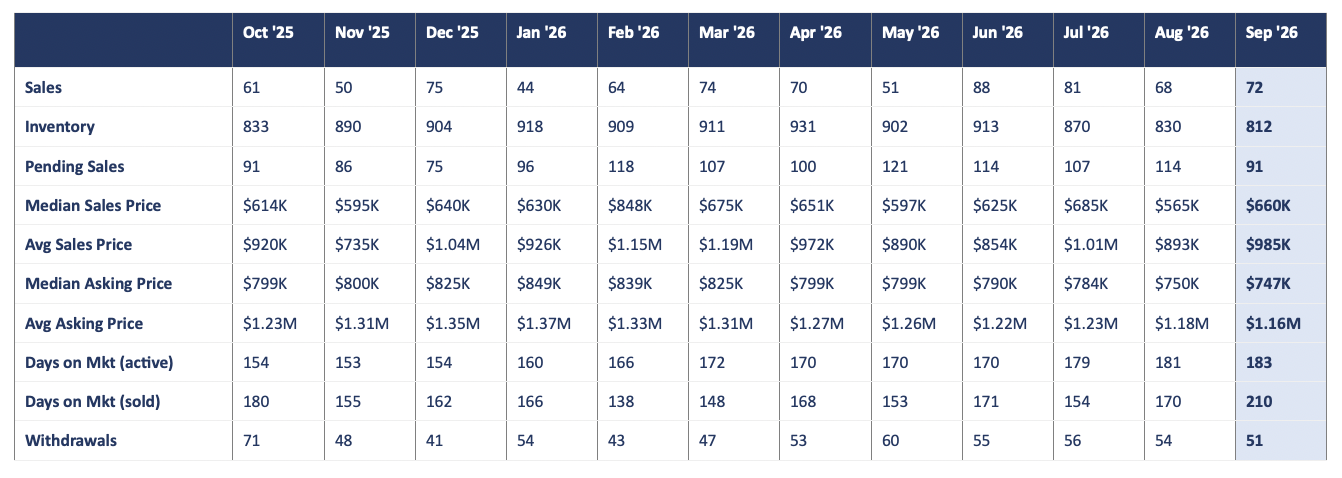
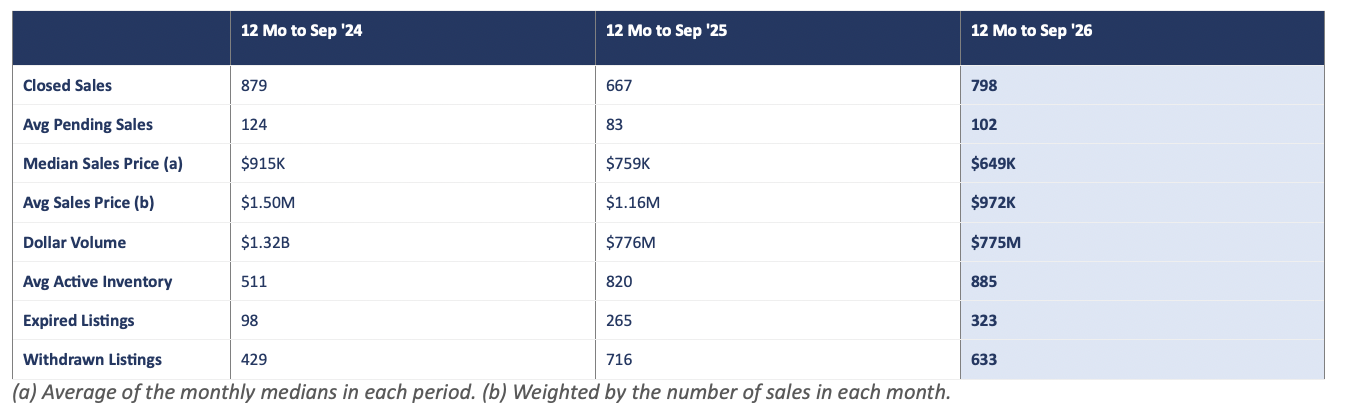
Posted in Lahaina Recovery
July 9, 2026

Maui Real Estate Market Update: July 2026 | Maui Real Estate Advisor

By Lahaina Lee, Aloha Group Maui  |  June 2026 market data

Last month, we told you the most important number in the report was 121 pending condo sales, and that buyers were circling. In June, they landed. Condo closings surged to 88, the highest total in over 2 years, while the median condo price bounced to $625,000. Homes joined the party: 78 closings, the most since August of 2022, and a median price of $1,356,975, the highest since January, pushing supply down to about 5.9 months. Here is what the data shows, what it means, and where we hedge.


July 2026 Key Takeaways

Condo closings: 88 in June, up from 51 in May, the highest number in over 2 years. The pendings converted, right on schedule.

Condo prices: Median sold price bounced to $625,000 from May's $597,000. The bottom held, at least for a month.

Condo inventory: 913 active listings. At June's sales pace, that's about 10.4 months of supply, down from nearly 18 last month. Still a buyer's market, but the discount window narrowed.

Home sales: 78 closings, up from 58 in May and the most of the past 12 months.

Home prices: Median sold price jumped to $1,356,975, the highest since January, one month after the second-lowest reading of the year.

Home supply: Inventory at 464 works out to roughly 5.9 months of supply at June's pace. That's balanced-market territory. One caution: home pendings slipped to 96, tying December for the lowest of the year.


Quick housekeeping for anyone just joining us: this report covers the real estate numbers, and next week we'll publish the companion piece on the Lahaina rebuild, Bill 88, and tourism. One story, two sittings. That's the cadence going forward.

Now. Last month, with condo closings at a limp 51, we pointed at the 121 pending sales and said buyers weren't gone, they were circling. We're right about twice a year, so please allow us this one: June delivered 88 closed condo sales, the best month since 2024. The buyers stopped circling and started signing.

Let's do the numbers. Condos first, as always.


Jul '25

Aug '25

Sep '25

Oct '25

Nov '25

Dec '25

Jan '26

Feb '26

Mar '26

Apr '26

May '26

Jun '26

Sales

53

57

45

61

50

75

44

64

74

70

51

88

Inventory

863

849

842

833

890

904

918

909

911

931

902

913

Pending Sales

79

77

87

91

86

75

96

118

107

100

121

114

Median Sales Price

$675K

$650K

$650K

$614K

$595K

$640K

$630K

$848K

$675K

$651K

$597K

$625K

Avg Sales Price

$911K

$1.14M

$947K

$920K

$735K

$1.04M

$926K

$1.15M

$1.19M

$972K

$890K

$854K

Median Asking Price

n/a

$849K

$823K

$799K

$800K

$825K

$849K

$839K

$825K

$799K

$799K

$790K

Avg Asking Price

n/a

$1.28M

$1.26M

$1.23M

$1.31M

$1.35M

$1.37M

$1.33M

$1.31M

$1.27M

$1.26M

$1.22M

Days on Mkt (active)

151

154

154

154

153

154

160

166

172

170

170

170

Days on Mkt (sold)

145

167

125

180

155

162

166

138

148

168

153

171

Withdrawals

62

68

72

71

48

41

54

43

47

53

60

55


* Data collected on the 1st of the following month. June figures were collected July 1, 2026.

* Asking price data unavailable prior to August 2025.


88 closed condo sales in June. To put that in perspective, the previous best month was April of 2024, and last month we managed just 51. That's a 73% jump in a single month. When closings drop while pendings spike, we said, that's a market where buyers smelled a deal. June is what it looks like when they act on it.

And the pipeline isn't empty. Pending sales came in at 114, the third-highest of the past twelve months, behind only May's 121 and February's 118. So July closings should stay healthy. This wasn't one hungry month clearing the buffet; there's another seating behind it.

Prices tell the same story. The median condo selling price bounced to $625,000, up from May's $597,000, which we called a retest of the bottom. One month doesn't make a floor, and we're not calling one. But when volume surges and the median rises at the same time, that's demand doing the lifting, not a couple of lucky luxury closings. For what it's worth, the average came in at $854,000, the softest of the year, which tells you the action was concentrated in the affordable and mid-range segments. That's welcome news — it's where the deals were, and buyers knew it.

We saw it on the ground, too. Showings and inquiries are both up across our team, and here's the anecdote of the month: we put three condos at Kaanapali Shores under contract on the same day, all at higher prices than comparable units were fetching earlier this spring. One escrow is a transaction. Three in an afternoon is a data point.

A note on days on market for solds: 171 days, near the top of the year's range. Translation: buyers weren't just grabbing fresh listings, they were finally absorbing inventory that had been sitting for months. That's how an overhang starts to clear.

Inventory ticked up to 913 active listings, still below April's 931 peak. Here's the number that changed the most: months of supply. At June's sales pace, 913 listings is about 10.4 months, down from nearly 18 a month ago. At the trailing year's average pace it's closer to 15. Either way, still a buyer's market. But if June's pace holds, and that's an if, the widest part of the discount window may be behind us. That's the good news and the bad news, depending on which side of the table you're sitting on.

Sellers seem to be reading the same tea leaves. Expired listings fell back to 22 after May's spike of 43, withdrawals eased to 55, and the median asking price slipped to $790,000, the first move below the $799,000 shelf it sat on for months. The gap between median ask and median sold narrowed to about $165,000. Still wide. Still narrowing from both directions.

And the elephant in the room got a little louder. On June 19, the County Council passed Bill 88 by a 7 to 2 vote, creating the new H-3 and H-4 hotel districts that could give thousands of apartment-zoned vacation rental condos a path forward. As of this writing, the Mayor has not signed it, and the planning department has not put forward a rezoning process, so nothing is rezoned and nobody's rental clock has changed. But it's hard to look at June's condo surge, especially in places like Kaanapali, and not see some of that optimism getting priced in. We'll break down the whole thing, including what Bill 88 does and doesn't do, in next week's companion blog.

Bottom line on condos: the pendings converted, prices bounced off the bottom, and buyers just showed us where the demand line sits. It's still a buyer's market, but the capital B got a little smaller in June.

Key Takeaways: Condos

88 condo closings in June, up 73% from May's 51 and the highest total in over 2 years. The pending surge converted.

Pending sales at 114, third-highest of the year. The pipeline for July remains full.

Median selling price: $625,000, up from $597,000. Volume and price rose together, a sign of real demand.

913 condos for sale. Months of supply fell from roughly 18 to about 10.4 at June's pace. Still a buyer's market, but tightening.

Expired listings fell to 22 from 43; median asking slipped to $790K. The ask/sold gap narrowed to roughly $165,000.

Bill 88 passed Council 7 to 2 on June 19. Not yet signed, no rezoning process yet. Full coverage next week.


Single-Family Homes


Jul '25

Aug '25

Sep '25

Oct '25

Nov '25

Dec '25

Jan '26

Feb '26

Mar '26

Apr '26

May '26

Jun '26

Sales

60

60

56

63

49

66

52

46

76

49

58

78

Inventory

439

441

438

436

450

446

456

448

436

437

444

464

Pending Sales

112

108

109

101

104

96

120

134

110

119

108

96

Median Sales Price

$1.32M

$1.28M

$1.29M

$1.23M

$1.15M

$1.34M

$1.45M

$1.25M

$1.20M

$1.29M

$1.17M

$1.36M

Avg Sales Price

$1.65M

$1.86M

$1.76M

$1.52M

$1.34M

$1.93M

$1.93M

$1.37M

$1.49M

$1.51M

$1.48M

$1.85M

Median Asking Price

n/a

$1.77M

$1.70M

$1.68M

$1.70M

n/a

$1.95M

$2.00M

$1.95M

$1.85M

$1.85M

$1.84M

Avg Asking Price

n/a

$3.34M

$3.26M

$3.12M

$3.16M

$3.55M

$3.56M

$3.70M

$3.71M

$3.48M

$3.49M

$3.52M

Days on Mkt (active)

139

141

141

138

138

140

136

144

147

153

158

156

Days on Mkt (sold)

185

193

187

135

199

162

232

208

142

160

150

145

Withdrawals

21

37

28

45

36

33

28

25

41

25

35

31

* Data collected on the 1st of the following month. June figures were collected July 1, 2026.

* Asking price data unavailable prior to August 2025; December '25 median asking price unavailable.


Last month we said the home market's flirtation with balance was on pause. Apparently the pause lasted about four weeks.

June delivered 78 closed home sales, up from 58 in May and the most since the sales spike of 2022. Inventory did rise to 464, the highest of the year, but at June's sales pace that works out to roughly 5.9 months of supply. Six months is the textbook definition of a balanced market, and we are now knocking on that door.

The price whiplash deserves its own paragraph. In May, the median home price was $1,174,500, the second-lowest of the year. In June, it jumped to $1,356,975, the highest since January. The average leapt too, to $1.85 million. What happened? More of everything, but especially more at the top: the well-priced luxury listings that had been aging on the vine finally found buyers, and that mix shift pulls the median up. Days on market for solds dropped to 145, and days on market for active listings dipped to 156, the first decline since January after four straight months of climbing.

Now for the hedge, because you know we always bring one. Pending home sales slipped to 96, matching December for the lowest of the past twelve months. Pendings are the preview of coming attractions, and this preview suggests July closings will cool back toward the historical average of about 60 a month. So no, we are not declaring a new era after one strong month. We've been doing this too long for that.

On the asking side, the median eased to $1.84 million and the average settled around $3.52 million, essentially flat. The luxury end is still adjusting, just slowly, the way luxury does everything except spend money.

Bottom line on homes: the best sales month in a year, the highest price since January, and supply back under six months. The balanced-market flirtation is back on. But with pendings at a 12-month low, don't book the wedding yet.


Key Takeaways: Homes

78 home closings in June, up from 58 in May and the highest of the past 12 months.

Median selling price: $1,356,975, the highest since January, one month after the second-lowest reading of the year. Luxury closings drove the mix.

Inventory at 464 works out to about 5.9 months of supply. Balanced-market territory.

Pending sales fell to 96, tying December for the lowest of the past 12 months. Expect July closings to cool toward the norm.

Days on market for active listings dipped to 156, the first decline since January.


A Quick Word on Land

Twelve vacant-land sales closed in June against 203 active listings, and the median sale price fell to $309,000, the lowest of the past year by a comfortable margin. Small sample, big swings; that's land. It remains a thin, patient market measured in seasons, not months. If you're a buyer with vision and a long timeline, there are sellers out there ready to talk story, and June's prices suggest some of them are motivated.

Our Take

June was the month the fence got uncomfortable.

On condos: everything we watch pointed the same direction at once. Closings at their highest in over 2 years, pendings still elevated, prices bouncing off the bottom, expireds falling, the ask/sold gap narrowing, and our own phones ringing more. Add the Council's passage of Bill 88, and some of the zoning uncertainty that's been sitting on this market like a wet blanket is starting to lift. We're not calling a bottom; we don't do that, and anyone who does is selling something. But if you've been waiting for a sign that demand still exists at these prices, June was about as loud as signs get. The leverage is still with buyers. It's just no longer growing.

On homes: the market spent June reminding everyone that Maui inventory is thin and good product moves. Sub-six months of supply is a different conversation than the ten-plus the condo market is having. Sellers who price to the last 90 days of comps are being rewarded, and in June, even some of the patient luxury listings got paid. The pending dip says July will be quieter. The trend says the window where home buyers held all the cards is narrowing.

For condos, it's still a buyer's market, but June is what the early innings of a turn can look like, and this time the closings showed up to say so. For homes, we're back on the doorstep of balance. Either way, the most expensive thing you can do right now is wait without information.

And remember, next week we'll be back with the companion blog covering the Lahaina rebuild, Bill 88 and what it does and doesn't mean for condo owners, and where tourism stands at the peak of summer. Those forces shape everything you just read, so don't miss it.

Let's Talk Story

If you have questions about your property's value, what these numbers mean for your situation, or whether this market is your moment to make a move, reach out anytime. We're here as a resource for the Lahaina and Maui community, whether you're ready to act or just trying to make sense of the headlines. No pressure, no agenda, just a conversation.

And if you or someone you know is thinking about buying, selling, or simply keeping track of Maui's real estate market, we've got a fabulous team of seasoned, well-trained agents standing by to help.

You can search every property listed for sale at www.AlohaGroupMaui.com, or email me directly at lee@alohapotts.com. I answer every one.

From the greatest island on Earth, I'm Lahaina Lee, saying ALOOHA.


June 25, 2026

Maui Recovery Update: Bill 88, Lahaina Rebuild and Tourism - June 2026 | Maui Real Estate Advisor


June 2026 — What You Need to Know

  • Bill 88 passed the Maui County Council 7-2 on June 19 — and is now on Mayor Bissen's desk awaiting signature.
  • Bill 88 creates H-3/H-4 hotel zoning categories but does NOT rezone any property. Every complex still faces its own application process — and no eligibility list has been published yet.
  • Bill 9 remains fully in effect. No amendments, no repeal, no new litigation.
  • Lahaina residential rebuild: 575 permits issued, 220 homes complete, 310 under construction. Progress is real — but commercial rebuilding on Front Street is virtually nonexistent.
  • Maui tourism: stable but split. Ka'anapali and Wailea are holding up. Other areas are struggling, and low rates aren't filling the gap.
  • The Planning Department's eligibility list — not yet published — is now the most important document in Maui real estate. Watch for it.


Aloha, this is Lahaina Lee with the June 2026 edition of the Maui Real Estate Advisor.

June has been one of the most consequential months for Maui real estate and Lahaina recovery in a long time. Bill 88 passed. Lahaina is rebuilding — at a painfully slow pace. Infrastructure projects are getting underway. And even as what some are calling a big legislative win sinks in, new questions are already emerging about what comes next. There is still so much of what has been lost, and what has been taken away.

Here is where things stand as we close out the month.


Bill 88 Passes — Now Awaiting Mayor Bissen's Signature

The headline: the Maui County Council passed Bill 88 by a 7-2 vote on June 19, and the bill now awaits Mayor Richard Bissen's signature. As of this writing, no public announcement of a signature has been made, but Mayor Bissen is widely expected to sign it.

Bill 88 creates two new hotel zoning categories — H-3 and H-4 — designed specifically to provide a new legal pathway for the thousands of apartment-zoned condominium units currently affected by Bill 9 that have historically operated as vacation rentals.

It's important to be clear about what this bill does and doesn't do. Bill 88 does not automatically rezone any property. It creates the zoning categories. Each individual complex would still need to apply for rezoning through its own separate process — Planning Commission review, committee hearings, and Council readings. And remember: the planning commissions all voted against creating this zoning. Housing and Land Use Committee Chair Nohelani U'u-Hodgins reiterated this point directly after the vote: the bill establishes the districts, but separate rezoning actions are required for every property that seeks to use them.

The 7-2 margin is significant. Council members who supported the bill were clear about their reasoning: many Minatoya-listed properties already operate as hotels in every practical sense. Keeping them classified as apartment buildings creates regulatory mismatches, permitting friction, and legal exposure for the county — not to mention the property owners. As one Council member put it, trying to fit these properties into apartment zoning is like putting a square peg in a round hole.

Approximately 4,500 units across roughly 104 complexes are potentially eligible for consideration under H-3/H-4.


The Next Big Question: Implementation

With the Council vote behind us, the conversation has already shifted to what happens next — and the honest answer is that a lot remains to be determined.

Three things that do not yet exist:

  • No H-3/H-4 application process has been released by the Planning Department
  • No official eligibility list identifying which properties may apply has been published
  • No timetable for accepting rezoning applications has been announced

For owners at Bill 9-affected complexes, the absence of the Planning Department's eligibility list and the absence of a process are now the most significant unresolved issues. Post-vote reporting has made clear that this list — which the Planning Department is required to maintain and publish — will be the gateway document for any property seeking to pursue H-3/H-4 rezoning.

The next major development to watch is not the Mayor's signature, though that matters. It's when and how the Planning Department releases implementation guidance, and which properties are included on the eligibility list when it arrives. That is the document that will answer the real question for thousands of condo owners: is my building on the path forward, or not?


Bill 9: Still in Effect

With all the attention on Bill 88, it is easy to lose sight of the fact that Bill 9 remains fully in effect. No amendments. No repeal. No new litigation was filed in the final weeks of June. The phaseout of short-term rental use in apartment-zoned units is still the law.

Bill 88's passage is a major step forward — but it is the beginning of a new process, not the end of the old one. If you own in a Bill 9-affected complex, the practical advice hasn't changed: get good legal counsel, understand your specific building's situation, and don't for a minute think passage automatically resolves your situation. A pathway now exists. Whether your building can use it depends on what the Planning Department publishes next.


Lahaina Recovery: Momentum on the Ground

Three years after the August 2023 fire, Lahaina's recovery continues to move forward on the residential side — steadily, if not dramatically.

MauiRecovers.org Dashboard — June 2026

Lahaina Residential Rebuild — Status as of June 2026

Permits issued

575 total residential building permits

Homes completed

220 completed and approved for occupancy

Under construction

310 homes actively being built

In processing

352 permits currently being reviewed

Non-residential permits

25 issued; 163 in process — no new commercial buildings open

FEMA housing

Households in temporary housing extended into 2027


The residential progress is real, and I don't want to minimize it. Those numbers have continued to tick upward through the final weeks of June. It is not a sudden surge — consistent progress is what long-term recovery looks like. And yet, the fire destroyed roughly 2,200 structures. More than 1,000 property owners haven't started, can't start, or may have already given up.

Programs supporting homeowners remain active and have capacity. The Single-Family Homeowner Reconstruction Program has 50 active applications and room for 250 more. HUD raised income limits for Maui County on June 1 — so if you or someone you know was told they didn't qualify before, it is worth checking again.

Commercial rebuilding is virtually nonexistent.

Our state and local leadership has shown no will and no real interest in cutting through the red tape of historic review, coastal regulations, infrastructure sequencing, and permitting layers that are completely blocking any commercial progress. The Lahaina Royal Complex Master Plan process has formally launched with community engagement — but commercial recovery is a multi-year effort at best, and nobody should pretend otherwise.

On the community side, Hot Kūpuna Nights returned to the Lahaina Civic Center this week, and planning is underway for the Lahaina Homecoming event scheduled for July 17–19 — a meaningful moment in the community's ongoing effort to reconnect with place and culture.


Infrastructure Moving Forward

Several significant infrastructure projects are now underway or imminent:

  • The Lahaina Waterline Improvement Project begins construction in mid-July — replacing 20,000 feet of water main over two years, with added fire hydrant capacity
  • The Lahaina Emergency Evacuation Route (2.5 miles) is in active construction planning
  • Guardrail replacement along Honoapi'ilani Highway is underway, with mid-October completion expected
  • Five traffic signals between Shaw Street and Hina Street will be replaced by end of 2026
  • The Lahaina Harbor railing project is complete — blessing ceremony is July 1
  • Playground groundbreaking at the War Memorial Recreation Center is set for August 12

Mayor Bissen also signed the FY2027 County Budget into law this month, which will shape recovery and infrastructure spending priorities in the year ahead.


Tourism: Stable, but Deeply Split

No new visitor statistics were released in the final days of June. The picture remains what it has been: Maui's tourism market is steady but uneven — and the gap between who is thriving and who is struggling is widening.

Visitors who do come are spending well. The resort areas of Ka'anapali and Wailea appear to be holding up — in some cases, thriving. Other areas are starving, and low rates don't seem to be drawing the visitors. It's a K-shaped tourism economy, and which side of that K your property sits on matters more than any headline number.

For vacation rental owners, performance increasingly comes down to location, property quality, management, and pricing — in that order. 

For buyers evaluating investment potential, the tourism environment is one more variable to weigh carefully alongside the Bill 9 and Bill 88 landscape. Run your numbers conservatively. Use current occupancy data, not peak-year projections.


The Bottom Line

June 2026 delivered a welcome win in Bill 88's passage. But let's be clear about what that means: at its very best, this is just a pathway to getting back some of the legal rights that were already taken away. Lahaina's residential recovery is gaining real momentum. Infrastructure investment is accelerating.

The work ahead is significant. Mayor Bissen's signature is the next step on Bill 88. After that, the Planning Department's eligibility list and implementation guidance become the most important documents in Maui real estate – and they don't exist yet. That is the story to watch heading into July. And as for the tourism market – let's hope that picks up for the places that aren't on the upward angle of our K-shaped economy.

As always, we're here to help you navigate whatever comes next.


Mahalo,


Lee Potts  |  Aloha Group Maui

Lee@AlohaPotts.com  |  AlohaGroupMaui.com

Have questions about how Bill 9 or Bill 88 affects a specific property? Reach out directly — I answer every message.

From the greatest island on earth — this is Lahaina Lee saying Aloooooha.


Frequently Asked Questions

The questions we're hearing most from buyers, sellers, and investors right now.

What did Bill 88 actually do?

Bill 88 created two new hotel zoning categories — H-3 and H-4 — that give apartment-zoned condominium complexes historically operating as vacation rentals a potential path to legal rezoning. It passed the Maui County Council 7-2 on June 19 and is now awaiting Mayor Bissen's signature. What it does not do is automatically rezone any property. Every complex that wants to use the new categories still has to apply through a separate, full rezoning process.

What happens now that Bill 88 has passed?

The next steps are the Mayor's signature, followed by the Planning Department publishing an eligibility list identifying which properties may apply for H-3/H-4 rezoning. That list has not been released yet. No application process has been announced, and no timetable has been set. For condo owners, the eligibility list is the document that actually answers whether your building has a path forward.

Does Bill 88 cancel out Bill 9?

No. Bill 9 remains fully in effect. No amendments, no repeal. Bill 88 creates a potential pathway for some affected properties to seek rezoning — but that process is separate, requires County approval, and has not yet been defined. Bill 9's phaseout of short-term rental use in apartment-zoned units is still the law.

Which properties are eligible for H-3/H-4 rezoning?

Approximately 4,500 units across roughly 104 Minatoya-listed complexes are potentially in scope. But the Planning Department has not yet published an official eligibility list. Until that list exists, no individual owner or complex can definitively know whether they qualify to apply. This is the most important unresolved question in Maui real estate right now.

What is the current status of Lahaina's rebuild in 2026?

As of late June 2026, the MauiRecovers.org dashboard shows 575 residential permits issued, 220 homes completed, and 310 under construction. Residential progress is real and moving. Commercial rebuilding on Front Street is a different story — no new commercial buildings have opened, no commercial permits were filed in early 2026, and a realistic timeline for meaningful Front Street recovery is years away.

How is Maui tourism doing in 2026?

Stable but uneven. Ka'anapali and Wailea resort areas are performing well. Other areas — particularly those dependent on the Lahaina visitor economy — are struggling, and low rates aren't drawing visitors the way owners hoped. The visitor profile has shifted toward higher spenders, which helps revenue for premium properties but doesn't lift the whole market. Overall volume remains below 2019 levels.


About Lahaina Lee & The Maui Real Estate Advisor

Lahaina Lee is a licensed real estate broker on Maui, Hawaii, and the publisher of the Maui Real Estate Advisor — a monthly market report covering Maui condo and single-family home trends, luxury real estate, short-term rental regulations, the Lahaina rebuild, and Maui's broader economic picture.

Contact: Lee@AlohaPotts.com  |  AlohaGroupMaui.com

June 12, 2026

Maui Real Estate Market Update: June 2026

The Maui real estate market in May 2026 is telling two stories at once. Condo closings slipped to 51, one of the weakest months of the past year, yet pending condo sales surged to 121, the highest in at least twelve months, just as the median condo price touched $597,000. On the home side, sales rebounded from a sleepy April, the median price slid to its second-lowest level in a year, and days on market hit a new high. Here is what the data shows, what it means, and what we're watching.


June 2026 Key Takeaways

  • Condo closings: 51 in May, down from 70 in April. The spring rally on closings stalled.
  • Condo pendings: 121, the highest of the past 12 months. Buyers are circling, and they're writing offers.
  • Condo prices: Median sold price fell to $597,000, within $2,000 of the 12-month low. Maui condos are on sale.
  • Condo inventory: 902 active listings, down from April's 931 peak, but still nearly 18 months of supply at May's sales pace.
  • Home sales: 58 closings, up from 49 in April. Inventory at 444 puts homes back at about 7.7 months of supply, so the brief flirtation with a balanced market is on pause.
  • Home prices: Median sold price slid to $1,174,500, the second-lowest of the past year, while active listings now sit an average of 158 days, the longest all year.


Aloha, this is Lahaina Lee with your June edition of the Maui Real Estate Advisor market report.

First, a little housekeeping. Starting this month, we're splitting the report in two. Today is all real estate: the numbers, the trends, and what they mean for buyers and sellers. Next week, we'll publish a companion piece covering the Lahaina rebuild, Bill 9, and tourism. Those topics deserve more than a paragraph squeezed between data tables, and frankly, so do the data tables. Same talk story, two sittings.

So, how's the market? Well, if you only looked at closed sales, you'd say the condo market took another nap in May. Just 51 closings. But look one layer deeper and you'll find the most interesting number of the month: 121 pending condo sales, the highest we've seen in at least a year. Buyers aren't gone. They're circling. And I think I know why.

Let's do the numbers. Condos first, as always.


Condos


Jun '25

Jul '25

Aug '25

Sep '25

Oct '25

Nov '25

Dec '25

Jan '26

Feb '26

Mar '26

Apr '26

May '26

Sales

56

53

57

45

61

50

75

44

64

74

70

51

Inventory

872

863

849

842

833

890

904

918

909

911

931

902

Pending Sales

80

79

77

87

91

86

75

96

118

107

100

121

Median Sales Price

$700K

$675K

$650K

$650K

$614K

$595K

$640K

$630K

$848K

$675K

$651K

$597K

Avg Sales Price

$1.31M

$911K

$1.14M

$947K

$920K

$735K

$1.04M

$926K

$1.15M

$1.19M

$972K

$890K

Median Asking Price

n/a

n/a

$849K

$823K

$799K

$800K

$825K

$849K

$839K

$825K

$799K

$799K

Avg Asking Price

n/a

n/a

$1.28M

$1.26M

$1.23M

$1.31M

$1.35M

$1.37M

$1.33M

$1.31M

$1.27M

$1.26M

Days on Mkt (active)

144

151

154

154

154

153

154

160

166

172

170

170

Days on Mkt (sold)

124

145

167

125

180

155

162

166

138

148

168

153

Withdrawals

58

62

68

72

71

48

41

54

43

47

53

60

* Data collected on the 1st of the following month. May figures were collected June 1, 2026.

* Asking price data unavailable prior to August 2025.


Coming into May, the condo story was a modest recovery: 44 closings in January, then 64, 74, and 70. May broke the streak at 51 closed sales, a 27% drop from April. After three encouraging months, that stings. But I'd caution against reading it as a reversal, and here's why.

Pending sales jumped to 121, the highest level of the past twelve months, beating February's 118. Pendings are our leading indicator, the preview of June and July closings. When closings drop but pendings spike, that's not a market rolling over. That's a market where buyers smelled a deal and started writing offers.

And the deals are real. The median condo selling price dropped to $597,000, down from $651,250 in April. Outside of last November's $595,000, that's the lowest median of the past year. Call it a retest of the bottom. The average selling price came in at $890,000, ending a stretch where the average held above $1 million for much of the spring. Maui condos are on sale, and the pending numbers tell you the shoppers have noticed. For sellers, that's the good news and the bad news.

Inventory eased to 902 active listings, down from April's peak of 931. That's the first meaningful dip since winter. Don't celebrate yet: at May's sales pace, that's still nearly 18 months of supply, and even at the past year's average pace it's about 15 and a half months. A balanced market is roughly six. This remains one of the strongest buyer's markets Maui has seen in a generation.

Two more telltales worth your attention. Average days on market for active condo listings is sitting at 170 days. And 43 condo listings expired in May, double April's count and the most in over a year. Some sellers are reading the room and stepping off the field rather than chasing the market down. The ones who stay are pricing closer to reality: the median asking price has now settled at $799,000 for a second straight month, down from $839,000 in February. The gap between asking and selling is still wide (about $200,000 at the medians) but it's narrowing from both directions.

One quick note on the elephant in the room: Bill 9 is now law, and it is absolutely part of why condo pricing looks the way it does. Every apartment-zoned condo now has a rental-rights clock attached to it, and the market is pricing that clock in. We'll cover the latest, including the H-3/H-4 rezoning question, in next week's companion blog.

Bottom line on condos: closings dipped, but pendings hit a 12-month high right as prices retested the bottom. It's still a buyer's market with a capital B, and the buyers know it.


Single-Family Homes


Jun '25

Jul '25

Aug '25

Sep '25

Oct '25

Nov '25

Dec '25

Jan '26

Feb '26

Mar '26

Apr '26

May '26

Sales

66

60

60

56

63

49

66

52

46

76

49

58

Inventory

438

439

441

438

436

450

446

456

448

436

437

444

Pending Sales

105

112

108

109

101

104

96

120

134

110

119

108

Median Sales Price

$1.32M

$1.32M

$1.28M

$1.29M

$1.23M

$1.15M

$1.34M

$1.45M

$1.25M

$1.20M

$1.29M

$1.17M

Avg Sales Price

$2.22M

$1.65M

$1.86M

$1.76M

$1.52M

$1.34M

$1.93M

$1.93M

$1.37M

$1.49M

$1.51M

$1.48M

Median Asking Price

n/a

n/a

$1.77M

$1.70M

$1.68M

$1.70M

n/a

$1.95M

$2.00M

$1.95M

$1.85M

$1.85M

Avg Asking Price

n/a

n/a

$3.34M

$3.26M

$3.12M

$3.16M

$3.55M

$3.56M

$3.70M

$3.71M

$3.48M

$3.49M

Days on Mkt (active)

136

139

141

141

138

138

140

136

144

147

153

158

Days on Mkt (sold)

191

185

193

187

135

199

162

232

208

142

160

150

Withdrawals

30

21

37

28

45

36

33

28

25

41

25

35

* Data collected on the 1st of the following month. May figures were collected June 1, 2026.

* Asking price data unavailable prior to August 2025; December '25 median asking price unavailable.


Last month we told you the home market was approaching balance. March's 76 closings against shrinking inventory had supply down to 5.7 months, and we said the buyer-friendly window might be narrowing. Well, the market heard us and decided to be difficult.

April closings slumped to 49, and May recovered to 58 closed sales, a solid bounce that lands right around the two-year average of roughly 60 per month. Meanwhile, inventory ticked up to 444 homes. Run the math and we're back to about 7.7 months of supply. So the flirtation with a balanced market is on pause. Buyers, you've been given a reprieve.

Pending sales came in at 108, down from 119 in April and within range of the 12-month norm. Expect June closings to land somewhere in the high 50s to 60s unless something surprises us.

The price story is where it gets interesting. The median home selling price slid to $1,174,500, the second-lowest of the past twelve months, behind only last November's $1.15 million. The average came in just under $1.5 million. As we noted last month, when the median drifts down toward a level where more buyers can transact, sales volume tends to follow, and that's consistent with the rebound we saw in May.

Now look at the asking side. The median asking price held at $1.85 million, and the average asking price came in around $3.49 million, down significantly from March's $3.71 million peak. That's two months of softening at the top, which suggests some luxury sellers are finally adjusting. They may want to hurry: average days on market for active home listings has climbed every single month this year and now sits at 158 days, the highest of the past twelve months. The well-priced homes are selling. The aspirationally priced ones are aging like fine milk.

Oy.

Bottom line on homes: sales bounced back, prices came down to where buyers live, and the top of the market is slowly getting the memo. It's a mild buyer's market, for now.

Key Takeaways: Homes

  • 58 home closings in May, up from 49 in April, back near the two-year average of roughly 60 per month.
  • Inventory at 444 homes works out to about 7.7 months of supply. The move toward a balanced market is on pause.
  • Median selling price: $1,174,500, the second-lowest of the past 12 months. Lower prices appear to be supporting volume.
  • Average asking price fell to $3.49M from March's $3.71M peak. The luxury end is starting to adjust.
  • Days on market for active listings hit 158, the highest of the year, and it has risen every month since January.


A Quick Word on Land

Eleven vacant-land sales closed in May against 202 active listings, and the median sale price dropped to $495,000, the lowest of the past year. Land remains a thin, patient market measured in seasons, not months. If you're a buyer with vision and a long timeline, there are sellers out there ready to talk story.

Our Take

Maui is a place that earns your patience, and May 2026 is a good example of why that patience pays.

On condos: don't let the 51 closings fool you. The combination we saw in May (prices retesting the bottom, inventory off its peak, expired listings doubling, and pendings at a 12-month high) is what the early innings of a turn can look like. We're not calling a bottom; we don't do that, and anyone who does is selling something. But the buyers writing offers right now are getting selection and leverage that simply didn't exist two years ago. If you've been considering a Maui condo, the homework matters more than ever; zoning and rental rights now drive value as much as the ocean view does. The math, though, has rarely been more in your favor.

On homes: the market keeps finding its footing right around $1.2 million. The action is at the entry and mid-level; the luxury end is sitting, and the steady climb in days on market is the proof. Sellers who price to the last 90 days of comps are closing. Sellers pricing to 2022 are watching their listings turn stale, and increasingly, watching them expire.

For condos, it's a buyer's market with a capital B, and the pending numbers say buyers have figured that out. For homes, it's a mild buyer's market with a moving floor. Either way, the most expensive thing you can do right now is wait without information.

And remember, next week we'll be back with the companion blog covering the Lahaina rebuild, the latest on Bill 9 and the H-3/H-4 rezoning question, and where tourism stands heading into summer. Those forces shape everything you just read, so don't miss it.

Let's Talk Story

If you have questions about your property's value, what these numbers mean for your situation, or whether this market is your moment to make a move, reach out anytime. We're here as a resource for the Lahaina and Maui community, whether you're ready to act or just trying to make sense of the headlines. No pressure, no agenda, just a conversation.

And if you or someone you know is thinking about buying, selling, or simply keeping track of Maui's real estate market, we've got a fabulous team of seasoned, well-trained agents standing by to help.

You can search every property listed for sale at www.AlohaGroupMaui.com, or email me directly at lee@alohapotts.com. I answer every one.

From the greatest island on Earth, I'm Lahaina Lee, saying ALOOHA.


June 8, 2026

Maui Luxury Market Report Week Ending June 6, 2026 Aloha Group Maui with Lahaina Lee | Single-Family Homes $4M+ | Condominiums $3M+


Weekly Luxury Market Snapshot


Category

This Week

Price Range

Market Signal

Sold

3

$4,150,000 - $9,875,000

Two SF homes close in Launiupoko and Kula; Makena Surf condo trades at discount

Pending

2

$5,295,000 - $5,900,000

Olinda estate goes fast; WBV Penthouse finds buyer after 170 days

New Listings

3

$7,500,000 - $45,000,000

Lanikeha new build, Halama beachfront, and $45M Makena compound debut

Price Reductions

9

$3,650,000 - $14,400,000

Broad-market repositioning -- West Maui, Kula, North Shore, Wailea all represented

Cancelled / Expired

5

$4,650,000 - $13,500,000

Four expireds and one cancellation -- inventory leaves across multiple segments


Market Snapshot


We are reporting on 22 listings this week. Three closings, two pendings, three new-ish listings, nine price reductions, and five properties leaving the market. Both properties that went pending did so after meaningful time on market -- the Olinda estate found a buyer in just 18 days, while the Wailea Beach Villas penthouse closed out a 170-day run. That combination -- quick moves and patient moves both finding resolution -- is a healthy sign for a market sorting itself out.


Three new listings entered: a brand-new Lanikeha single-family in Kaanapali, a sandy beachfront estate on Halama Street in Kihei at $12.4M, and the Makena Road compound debuting at $45,000,000 as a unified two-parcel offering. The compound's entry at this price point is the week's most headline-worthy event -- it is either a bold statement of value or a significant test of the ultra-luxury market's depth.


Nine price reductions across West Maui, Kula, North Shore, and Wailea tell a consistent story: sellers who entered the market at aspirational prices are now finding the floor. That repricing, combined with the five departures this week, is clearing the decks. A leaner, better-priced inventory is exactly what attracts the buyers who have been watching and waiting.


Closed Sales


Single-Family Homes

Launiupoko  |  205 Pua Niu Way

5 bd  |  4.5 ba  |  3,697 sf  |  2.77 ac  |  ocean view  |  pool

List Price: $6,290,000  |  Sold Price: $5,950,000  |  DOM: 30  |  Cash

This one came to market 4 times starting back in 2023. Back then it was listed for $7,450,000. It came back to the market for the 4th time and went under contract on the same day, which is a bit odd. Dropping from $7.4+ to a final sale of just under $6M over a 2 1/2 year timeframe, likely tells us the whole story.


Kula  |  730 Lower Kimo Dr

3 bd  |  4 ba  |  7,102 sf  |  5.28 ac  |  bi-coastal view  |  pool

List Price: $9,875,000  |  Sold Price: $9,875,000  |  Original: $11,000,000  |  DOM: 425  |  Cash

Four hundred twenty-five days on market this time after a previous listing period of 353 days with the same broker and a reduction from $11M to selling price $9.875M to get here. Seven-thousand-plus square feet of concrete construction on 5.28 acres with bi-coastal views over all of Maui. Copper roofing, Italian and Spanish gold antique marble, Jerusalem stonework, Acacia hardwood floors. The journey from March of 2023 until now is the real data point for the Kula estate segment -- buyers will wait, and they will wait at a price they set.


Condominiums

Makena Surf  |  Makena  |  4850 Makena Alanui Rd, Unit F-207

2 bd  |  2 ba  |  1,313 sf  |  fl. 2  |  oceanfront  |  ocean view  |  Hotel Zoned - STR Allowed

List Price: $4,495,000  |  Sold Price: $4,150,000  |  Original: $4,495,000  |  DOM: 184  |  Cash

Once again the 3rd time is the charm. Originally listed in 2023 for $5.350M, this one came back 6 months ago at $4,495,000 and attracted a buyer. Six months on market and a $345,000 discount on a renovated second-floor Makena Surf unit -- the second consecutive week a Makena Surf condo has closed. Building F offers unobstructed views from Kaho'olawe to West Maui with year-round sunsets. Renovated 2015 with travertine tile, recessed lighting, central A/C. Hotel Zoned - STR Allowed, active vacation rental. Contract date was March 9 with a nearly three-month escrow on a cash transaction -- longer than typical, which is worth noting for buyers underwriting Makena Surf properties.


Pending Sales


Single-Family Homes

Olinda  |  1630 Olinda Rd

4 bd  |  4.5 ba  |  5,035 sf  |  2.07 ac  |  bi-coastal view  |  pool

List Price: $5,295,000  |  Original: $5,295,000  |  DOM: 18  |  Contract: 6/1/2026

Eighteen days to contract on this Olinda estate -- one of the faster moves in the Upcountry market in recent months. Over 5,000 sf of main residence plus an attached apartment, detached cottage, and barn/workspace on 2 acres along the slopes of Olinda Road. Bi-coastal views, pool, tennis court, spa. Built 1996, remodeled 2022. The Upcountry buyer pool is narrow but motivated when the right property arrives at the right price -- this one hit both marks.


Condominiums

Wailea Beach Villas  |  Wailea  |  3800 Wailea Alanui Blvd, Unit PH503

3 bd  |  3 ba  |  1,961 sf  |  fl. 5 (penthouse)  |  beachfront  |  ocean view  |  Hotel Zoned - STR Allowed

List Price: $5,900,000  |  Original: $6,895,000  |  DOM: 170  |  Contract: 6/2/2026

After 170 days and a $995,000 reduction from original ask, the top-floor penthouse at Wailea Beach Villas found a buyer. Listed December 2025, it sat through the slower winter season before the spring market delivered a contract. Renovated 2025, fully furnished, active vacation rental with bookings transferable. Fifth floor, 283 sf lanai, Gaggenau/SubZero/Thermador kitchen. Hotel Zoned - STR Allowed. For context, Wailea Beach Villas B-102 -- a first-floor front-row unit in the beachfront B building -- expired this same week after 366 days at $12,950,000. Same complex, very different outcomes.


New Listings


Single-Family Homes

Lanikeha  |  Kaanapali  |  1015 Anapuni Pl

4 bd  |  4.5 ba  |  4,012 sf  |  0.48 ac  |  ocean view  |  pool  |  + 1/1 ohana

List Price: $7,500,000  |  Listed: 6/1/2026  |  DOM: 6

After expiring in May, this one is back on the market in time for the summer buying season. Brand-new 2025 construction in Lanikeha -- Kaanapali Golf Estates' double-gated upper tier. Designed by architect Atom Kasprzycki and built by Thad Henry Design Group.


Halama Street  |  Kihei  |  1536 Halama St

5 bd  |  5.5 ba  |  5,070 sf  |  0.40 ac  |  beachfront  |  sandy beach  |  pool  |  + 1/1 ohana

List Price: $12,400,000  |  Listed: 6/2/2026  |  DOM: 5

Back to the market after failing to sell during the 2023/2026 winter season. This is a 2015-built family beachfront compound on Halama Street. Five ensuite bedrooms, primary suite claiming the entire upper level with its own laundry, dedicated office, and private covered lanai. The 3-car garage includes an upstairs ohana for caretaker or overflow. Monier tile roof, Hardie siding. The quiet end of Halama is a meaningful distinction -- a different experience from the more trafficked sections. At $12.4M buyers will want to benchmark carefully against recent Kihei and Wailea coastal comps.


Poolenalena  |  Wailea/Makena  |  4640 & 4650 Makena Rd

8 bd  |  7.5 ba  |  7,510 sf  |  1.21 ac  |  beachfront  |  ocean view  |  pool

List Price: $45,000,000  |  Listed: 6/5/2026  |  DOM: 2

Two side-by-side oceanfront parcels on Makena Road offered as a single $45,000,000 compound. Positioned approximately 40 feet above a crescent-shaped white sand beach framed by a lava rock outcropping -- a setting that cannot be replicated under current coastal regulations. Two distinct residences: one single-level with immediate livability and preliminary plans for a modern renovation, the other with 15-foot ceilings and an open-concept great room. Gated, sweeping views from Makena to the West Maui Mountains, year-round sunsets. At $45M this is one of the highest-priced residential offerings on Maui and a global buyer conversation -- proof of funds required, listing agent must be present.


Price Reductions


Single-Family Homes

Kula  |  7700 Kula Hwy

58-acre agricultural estate  |  4,200 sf ag shop  |  commercial greenhouses  |  8 TMKs

Current Price: $14,400,000  |  Original: $14,900,000  |  DOM: 59

A $500,000 reduction after 59 days on this rare 58-acre Kula ag estate -- four ag buildings, two fully automated commercial greenhouses, off-grid solar, established income leases. A very narrow buyer pool at any price.


Kula  |  7850 Kula Hwy

3 bd  |  2.5 ba  |  3,832 sf  |  2.0 ac  |  ocean view

Current Price: $7,150,000  |  Original: $7,450,000  |  DOM: 233

A $300,000 reduction at 233 days on this modern single-level Kula view home. Eight months in and still looking for its buyer.


Spreckelsville  |  1050 Kapukaulua Pl

4 bd  |  2.5 ba  |  2,606 sf  |  0.90 ac  |  beach access

Current Price: $6,800,000  |  Original: $7,250,000  |  DOM: 257

$450,000 off at 257 days on this gated multi-structural Spreckelsville coastal estate. The North Shore buyer pool is patient, and this seller has been waiting a long time.


Mahana Estates  |  Kapalua  |  300 Mahana Ridge St

4 bd  |  4.5 ba  |  3,156 sf  |  1.29 ac  |  ocean view  |  pool

Current Price: $5,495,000  |  Original: $5,950,000  |  DOM: 128

Down $455,000 from original ask at 128 days. The developer's personal lot selection in Mahana Estates, now the most aggressively priced home in the community. Comparable homes in the community sold at $7.625M and $7.8M -- this seller is pricing well below that to move.


Lanikeha  |  Kaanapali  |  44 Loli'i Pl

4 bd  |  5 ba  |  3,691 sf  |  0.46 ac  |  ocean view  |  pool

Current Price: $5,245,000  |  Original: $5,895,000  |  DOM: 336

$650,000 off original ask at 336 days -- a 2022-built Lanikeha home working its way down for nearly a year. Notably, a brand-new Lanikeha home entered the market this week at $7.5M. Buyers can now compare directly within the same gated community.


Spreckelsville  |  462 Laulea Pl

2 bd  |  2 ba  |  1,165 sf  |  0.23 ac  |  ocean view  |  + 1/1 cottage

Current Price: $4,400,000  |  Original: $4,888,000  |  DOM: 127

$488,000 off at 127 days on this Old Spreckelsville compound on Laulea Place -- Tahitian-style structures on a private gated quarter acre near beach access, four distinct living areas. The as-is addendum is a signal buyers should read carefully.


Condominiums

Honua Kai - Konea  |  Kaanapali  |  130 Kai Malina Pkwy, Unit NR202

3 bd  |  3 ba  |  2,230 sf  |  fl. 2  |  beachfront  |  ocean view  |  Hotel Zoned - STR Allowed

Current Price: $4,950,000  |  Original: $5,400,000  |  DOM: 371

A year on market and $450,000 down from original ask -- this is the only oceanfront three-bedroom currently available at Honua Kai. The listing agent is out of state, which has been noted by local brokers throughout the listing history. At $4,950,000 the question remains whether pricing has finally reached the threshold where the buyer math works.


Ho'olei  |  Wailea  |  21 Kiloa St, Unit O-4

3 bd  |  3.5 ba  |  2,619 sf  |  fl. 2  |  ocean view  |  Hotel Zoned - STR Allowed

Current Price: $4,650,000  |  Original: $4,890,000  |  DOM: 104

$240,000 reduction at 104 days on this Ho'olei townhome in the heart of Wailea. Active Grand Wailea rental program, Kulana Club membership negotiable, Fleetwood pocket sliders, Wolf and Sub-Zero kitchen. The reduction signals the seller is watching the market closely.


Kapalua Ironwoods  |  Kapalua  |  62 Ironwood Ln, Unit 62

2 bd  |  3 ba  |  1,750 sf  |  fl. 1  |  beachfront  |  ocean view  |  No STR

Current Price: $3,650,000  |  Original: $3,850,000  |  DOM: 179

$200,000 off at 179 days on this 2022-remodeled single-level Ironwoods residence with private direct-from-garage entry -- a rare configuration in the complex. Short-term rental not permitted; owner-user or long-term rental play only.


Cancelled / Expired


Single-Family Homes

Launiupoko  |  91 Kumu Niu Pl

4 bd  |  4.5 ba  |  4,012 sf  |  2.09 ac  |  ocean view  |  pool  |  New Construction

List Price: $7,440,000  |  DOM: 372  |  EXPIRED

Under-construction spec home in Launiupoko that never found a buyer at this price -- a year-plus on market is the verdict on what the market will pay for unfinished product in this location.


Olowalu  |  49 Kuahulu Pl

3 bd  |  3.5 ba  |  3,477 sf  |  2.0 ac  |  oceanfront  |  ocean view  |  pool  |  + 2/1 ohana

List Price: $13,500,000  |  DOM: 169  |  EXPIRED

Private oceanfront gated estate on 2 acres at the quiet end of West Maui. Five months without a match at $13.5M -- a price and a location that require a very specific buyer.


Kihei  |  1656 Halama St

4 bd  |  3 ba  |  2,150 sf  |  0.46 ac  |  oceanfront  |  ocean view  |  pool  |  + 1/1 ohana

List Price: $4,650,000  |  DOM: 31  |  CANCELLED

Oceanfront plantation-style home on Halama Street cancelled after just 31 days. A property that pulls that quickly often comes back relisted -- watch for it.


Condominiums

Wailea Point  |  Wailea  |  4000 Wailea Alanui Dr, Unit 1404

3 bd  |  3 ba  |  2,430 sf  |  fl. 2  |  oceanfront  |  ocean view  |  No STR

List Price: $9,500,000  |  Original: $11,500,000  |  DOM: 287  |  EXPIRED

Repositioned down from $11.5M after an extensive renovation. Nearly ten months on market and pricing remained the barrier to the end.


Wailea Beach Villas  |  Wailea  |  3800 Wailea Alanui Dr, Unit B-102

3 bd  |  3.5 ba  |  2,931 sf  |  fl. 1  |  beachfront  |  ocean view  |  Hotel Zoned - STR Allowed

List Price: $12,950,000  |  DOM: 366  |  EXPIRED

Front-row beachfront villa in the coveted B building -- one of only eight in that position -- held since 2007 and on the market for nearly a year without a deal. The PH503 in the same complex went pending this week at $5.9M. Different units, very different outcomes.


Our Take


With 9 price reductions and 3 new-ish listings we are seeing sellers try to get repositioned for a summer selling season after a disappointing winter season. Adding to the changing tableau were 5 properties leaving the market. Will those be back for the late summer -- they have to be off 30 days to reset the days on market (DOM) counter -- or will they wait until the 2026 winter season.


Even with all of that activity, the inventory levels didn't change much. We have 97 luxury homes and 68 high end condos for sale. With homes selling at a rate of just under 3 per month and condos selling at 2.5 per month on average, we have over 3 years of inventory in each category. Buyers have a lot of choices.


Three sales this month and 2 new pendings at the tail end of our shoulder season and before summer is fully underway is a very good sign. Realtors are reporting more showings and inquiries across the board. Maybe potential buyers who were waiting to see what geopolitical situation would shake out are tired of waiting. If so, it would certainly be good news for our sellers.

Posted in Luxury Update
May 31, 2026

MAUI WEEKLY LUXURY REPORT ~ Homes $4M+ | Condos $3M+ | Week Ending May 30, 2026


Category

This Week

Price Range

Market Signal

Sold

1

$5,600,000

Ka'anapali Coffee Farms closes after 225 days

Pending

2

$4,495,000 – $6,696,000

Makena Surf finds buyer; Puunoa deal tightens

New Listings

5

$4,700,000 – $26,500,000

Broad range — Hana to Makena, Maalaea oceanfront joins the week

Price Reductions

3

$4,095,000 – $5,495,000

West Maui and Wailea sellers repositioning

Cancelled / Expired

0

---

Quiet week on the exit side


Market Snapshot

One closing, two pendings, five new listings, and three price reductions — a busier-than-recent week with movement across multiple segments. The closed sale is the Ka'anapali Coffee Farms estate that went under contract in May after two and a half years of price discovery; it finally found a cash buyer at $5,600,000. On the pending side, Makena Surf E-205 goes under contract after 207 days, and the long-running Puunoa estate at 200 Hokiokio Pl quietly shifts from Pending-Continue to Show to Pending-Do Not Show — a meaningful signal after eight months in escrow.

Five new listings entered the market spanning a remarkable range: a 2002 oceanfront home in Hana at $4.7M, a six-bedroom Makena compound at $26.5M, a 1942 oceanfront estate in Maalaea, and two Wailea/Kapalua condos freshly priced. The price reduction section tells its own story — three sellers in West Maui and Wailea adjusting after 121 to 364 days on market. The Honua Kai Konea NR202 reduction after nearly a year is the headline: the only oceanfront three-bedroom at Honua Kai has now come down $450,000 and the seller needs to find a buyer.

Closed Sales

Single-Family Homes

Ka'anapali Coffee Farms | Ka'anapali | 2600 Aina Mahiai St
5 bd | 4.5 ba | 3,555 sf | 5.19 ac | mountain/ocean view

List Price: $5,900,000 | Sold Price: $5,600,000 | DOM: 225 | Cash

This one was covered in last week's pending section, but the full arc is worth recapping on the close. Third time on the market since September 2023, originally asking $7,495,000. Five price reductions over nearly two and a half years to land a cash buyer at $5,600,000 — a $1,200,000 discount from final list and $1,895,000 off the original ask. The 5.18-acre lot within Ka'anapali Coffee Farms' gated organic plantation community above Ka'anapali: heated pool, fruit orchard, trade winds, ocean views. Sold cash with a contract date of May 7 and a quick 20-day close. The journey from $7.495M to $5.6M is the real story of where this segment has moved over the past two and a half years.

Pending Sales

Single-Family Homes

Puunoa | Lahaina | 200 Hokiokio Pl
4 bd | 4.5 ba | 3,854 sf | 5.77 ac | ocean view

List Price: $6,696,000 | Original: $7,295,000 | DOM: 457 | Contract: 9/23/2025 | Status: Pending – Do Not Show

This one has been quietly sitting in Pending-Continue to Show since September 23, 2025 — nearly eight months. This week it shifted to Pending-Do Not Show, which is the signal we've been waiting for. When a seller stops accepting backup showings after that long a wait, it almost always means a meaningful due diligence hurdle has cleared. What that hurdle was, we won't know until it closes. The deal structure is unusual: the listing offered 50% seller financing at 5% for five years, plus a 25% co-ownership option through Cohana Homes — creative terms that suggest a seller who needed to engineer the right buyer rather than wait for a conventional one. 2020-built single-level estate on 5.77 acres in Puunoa above Lahaina, pool and spa, panoramic ocean and outer island views. At $6,696,000 after 457 days and a $599,000 discount from original list, when this closes it will be a meaningful comp for the above-Lahaina market.

Condominiums

Makena Surf | Makena | 4850 Makena Alanui Rd, Unit E-205
2 bd | 2 ba | 1,313 sf | beachfront | ocean view | Hotel Zone – STR Allowed

List Price: $4,495,000 | Original: $4,495,000 | DOM: 207 | Contract: 5/23/2026

This is the second time around for this property. It was originally listed by the same broker bake in January or 2025 for $5.195M. This time she hung in there for 207 days at the same list price and finally found a buyer — no price reduction, which is notable in this condo market. Second-floor unit at Makena Surf, perched above one of Makena's finest beaches with panoramic ocean and outer island views. 1984 construction with 2022 cosmetic upgrades: new A/C, paint, furnishings, lighting, carpet. Granite counters, tiled showers, plantation shutters, sold furnished. Hotel Zoned – STR Allowed, with an active rental program. Makena Surf units don't trade often — the complex is gated, 15 acres, two pools, tennis, pickleball, and sits at the quieter southern end of Wailea. 

New Listings

Single-Family Homes

Hana | 51 Kapohue Rd
3 bd | 3.5 ba | 3,295 sf | 1.10 ac | oceanfront

List Price: $4,700,000

This seller is hoping that the 4th time and the second broker are the charm. Previously listed at $5M this is a custom-built oceanfront home on 1.1 acres in Hana. There is very small pool of buyers for a home at this price in that location as demonstrated by the total amount of time it’s been on the market going back to the original listing in 2020. Three bedrooms, 3.5 baths, 3,295 sf with soaring ceilings and a tiki bar area on the oceanfront grounds. Paragon shows the listing agent must be present for all showings with 48-hour notice, which is standard for a working property in this location. At $4.7M for direct oceanfront on 1.1 acres, the pricing will depend entirely on condition and how serious the buyer pool for Hana oceanfront is right now. 


Makena | 7505 Makena Rd
6 bd | 6 ba | 8,664 sf | 1.03 ac | ocean view | + 2/2 ohana | across street from ocean

List Price: $26,500,000

This home was purchased in May of 2022 for $26,490,700. That odd number indicates some serious negotiation took place. It came back to market just 7 months later at $33,9M, and it’s been for sale ever since. The seller his/her third broker, and the price is back below the original purchase price. There was some renovation in 2024 with includes “the largest residential Tesla Solar Roof in the US. The compound is on a gated and walled one-acre estate in Makena: 8,664 sf of living across the main home plus a 2/2 ohana, heated lap pool, sauna, spa, 4-car garage plus 4 carports. It’s across the street from the ocean rather than on it, though ocean views and Haleakala sunrise views are cited. The ask of $26.5M puts this in very thin air — global buyer pool, proof-of-funds required, appointment only. Worth watching for how quickly the market responds to this entry point. 

Condominiums

The Resort at Kapalua | Kapalua | 1 Bay Dr, Unit 2204
3 bd | 3.5 ba | 2,789 sf | fl. 1 | beachfront | ocean view | Hotel Zoned - STR Allowed

List Price: $3,249,000

After 3 tries with a different broker at listing prices as high as $4.175M this seller is now two days on market with a new broker and much more competitive price. First-floor residence at The Resort at Kapalua on Kapalua Bay — the beach that Condé Nast Traveler has named the #1 in America. 2009-built, 2,789 sf, 613 sf covered lanai, sold furnished with exceptions. Hotel Zoned – STR Allowed. Important disclosure buyers will need to understand: there is a special assessment for an exterior renovation of Building 2, with construction scheduled October 20, 2026 through July 19, 2027 — a nine-month construction window that will affect the building and likely the guest experience for anyone running a short-term rental program during that period. At $3,249,000, pricing looks competitive for Kapalua Bay frontage, but buyers should underwrite the assessment and the construction timeline carefully before writing an offer.

Wailea Point | Wailea | 4000 Wailea Alanui Dr, Unit 1103
3 bd | 3 ba | 2,163 sf | fl. 1 | beachfront | ocean view | not STR eligible

List Price: $7,495,000

Six days on market. Wailea Point is one of the most exclusive low-density condominium communities on the Wailea coast — gated, beachfront, and positioned directly above the Wailea beach walk. Unit 1103 occupies an elevated promontory with unobstructed ocean, outer island, and coastline views from the main living area. 1987-built, renovated 2018: Koa wood entry door, sand-toned limestone floors, hand-cast glass tile, Taj Mahal Quartzite kitchen, Lutron smart lighting system, motorized shades. Inground, heated, and lap pools on site. Sold fully furnished. Short-term rental is not allowed — this is an owner-user or long-term rental play only, which narrows the buyer pool but also keeps the community quiet and exclusive. The listing includes a separately deeded garage parcel. At $7,495,000, Wailea Point is priced at the level its position on the coast commands. 

Maalaea | Wailuku | 210 S Hauoli St
2 bd | 2 ba | 1,900 sf | 0.84 ac | oceanfront | + studio cottage

List Price: $6,995,000

I’ve driven by this house for 20 years and never noticed it was even there. Over 125 linear feet of ocean frontage in Maalaea, which is one of the least-discussed and most underrated coastal addresses on Maui. 1942 original construction, fully remodeled in 2012: rich wood floors, vaulted ceilings, pocketing doors opening to expansive oceanfront decks, 1,900 sf main home plus a separate 320 sf guest cottage with private hot tub. Gated, 0.84 acres, beautifully landscaped. No pool. Maalaea as a location has its quirks — it is one of the windiest spots on the island, which keeps the kite surfers happy and the casual visitor moving along. It has been on the market with a different broker since 2024 when the asking price was $9.3M. After dropping to $7.9 in early 2026, the seller is trying a new broker and more attractive price. 

Price Reductions

Single-Family Homes

Mahana Estates | Kapalua | 300 Mahana Ridge St
4 bd | 4.5 ba | 3,156 sf | 1.29 ac | ocean view

Current Price: $5,495,000 | Original: $5,950,000 | DOM: 121

This is the 4th time this one has been listed and this time the seller has a new broker. Starting at $8.5M in 2024, the price has come a long way. Now, with a new broker and a new starting price under $6M, with this  $455,000 reduction after 121 days, the seller is getting serious. This 2021-built Mahana Estates home — the developer's personal lot selection out of all 51 parcels in the community, which the listing is not shy about noting. The listing makes a pointed comp argument: comparable homes at 500 Mahana Ridge and 410 Mahana Ridge sold for $7.625M and $7.8M respectively, positioning this at $2M+ below those comps. Whether that gap reflects condition, timing, or a different buyer dynamic is for the market to determine. 3,156 sf, 4 bed/4.5 ba, heated pool and spa, solar, 1.29 acres on a gentle slope. The 14 Halapa Pl sale at The Ridge at Wailea under contract at $11.998M next door in the luxury gated enclave segment provides some broader West Maui context. At $5,495,000 and 121 days in, the seller is adjusting before the market forces a larger cut.

Wailea Pualani | Wailea | 3378 E Lani Ikena Way
4 bd | 4.5 ba | 3,328 sf | 0.25 ac | mountain/ocean view

Current Price: $4,095,000 | Original: $4,799,000 | DOM: 127

A $704,000 reduction — nearly 15% off original ask — after 127 days on this newly completed 2025 Wailea estate. New construction in Wailea Pualani: floor-to-ceiling glass, hardwood floors, natural stone, waterfall-edge kitchen island, lap pool with Baja shelf and spa, solar, smart home. One of the listing agents is the seller — a builder/developer selling their own product. The pricing arc from $4,799,000 down to $4,095,000 on a brand-new home in 127 days is a signal that new construction in this location has found its ceiling, and the seller knows it. At $4,095,000 for a 2025-built Wailea view home, this may finally be where the math starts to work for buyers.

Condominiums

Honua Kai – Konea | Ka'anapali | 130 Kai Malina Pkwy, Unit NR202
3 bd | 3 ba | 2,230 sf | fl. 2 | beachfront | ocean view | Hotel Zoned – STR Allowed

Current Price: $4,950,000 | Original: $5,400,000 | DOM: 364

364 days and now a $450,000 reduction drops this condo into a new price band. This is the only oceanfront three-bedroom currently available at Honua Kai — a rare product type that the listing notes hasn't been offered in nearly three years. Second floor, L-shaped lanai with 600 sf of covered and uncovered space, Viking grill, professional kitchen, fully furnished, active rental program. The property is real; the pricing has been the story. At $5,400,000 for nearly a year the market said no. At $4,950,000 the question is whether this finally enters the range where the buyer math pencils. For context, the Honua Kai SR409 two-bedroom at $3,200,000 listed last week — a very different unit type, but the same resort. Buyers in this complex now have two meaningful data points to work with.

Cancelled / Expired

None this week.

Our Take

The $4M+ home inventory rose slightly this week, moving up from 93 to 97 homes for sale. Condo inventory in the $3M+ range remained steady with 71 luxury condos for sale.  

As we begin the turn into the summer buyer season, we are seeing some inventory return to the market with new listings and, in many cases, much more realistic pricing. It seems like sellers — at least these sellers — are beginning to find some motivation. This is as expected.  

Now, will buyers respond? Will high-net-worth investors take some of their AI gains out of the market, which continues to hit new highs, and move to hard assets like Maui luxury real estate? As we see new listings coming in at lower asking prices and continuous price reductions — including revenue-producing luxury condos — it may be a good time to buy low and sell high.

Posted in Luxury Update
May 25, 2026

Maui Luxury Market Report ~ Homes $4M+ | Condos $3M+ | Week Ending May 23, 2026

Category

This Week

Price Range

Market Signal

Sold

0

---

No closings within our thresholds

Pending

1

$4,795,000

North Shore oceanfront finds a buyer

New Listings

5

$3,200,000 – $9,500,000

Fresh inventory across Maui

Price Reductions

2

$11,500,000 – $24,500,000

Upper tier sellers repositioning

Cancelled / Expired

2

$6,195,000 – $7,300,000

North Shore and Wailea condo exit


Market Snapshot

No closings within our thresholds this week, one pending, five new listings, and two cancellations. The most notable story is on the new listing side: five properties entered the market, ranging from a Honua Kai condo at $3.2M to a 39-acre Haiku estate at $9.5M. New inventory is finally starting to move in. The upper end of the market continues to struggle — the $24.5M Keawakapu beachfront reduced from $26M while 33 Hana Hwy in Paia Bay, carrying a lis pendens and a complicated portfolio ownership structure, cancelled again after 157 days.

Closed Sales

None within our price thresholds this week.

Pending Sales

Single-Family Homes

Kuʾau | 519 Hana Hwy

3 bd | 3 ba + 2/3 ba cottage | 1,309 sf + 1,156 sf cottage | 0.35 ac | oceanfront

List Price: $4,795,000 | Original: $5,000,000 | DOM: 65 | Contract: 5/16/2026

This one has been a roller coaster ride for the owners and their listing agents. It is now under contract — but as this property’s history reminds us, it ain’t over ’til it’s over.

This is the fourth time on the market since May 2024. The initial offering price was $6.95M. After 140 days and two price reductions down to $5.45M, the listing was cancelled. It came back 30 days later with the same broker at $4,999,999, went under contract just 20 days in, and then that escrow was cancelled nine days later. The price was reduced to $4.988M, then $4.88M, and went under contract again six months later — only for escrow to cancel again after all contingencies appeared to have cleared. The listing was then cancelled in March of this year, came back days later with a new broker, was reduced a final $205,000, and now has a buyer once more. Third time is the charm — we’ll soon find out.

The property itself is a classic North Shore oceanfront compound in Kuʾau: two homes on a third of an acre with direct ocean frontage on Tavares Bay, front-row surf views, new standing-seam metal roofs on both structures, and 1960 bones updated with casual beach elegance. The owners are licensed Realtors in Hawaiʻi.

New Listings

Single-Family Homes

The Ridge at Wailea | Wailea/Makena | 19 Halapa Pl

4 bd | 3 ba | 3,059 sf | 0.51 ac | ocean view

List Price: $5,900,000

This is the second time around for this home at The Ridge at Wailea — the exclusive nine-lot enclave at the top of Wailea where 14 Halapa Pl just went under contract at $11,998,000 after 317 days. Previously listed at $7.2M, it ran 153 days without a sale. Now back at $5,900,000 — a meaningful reset. 2020-built, single-level, 4bd/3ba, 3,059 sf on half an acre, owned photovoltaic, pool and spa, gated. The listing agent is one of the sellers. Worth watching to see whether activity at No. 14 generates any halo effect here.


Maui Meadows | Kihei | 557 Kupulau Dr

4 bd | 4 ba | 3,447 sf | 0.57 ac | ocean view | + 1/1 ohana

List Price: $5,000,000

New to market in Maui Meadows. Purchased in 2019, 1972 original construction renovated in 2022, above-ground pool, detached ohana, solar. The bones are straightforward: a renovated view home with an income unit. The context worth noting: the highest sale in this neighborhood in the last 12 months closed at $3.85M. The market will tell us quickly whether $5M finds traction here.


Napili/Kahana | 10 Hui Rd E

3 bd | 4 ba | 3,175 sf | 0.34 ac | oceanfront

List Price: $6,495,000

Just listed — a fully renovated 2026 oceanfront home south of Kapalua, positioned one step back from the front row but capturing elevated Pacific views and year-round sunsets without the front-row price premium. Stone floors, custom cabinetry, premium appliances, primary suite occupying the entire second level with ocean deck. Rebuilt and refinished top to bottom in 2026. The seller is currently in residence. At $6,495,000 for oceanfront in this corridor, it will be interesting to see how quickly the market responds to a move-in-ready product.


West Kuiaha | Haiku | 1949 W Kuiaha Rd

4 bd | 3.5 ba | 4,366 sf | 39 ac | mountain/ocean view | + 2/2.5 cottage

List Price: $9,500,000

A new Haiku estate enters the market — 39 rolling acres, two homes, panoramic ocean views across gently sloping green pastures. The main home is 4,366 sf with massive beam construction, Venetian plaster walls, a 1,050 sf primary suite with fireplace and clawfoot tub, and its own 756 sf private Ipe deck. Beyond a bamboo grove sits a 2bd/2.5ba cottage with Monkeypod slab counters and a vaulted cupola roof. Three horse paddocks, fruit trees, PV system, 10-car garage. The listing agent is related to the seller. This neighborhood is already home to the award-winning SEE Architecture estate at $13.9M (still active after a failed escrow) — two very different Haiku estates now in the market simultaneously, each appealing to a distinct buyer profile.

Condominiums

Honua Kai - Hoku Lani | Kaʻanapali | 130 Kai Malina Pkwy, Unit SR409

2 bd | 2 ba | 1,300 sf | beachfront | ocean view | hotel zoned | STR eligible

List Price: $3,200,000

Brand new to market — DOM 0. This unit was originally hand-selected by the Honua Kai developer as his personal residence, which tells you something about the position. The ’09” stack is the closest two-bedroom stack to the ocean at the resort, with unrestricted ocean and Molokaʻi views. The coveted L-shaped double lanai gives owners both sun and shade simultaneously. Immaculate condition with recent upgrades. Hotel zoned and short-term rental eligible. At $3.2M for a beachfront Honua Kai two-bedroom, the pricing will get attention.

Price Reductions

Single-Family Homes

Mahanalua Nui | Launiupoko | 426 Wailau Pl

5 bd | 7 ba | 6,682 sf | 25.87 ac | ocean view

Current Price: $11,500,000 | Original: $12,000,000 | DOM: 101

A $500,000 reduction after 101 days on this substantial Launiupoko mountaintop estate built in 2023 by Imagine It Builders. 6,682 sf of single-level living across two wings, dual primary bathrooms, fully outfitted gym, 4-car garage, pool. The views from the uppermost heights of Launiupoko span the Auʻaʻu Channel from Sweetheart Rock on Lanaʻi to nearly Elephant Rock on Molokaʻi — genuinely exceptional. Around 18 acres are under conservation easement. New construction cost was $9.75M in 2021, so the seller has real basis here. At $11.5M this is an early adjustment; the market will tell us whether it’s enough.


Keawakapu Beach | Kihei | 3060 S Kihei Rd

4 bd | 5.5 ba | 5,435 sf | 0.60 ac | beachfront | + 1/1 ohana

Current Price: $24,500,000 | Original: $26,000,000 | DOM: 100

A $1,500,000 reduction on one of Keawakapu Beach’s most significant estates. Completely rebuilt from the foundation up in 2013 with a grandfathered beachfront setback — a rare preservation of legal non-conforming status that gives the property an irreplaceable coastal position. 5,435 sf main home plus separate guest house, resort-style pool with rock grotto, game room with custom Koa bar, in-home gym, sauna. The original $26M ask was ambitious; at $24.5M the buyer pool remains very thin and global. Not to be confused with 3146 S Kihei Rd, which cancelled separately last week.

Cancelled / Expired

Single-Family Homes

Paia Bay | 33 Hana Hwy

4 bd | 3 ba + 2/1.5 ba cottage | 2,260 sf | 0.64 ac | beachfront

List Price: $7,300,000 | Original: $8,800,000 | DOM: 157 | Cancelled

The seventh time on the market without selling since 2021, and now cancelled again at 157 days. A lis pendens has been filed on the property, and the ownership structure adds further complexity — this is part of a 10-property commercial portfolio where the seller reserves the right to sell individually or as a package. Buyers at this level require clean, straightforward transactions, and this one doesn’t offer that yet. The asset is compelling: 145 linear feet of direct Paia Bay beachfront, recently appraised at $12.1M, plantation-style main home plus detached cottage. When — and if — the legal and structural issues resolve, expect serious interest at a motivated price.

Condominiums

Wailea Beach Villas | Wailea | 3800 Wailea Alanui Blvd, Unit PH407

2 bd | 2 ba | 1,978 sf | beachfront | ocean view | hotel zoned | STR eligible

List Price: $6,195,000 | Original: $6,195,000 | DOM: 172 | Cancelled

172 days at unchanged list price — cancelled. This is the third Wailea Beach Villas penthouse exit we’ve tracked in recent weeks: PH405 at $8.6M after 545 days, PH503 reduced to $5.9M and still active, and now PH407 at $6,195,000 giving up after nearly six months. The pattern is clear: the market is not supporting WBV pricing at these levels. Fourth floor corner unit, panoramic views of Wailea Beach, Molokini, Kahoʻolawe, and Lanaʻi, hotel zoned, fully furnished — the product is real. The pricing isn’t landing. Sellers in this complex should look at PH503’s $5.9M ask as a ceiling, not a floor, for where this market actually is.

Our Take

We currently have 95 luxury homes for sale with 10 pending — a reasonable pipeline heading into summer. The condo market tells a different story: 70 condos priced at $3M+ with only 5 pending sales, and the highest asking price among those pendings is $4,495,000. That tells you the top of the condo market is essentially frozen right now, even though 32 condos at $3M+ sold over the last 12 months.


We currently have 95 luxury homes for sale with 10 pending — a reasonable pipeline heading into summer. The condo market tells a different story: 70 condos priced at $3M+ with only 5 pending sales, and the highest asking price among those pendings is $4,495,000. That tells you the top of the condo market is essentially frozen right now, even though 32 condos at $3M+ sold over the last 12 months.


Zero new sales in May is disappointing but not terribly surprising. In May 2025 there were 2 luxury home sales and zero condo sales — so the shoulder season pattern holds, and our contemporaries in the market are seeing the same thing.


Four new home listings this week suggest sellers are positioning for the summer buying season. Just one new condo listing is more telling — likely a reflection of how slow that segment has been. Why bring a condo to market right now if the buyer pool is thin?


Rising mortgage rates and equity market volatility, combined with ongoing geopolitical uncertainty — tariff disputes, Middle East tensions, and broader questions about the dollar’s trajectory — are factors keeping some buyers on the sidelines. That said, I’ve recently spoken with buyers who told me that general unease about the economy is actually part of their motivation to buy. They see moving from equities into tangible assets as a prudent move right now. That’s an encouraging signal for Maui real estate, even in a quiet market.

Posted in Luxury Update
May 21, 2026

Maui Real Estate Advisor - Bill 9 Deep Dive: What Condo Owners & Investors Need to Know


Bill 9 — Where Things Stand in May 2026

  Bill 9 is law (Ordinance 5909). West Maui phase-out: Jan. 1, 2029. Everywhere else: Jan. 1, 2031.

  H3/H4 hotel zoning is politically stalled. All three planning commissions recommended denial. Council needs 6-3 supermajority.

  Multiple lawsuits filed. No injunction issued. The deadlines are in effect.

  Hotel-zoned properties — Honua Kai, Ka'anapali Alii, Kapalua Bay Villas — are not affected by Bill 9.

  Apartment-zoned condos on the Minatoya List face phase-out. Run your numbers without STR income.

  This piece covers Bill 9 only. Lahaina recovery and tourism update is a separate piece — link at AlohaGroupMaui.com.


Aloha, this is Lahaina Lee with the May 2026 edition of the Maui Real Estate Advisor.

This is a stand-alone deep-dive on Bill 9 – the short-term rental phase-out law that is now affecting thousands of apartment-zoned condo owners on Maui. My Lahaina recovery and tourism update is a separate piece this month. This one is specifically for anyone who owns, is considering buying, or is advising clients on Maui condo-tels and vacation rental properties.

I'm going to give you the full picture – what's law, what's still contested, and what you should actually do with this information.


Bill 9 – The Law as Written

Bill 9 was signed into law by Mayor Bissen on December 15, 2025, and codified as Ordinance 5909. It phases out short-term vacation rental use in apartment-zoned (A-1 and A-2) districts on Maui,  specifically targeting the roughly 6,200 properties on the Minatoya List, which have been operating as short-term rentals under a grandfathered exemption dating back to 1989.

The phase-out deadlines: January 1, 2029 for West Maui properties. January 1, 2031 for South Maui and everywhere else. After those dates, Minatoya-listed properties in apartment-zoned districts may no longer be rented to visitors for stays under 180 days.

What Bill 9 does not do: it does not eliminate tourism or short-term rentals on Maui. Approximately 6,500 hotel-zoned and resort-zoned TVR parcels, along with thousands of hotel units, timeshares, and B&Bs, continue operating without restriction. Hotel-zoned properties are not affected. Period.


The H3/H4 Zoning Pathway — What It Is, Where It Stands

When Bill 9 passed, it came with an implicit companion promise: the county would quickly create new H-3 and H-4 hotel zoning districts that would give qualifying apartment-zoned properties a path to continue legal STR operations by converting their zoning. The TIG (Temporary Investigative Group) identified roughly 4,519 units as candidates for this conversion.

Here's what's happened since:


The Timeline

December 19, 2025 - Four days after Bill 9 was signed, the Council attempted to advance Resolution 25-230 to create H-3 and H-4 districts. Couldn't muster enough votes. One council seat still unfilled.

January 7, 2026 - Council takes up Resolution 25-230 again. Passes 8-1 to refer it to the three County Planning Commissions for review.

February 24, 2026 - Maui Planning Commission votes to recommend denial of H-3/H-4. By the time Molokai and Lanai commissions weigh in, all three have recommended against.

May 2026 - No new Council action. The proposal sits in political limbo.


What the Planning Commissions' Denial Means

When all three commissions recommend denial, the County Council can still advance the proposal - but it now needs a supermajority: 6 of 9 members. That's a meaningfully higher bar than the 8-1 vote that sent it to the commissions in January.

The political math has shifted. West Maui Council member Tamara Paltin, a TIG member who voted to refer the proposal, has since indicated she won't support it without additional requirements. That matters, because without her vote the Council may not reach six.

The commissions' core objections were substantive: existing county policies consistently emphasize capping and phasing out short-term rentals, not accommodating them. Environmental concerns about shoreline erosion and aging structures were also cited. As one commissioner put it: "If the Council's goal is to protect the County's long-term revenue stream, we must evaluate H3/H4 holistically, with climate risk front and center."

H3/H4 is not dead. But it is not the likely outcome it may have appeared to be when Bill 9 was signed. Treat it as a possible upside scenario - not a base case for investment decisions.


The Lawsuits - What You Need to Know

Multiple lawsuits have been filed challenging Bill 9 on constitutional and property-rights grounds. The first was filed December 19, 2025 - four days after the law was signed - by Ka'anapali Royal condominium owners in 2nd Circuit Court (Malter v. Maui County, Case No. 2CCV-25-0003778).

The core constitutional argument: that allowing these units to operate as short-term rentals for nearly 45 years, then eliminating that use without compensation, constitutes a regulatory taking under Article 1, Section 20 of the Hawaii Constitution. The county disputes this, arguing that the law's amortization framework - which gives property owners years to wind down, not an immediate ban - makes it legally defensible.

As of May 2026: no court has issued an injunction or stay. The law remains fully in effect. The deadlines have not changed.

Mayor Bissen, a former judge, anticipated this litigation from the beginning. The county says the law was drafted specifically to withstand these challenges. That doesn't mean the lawsuits will fail - land use litigation in Hawaii is unpredictable and slow. But it does mean you should not make investment decisions based on the assumption that the courts will overturn Bill 9. That may happen. It may not. And it will take years to find out.


What This Means — A Plain-Language Guide for Condo Owners


Bill 9 Reality Check for Condo Owners

  Bill 9 is law. Phase-out dates (Jan. 1, 2029 West Maui; Jan. 1, 2031 elsewhere) are in effect.

  No court injunction has been issued. Assume the law will be enforced unless a court says otherwise.

  H3/H4 is not law. It's a proposal facing serious political opposition. Don't invest based on it passing.

  Hotel-zoned properties (Honua Kai, Ka'anapali Alii, Kapalua Bay Villas, etc.) are Bill 9-proof. That distinction matters.

  If your condo doesn't pencil out without STR income, the risk is real and it isn't going away.

  Buyers seeing value in apartment-zoned STRs may be betting on H3/H4, on litigation, or on long-term value as a second home. All are legitimate - as long as eyes are open.


If You Currently Own an Apartment-Zoned STR

You have time - but not unlimited time. West Maui owners have until January 1, 2029. That's roughly three years of rental income remaining under current law. The questions to answer now: Does the property make sense as a long-term rental or second home after that date? Does it make sense to sell while STR value is still priced in? Are you betting on H3/H4 or litigation? If so, have you stress-tested what happens if neither comes through?

I'm not telling you to sell. I'm telling you to run the real numbers and make a decision with eyes open.


If You're Considering Buying an Apartment-Zoned STR

The key question: does the property make sense without STR income after 2028 or 2030? If yes — as a second home, a long-term rental, or a hold for eventual H3/H4 conversion - the math may still work. If no — if the purchase price only makes sense assuming full STR rights in perpetuity - then you're taking on regulatory risk that is very real and not going away on its own.

Verify the zoning before you make any offer. Hotel-zoned is hotel-zoned. Apartment-zoned is apartment-zoned. There is no ambiguity in the law.


If You're Looking for a Bill 9-Proof Investment

Hotel-zoned properties. Full stop. Honua Kai, Ka'anapali Alii, Kapalua Bay Villas, Wailea Point, the Westin Nanea, and others in hotel or resort zoning are not subject to Bill 9 and will not be subject to it without a new legislative action. These properties carry a premium - but that premium is, in part, regulatory certainty. In a market where regulatory risk is the dominant story, certainty has value.


Our Take

Bill 9 is the most significant regulatory shift in Maui real estate in decades. It will reshape the condo market, compress the value of apartment-zoned STRs that don't find a path to H3/H4, and accelerate demand for hotel-zoned properties with clear STR rights.

The people who navigate this well are the ones who understand exactly what they own, exactly what the law says, and exactly what they're betting on if they're counting on H3/H4 or litigation to change the outcome.

The people who get hurt are the ones who bought based on a best-case scenario and didn't run the downside.

I'm here to help you understand both. Reach out anytime.


Questions? Reach out directly: Lee@AlohaPotts.com - I answer every one.


From the greatest island on earth - this is Lahaina Lee saying aloha.


Frequently Asked Questions — Bill 9 & Maui Condo Investors

The questions condo owners and investors are asking most right now. Here are the straight answers.


What is Bill 9 and what does it mean for Maui condo owners?

Bill 9 (Ordinance 5909) phases out short-term vacation rentals in apartment-zoned districts on Maui. Properties on the Minatoya List — roughly 6,200 apartment-zoned units - must cease short-term rental operations by January 1, 2029 in West Maui and January 1, 2031 elsewhere. Hotel-zoned and resort-zoned properties are not affected. The law is being challenged in court, but no injunction has been issued and the deadlines remain in effect.


What is the H3/H4 hotel zoning proposal and where does it stand?

The H-3/H-4 proposal would create two new hotel zoning districts allowing qualifying apartment-zoned properties to continue operating as short-term rentals by converting their zoning. All three Maui County Planning Commissions have recommended denial. The County Council now needs a 6-3 supermajority to advance it. The TIG identified roughly 4,519 units as candidates for H3/H4 if the districts are established. That is not a guarantee - it's a possibility.


Have the Bill 9 lawsuits succeeded in blocking the law?

No. As of May 2026, multiple lawsuits have been filed challenging Bill 9 on constitutional and property-rights grounds, but no court has issued an injunction or stay. The law remains fully in effect. The county believes the amortization framework - which gives property owners years to wind down rather than an immediate ban - will withstand legal challenge.


Which Maui condos are affected by Bill 9?

Bill 9 applies specifically to apartment-zoned condos on the Minatoya List. These are primarily concentrated in South Maui and West Maui. Hotel-zoned and resort-zoned properties - including Honua Kai, Ka'anapali Alii, Kapalua Bay Villas, and others - are not affected. Buyers should always verify the zoning of any specific property before assuming STR rights.


Should I buy a Maui condo with vacation rental rights in 2026?

It depends on the zoning. Hotel-zoned properties are Bill 9-proof and represent the clearest long-term STR investment. Apartment-zoned Minatoya properties face phase-out unless H3/H4 passes — which is politically uncertain. Run your numbers assuming no STR rights after the phase-out date. If the investment doesn't pencil out without rental income, the risk is real.


Is H3/H4 still possible?

It's not dead, but it faces serious headwinds. The Council would need 6 of 9 votes, and at least one TIG member who previously supported referral has shifted her position. Industry groups continue lobbying. A compromise proposal could still emerge. But treating H3/H4 as a likely outcome is a mistake. Treat it as a possible upside scenario, not a base case.


About Lahaina Lee & The Maui Real Estate Advisor

Lahaina Lee is a licensed real estate broker on Maui, Hawaii, and the publisher of the Maui Real Estate Advisor — a monthly market report covering Maui condo and single-family home trends, luxury real estate, short-term rental regulations, the Lahaina rebuild, and Maui's broader economic picture.

Contact: Lee@AlohaPotts.com  |  AlohaGroupMaui.com