A Talk Story About What Actually Happened
Every year when we put together the year-end market report, I remind myself why this matters.
These aren’t just stats for the moment. These are the official numbers. They’re what appraisers, attorneys, economists, buyers, sellers, and future policymakers are going to come back to years from now and ask, “What was really going on in the Maui real estate market in 2025?”
That’s why, for this report, we lean on Maui MLS data. It’s the most defensible snapshot we have. And 2025 was a year where the market didn’t collapse — but it didn’t cooperate either.
Lawrence Yun from the National Association of Realtors described the national market as “stagnant but not broken.” That actually feels pretty accurate for single-family homes here on Maui.
The condo market, though? That one’s a little more broken. A little confused. And definitely chaotic.
And as the saying goes, confusion creates chaos…and chaos creates opportunity.
Let’s start with single-family homes, because on the surface, that part of the market looked far calmer than it actually felt.
_________________________________________________
SIngle-Family Homes: A Market Split RIght Down the Middle
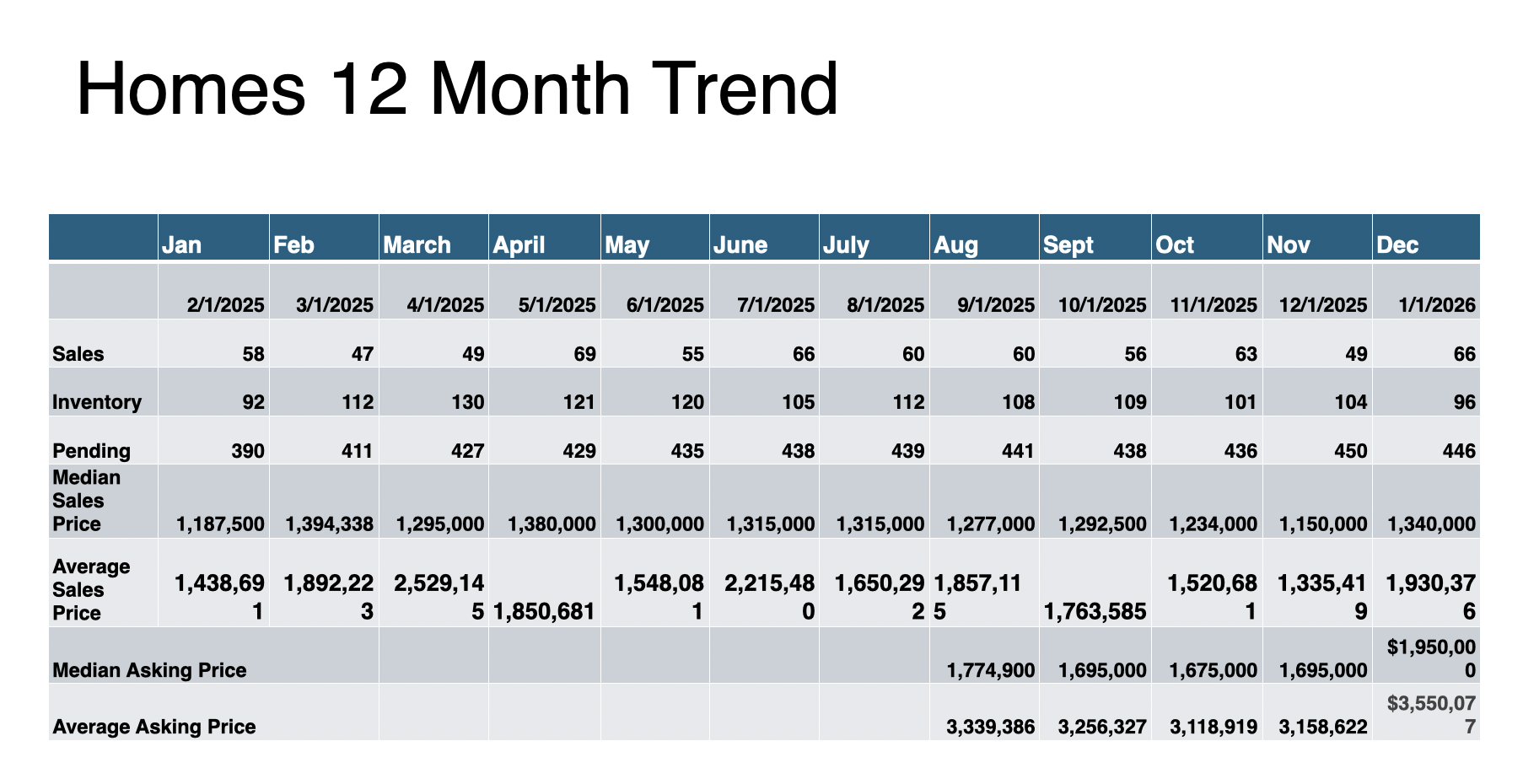
If you just glance at the year-end numbers for single-family homes, you might walk away thinking, “Well, that wasn’t so bad.” And in some ways, that’s true.
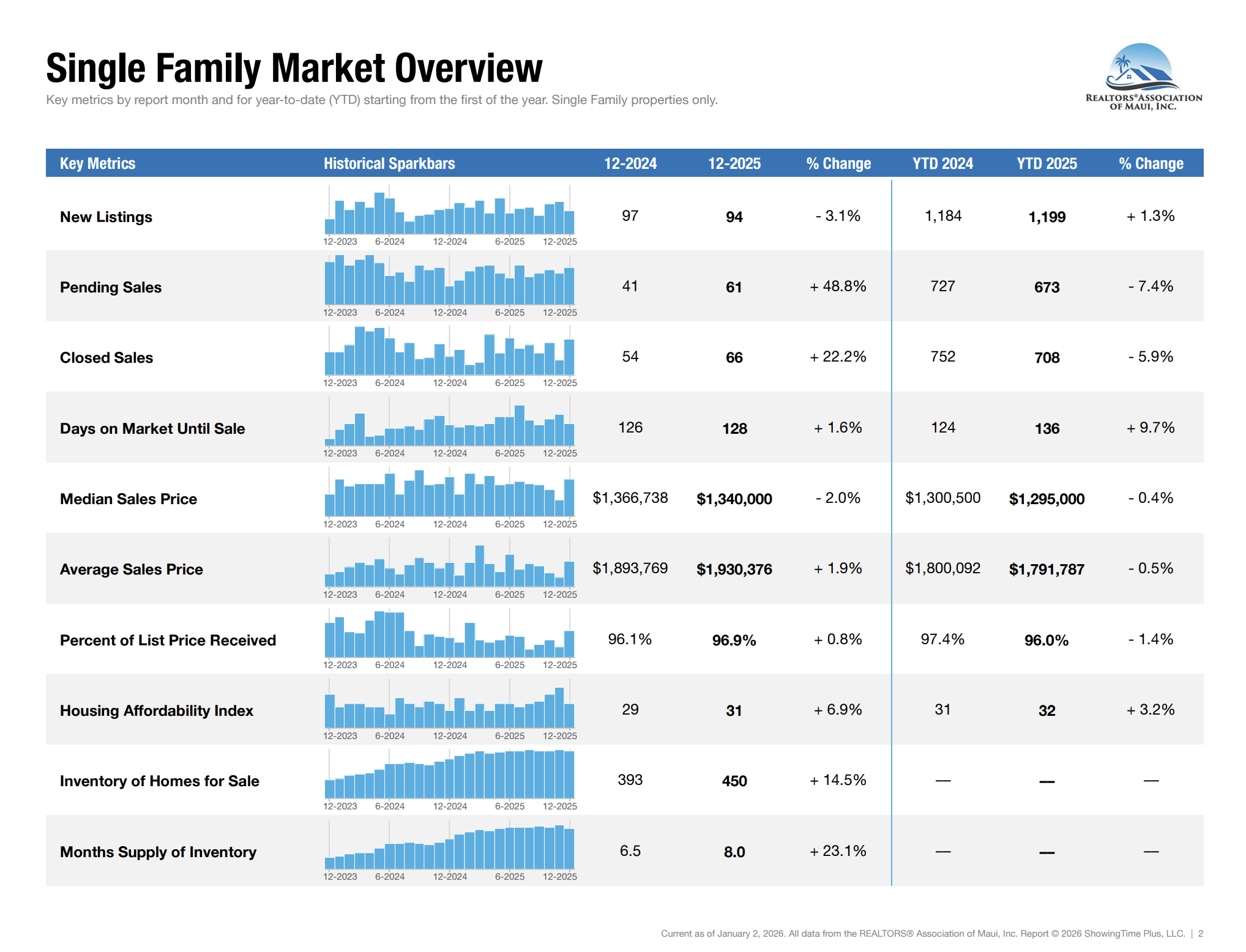
After a slight increase in sales in 2024, single-family home sales fell about six percent in 2025. Inventory grew only modestly, up just over one percent year over year, which left us ending the year with roughly six and three-quarter months of inventory. From thirty thousand feet, that looks like a fairly balanced market.
But that balance may not hold.
Pending sales — which are still our best leading indicator of where the market is headed — declined by just over seven percent. If supply holds steady while demand continues to soften, that balance will start to tilt.
At the same time, both the median and average selling prices finished the year essentially flat. The median came in at $1,295,000, down less than half a percent for the year. The average selling price ended just under $1.8 million, off by about half a point.
On paper, 2025 looks uneventful.
But once you step inside the data, the story gets more interesting.
For most of the year, the single-family home market on Maui wasn’t one market at all. It was two very different markets operating at the same time.
Homes priced at or below the median — roughly that one-point-three-million-dollar range — behaved very differently from everything above it. In Central Maui especially, where there’s simply more inventory in that price band, demand held up surprisingly well. In those neighborhoods, it often still felt like a seller’s market, or at least a balanced one.
Once you moved above that threshold, the tone changed.
In West Maui, South Maui, Upcountry, and particularly in the higher-end and luxury segments, buyers had the leverage. Homes took longer to sell, negotiations became the norm, and pricing discipline mattered again.
That split showed up clearly in the numbers. Days on market increased close to ten percent, and sellers, on average, received about ninety-six percent of their asking price.
That doesn’t sound dramatic until you unpack it. In many cases, buyers were negotiating roughly four percent off a list price that had already been reduced from the original asking. The adjustment happened quietly, but it happened.
The median selling price really brings this story into focus. For about eighteen months, it hovered right around $1.3 million. That number became a psychological ceiling as much as a statistical one. In late summer and early fall, the median finally dipped below that level, briefly touching the low $1.1 million range, before popping back above $1.3 million in December.
That December bounce doesn’t necessarily signal a new upward trend. It may simply reflect the higher-end sales we often see as we head into peak season. What it does tell us is that the market is still searching for equilibrium — and hasn’t quite found it yet.
Affordability technically improved in 2025. The housing affordability index rose modestly, which sounds encouraging. But when the median home still costs around $1.3 million, affordability remains an unrealistic concept for many Maui families.
That reality isn’t new. What is new is the scale of intervention that followed the Kula and Lahaina fires. With the help of substantial federal funding, Maui County moved forward with aggressive down-payment assistance programs. In some cases, the assistance offered would have been unthinkable just a few years ago, and for certain first-time buyers, it can be truly transformative.
But it comes with strings.
Those strings include deed restrictions designed to preserve affordability long-term. The intent is good. The trade-offs are significant. These restrictions limit resale options, cap appreciation, and make it very difficult to build generational wealth through housing. For some buyers, that trade-off is worth it. For others, it’s not. Either way, it’s something that needs to be understood clearly before moving forward.
By the end of the year, sales activity picked up somewhat. More homes sold in the second half of 2025 than in the first, and average prices climbed toward the two-million-dollar mark as higher-end sales re-entered the mix. At the same time, pending sales softened again in December, which adds a note of uncertainty heading into 2026.
So where does that leave the single-family home market?
Somewhere between stable and unsettled. Balanced on paper, segmented in reality, and highly dependent on price point and location.
_________________________________________________
Condos: The Year the Market Reset
If single-family homes quietly adjusted in 2025, condos did something very different.
They reset.
Prices hit a wall. Sales hit a wall. And for many owners, that came with real pain.
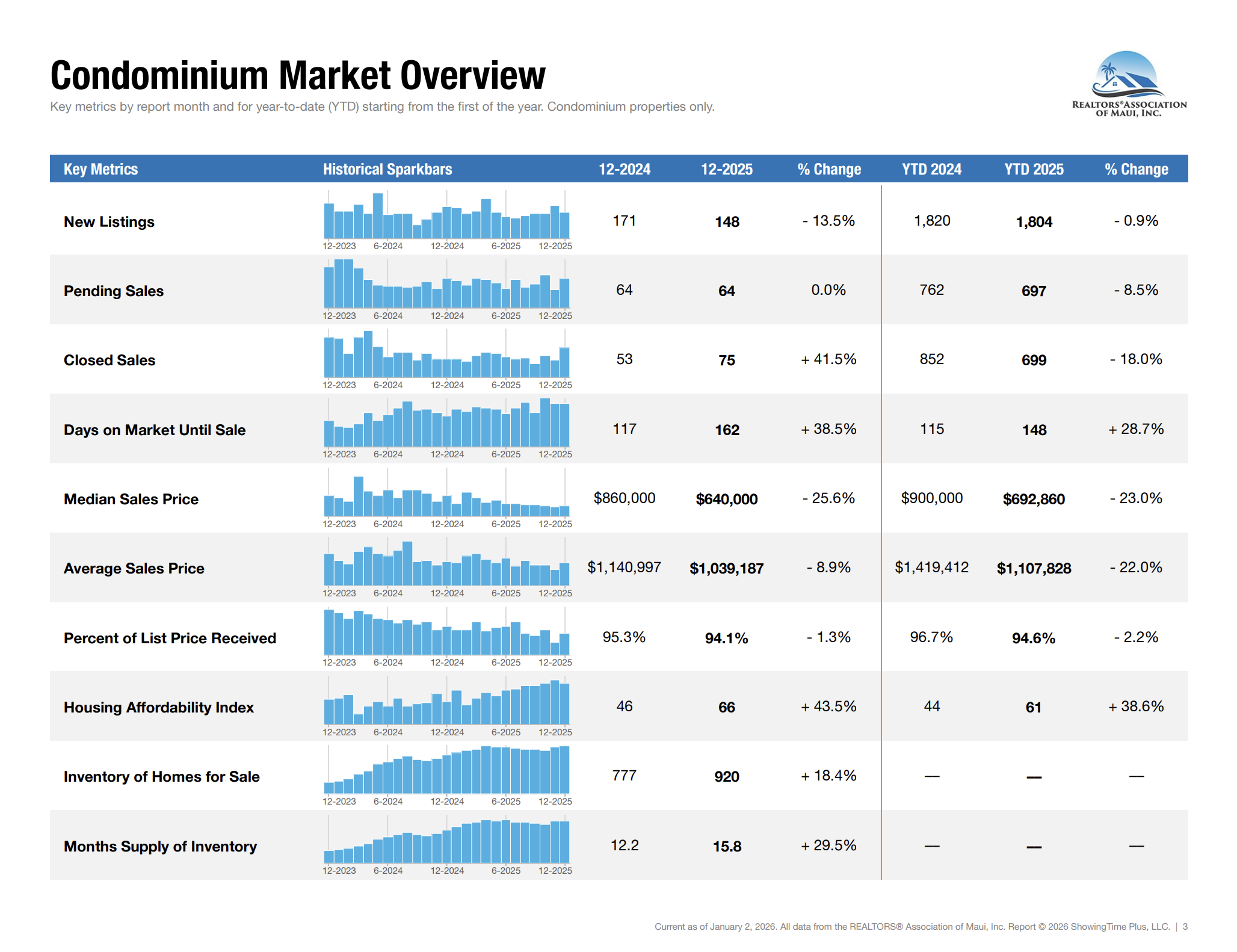
When I say the condo market “hit the wall,” it’s important to add some context. This wasn’t sudden. It’s been skidding to a stop since 2023. That year ended with closed sales down more than thirty-six percent. In 2024, sales fell another twelve percent, which felt like maybe things were slowing down. But 2025 proved otherwise, with sales dropping another eighteen percent.
Over that period, the median condo price declined from roughly $832,500 in 2023 to about $692,860 in 2025.
That’s the backdrop for how 2025 unfolded.
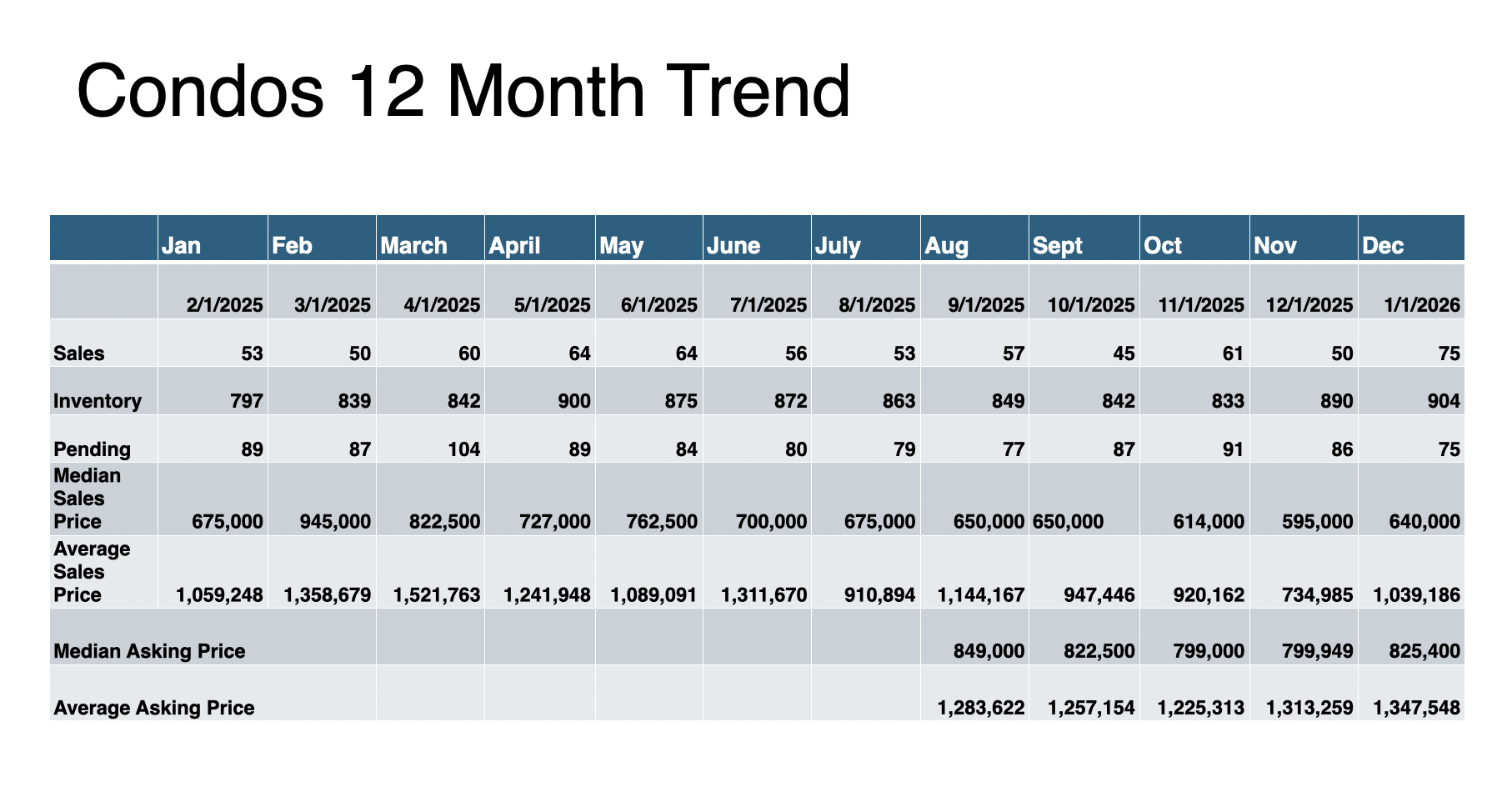
The year started with cautious optimism. Sales in January were modest, but as we moved into spring, it looked like momentum might be building. That optimism didn’t last. Summer turned into a letdown, and by November, condo sales had fallen to their lowest monthly total of the year.
December brought a strong rebound, with the highest number of condo sales we’d seen in about a year and a half. On its own, that sounds encouraging. But when you step back, it’s hard to ignore the weight that inventory and pricing exerted on the market all year long.
Inventory climbed quickly early in the year, eased for a bit, then surged again toward the end. By December, we were back above nine hundred condos for sale, which translates to roughly twelve months of inventory. In any textbook, that’s a buyer’s market.
And yet buyers remained cautious.
Even as prices fell — and they fell hard — pending sales never surged the way you’d expect in a classic buyer’s market. Throughout most of the year, condos under contract hovered in a relatively narrow range. We ended the year with fewer pending sales than you’d normally want to see heading into peak season.
Pricing tells the most sobering part of the story. The median condo price started the year near $945,000. By late spring, it dropped into the $700,000s. By mid-summer, it fell into the $600,000s. In November, it bottomed out just under $600,000 before ticking up slightly in December.
That decline isn’t theoretical. It represents real equity loss for real people.
The average selling price followed a similar path, falling from well over $1.5 million early in the year to the mid-$700,000s by November, before rebounding at the very end of the year as a handful of higher-priced condos closed.
Sellers, on average, received just under ninety-five percent of their asking price. But that figure hides the reality that many condos had already been repriced once — or several times — before they ever sold.
What we saw in 2025 wasn’t panic selling. It was something more controlled, but no less significant: a market slowly accepting a new reality.
It ain’t 2022 anymore.
_________________________________________________
Looking Ahead: What 2025 Means for 2026
If there’s one lesson 2025 delivered clearly, it’s this: Maui real estate is no longer coasting.
Buyers are careful. Sellers are being forced to price for the market we’re in, not the post-COVID rebound market. Policy decisions, insurance costs, HOA budgets, and financing constraints are now front-and-center in almost every transaction.
Single-family homes found a fragile balance. Condos went through a reset that may not be fully finished yet.
As we move into 2026, the real question isn’t whether Maui real estate will recover. It’s how uneven that recovery will be — and who will be positioned to take advantage of it.
The people who understand what actually happened in 2025 — not just the headlines, but the details — will be the ones best prepared for what comes next.
And that’s exactly why we do this report every year.
