Aloha Group Maui | Luxury Single-Family Market Analysis | Data through August 31, 2026
Lately I keep hearing the same question from clients, other agents, reporters, and the usual market pundits: is luxury real estate on Maui crashing?
I heard it again recently from a group of Realtors touring a high-end home. We were talking about tourism, the economy, and what we're seeing in the luxury market.
It's a fair question.
But then there are moments that make me wonder exactly what is going on.
Not long ago, Barb and I went to Merriman's in Kapalua. The valet parking was six cars deep. There was a crowd waiting out front, and the restaurant was packed.
Whatever else is happening in the economy, the upward angle of the K-shaped economy appears to be alive and well on Maui.
Which raises an interesting question: Where are all those luxury home buyers?
The question makes sense if your reference point is 2021. But 2021 was an extraordinary outlier. Sales volume exploded, days on market collapsed, discounting nearly disappeared, and buyers moved quickly.
Measured against that one year, everything since can look like a crash.
But when I updated the numbers through the end of August, I came away with a somewhat different answer than I did earlier this year.
The Maui luxury market isn't crashing. But I don't think we can call what's happening simply "normalization" anymore either.
Sales have fallen below the long-term norm. Inventory is aging. Negotiation has widened. And at the upper end of the market, there are a lot more homes looking for buyers than there are buyers willing to make a decision.
Prices however, have held up remarkably well.
So what we're seeing looks less like a price crash and more like a liquidity problem.
And if you like data, this one is for you.
The Big Picture: An 11-Year View
A longer lens matters here, and so does the yardstick.
A $4 million home in 2016 isn't economically the same thing as a $4 million home today. So rather than letting inflation quietly move our definition of "luxury," we adjusted the $4 million threshold backward using the Consumer Price Index.
In 2016, the equivalent threshold is about $2.88 million. By 2026, it's the full $4 million. That gives us a much better apples-to-apples picture.
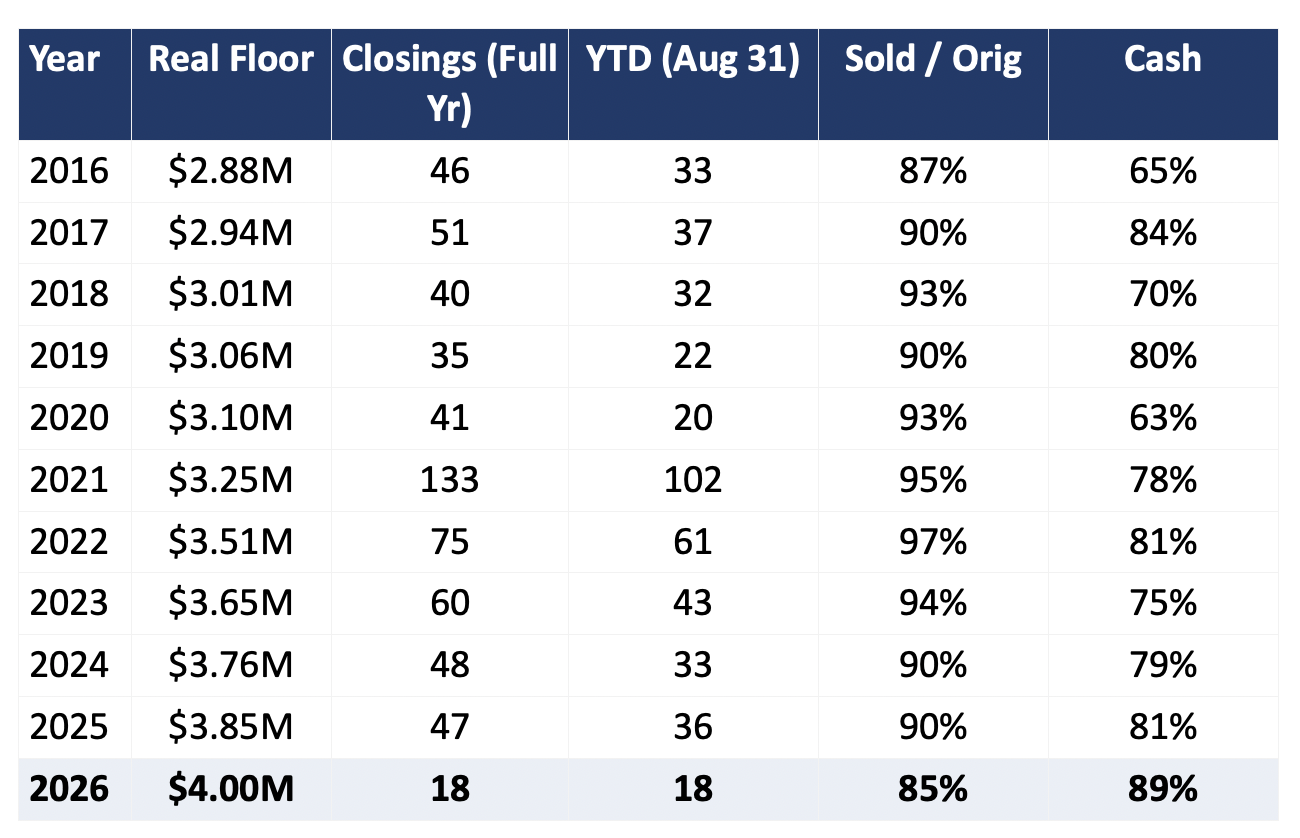
Real Floor is each year's inflation-adjusted $4M threshold. Sold/Orig is the meidan sale price as a share of the original asking price. 2026 is partial, through August 31.
Read the numbers that way and the story reorganizes itself.
From 2016 to 2020, Maui averaged roughly 43 inflation-adjusted luxury home sales per year.
Then came 2021. Sales jumped to 133. It wasn't a normal market. It was a convergence of stimulus, rapidly appreciating financial assets, extraordinarily low interest rates, remote work, and a sudden rethinking of where people wanted to live.
Then came the step-down: 75 sales in 2022, 60 in 2023, 48 in 2024, 47 in 2025.
That wasn't a crash. That was normalization.
But 2026 is different.
Through August 31, only 18 luxury homes have closed, the lowest January-through-August total in our 11-year inflation-adjusted comparison.
For the first time since the pandemic boom, we've moved below, rather than simply back toward, the historical norm. That's worth paying attention to.
Maui Doesn't Have One Luxury Market
We've traditionally talked about Maui luxury in fairly broad price bands. But looking at this year's numbers, I think that hides some of what's actually happening. Here's a better way to look at today's market:
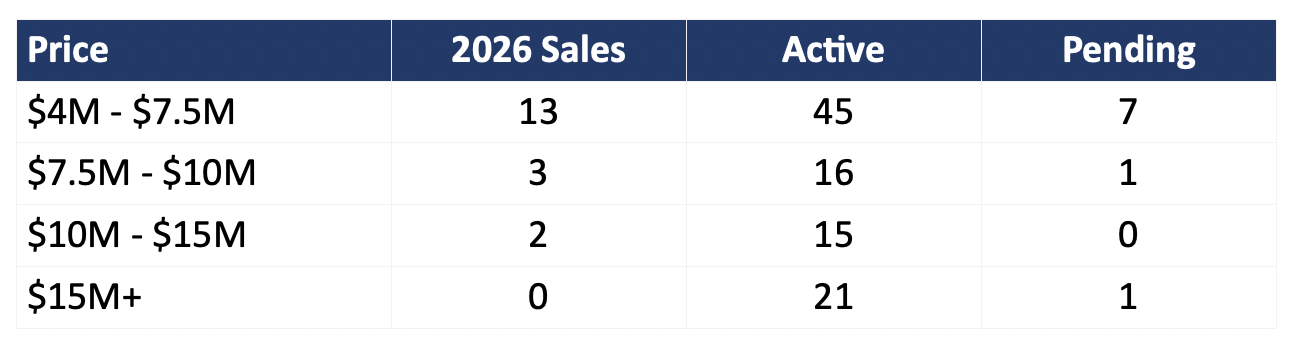
The $4 million to $7.5 million segment is still the engine of Maui luxury. Thirteen of this year's 18 sales are there, and seven of the nine homes currently under contract are there. It's slow, but it's functioning.
Once we get above $7.5 million, things change pretty quickly.
There are currently 52 homes for sale above $7.5 million. Only two are under contract.
Go above $10 million and there are 36 homes for sale, with just one pending.
And above $15 million? Twenty-one homes for sale. One pending. Not one closing so far this year.
That's a very thin market. The top isn't correcting on price. It's frozen.
At the Top, Buyers Are Looking for "The Home"
There is something about those numbers that the MLS can't tell you. I know, because we represented the seller on one of the two homes that sold this year between $10 million and $15 million.
On paper, it looks like that home sold relatively quickly. But the buyer didn't suddenly wake up a few weeks earlier and decide to spend eight figures on a Maui home.
He had been circling Maui for probably two years, looking for The. Home.
Then ours came on the market. It was in the right place. It had the right amenities. It checked the boxes he had been waiting to check. And he was ready to make an offer.'
I think that's an important distinction. At these price points, buyers don't necessarily need to buy. They can wait. And many aren't looking for just a nice Maui home. They're waiting for the particular home that makes them want to act.
So the problem isn't necessarily that there are no luxury buyers.
There are simply far more properties for sale than there are buyers who believe they've found "the one.
And maybe that helps answer my question about that packed restaurant in Kapalua. The people with money haven't disappeared.
The urgency to buy Maui real estate may have.
The Logjam
The trailing 12-month numbers make that even clearer.
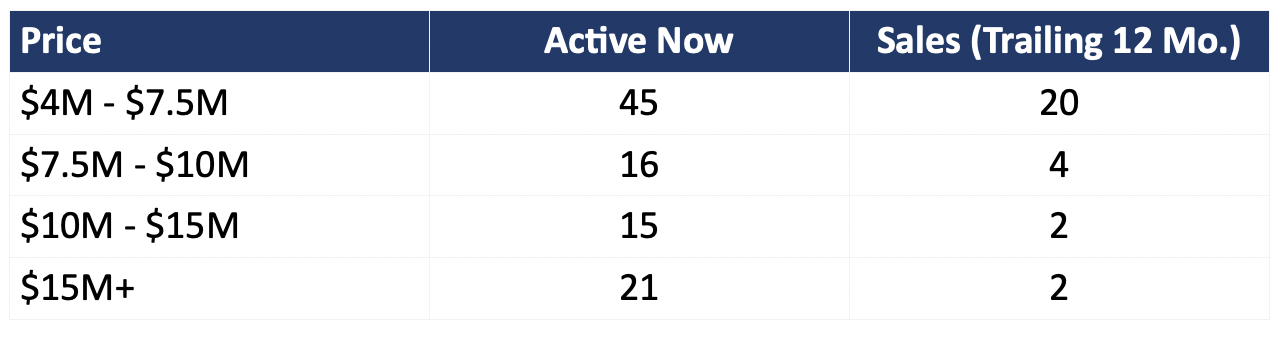
The core market has 45 homes for sale against 20 sales over the past 12 months.
Above $7.5 million, however, 52 homes are currently competing in a market that produced only eight sales over the last 12 months.
Above $10 million, it's 36 homes for sale against four trailing-year sales.
We can turn those numbers into "month of supply," and they become pretty dramatic. But at these prices points, where one or two transactions can change the calculation substantially, that suggests more precision than really exists. The simpler point is probably the better one: That's a lot of sellers waiting for not very many buyers.
Days on Market Tells Another Part of the Story
Here's where this gets especially interesting for owners.
The 18 luxury homes that actually sold this year took a median 140 days to find a buyer. That's not particularly fast.
But the homes still for sale have already been sitting on the market for a median 202 days. And at $15 million and above, the median is 254 days.
More than half of today's luxury inventory has already been exposed to the market for over six months. One listing has been out there for more than 900 days. So simply waiting longer isn't necessarily bringing buyers and sellers together.
There is an important caveat, though, and it goes back to the sale I mentioned earlier.
Days on market measures how long the property has been looking for a buyer. It doesn't measure how long the buyer has been looking for a property.
At the upper end of Maui's market, that distinction matters. A home can technically sell in 30 or 40 days to a buyer who has spent two years waiting for exactly that property to come along. That's one reason I don't think DOM by itself tells the whole story in luxury real estate.
But when the active listings have reached a median 202 days while the homes that actually sold did so at 140, the message for sellers is still pretty clear: Time alone isn't a strategy.
Price is Adjusting, Just Not the Way a Crash Looks
Negotiation has returned too. This year's luxury sales have closed at roughly 85% of their original asking price, the widest gap in our 11-year comparision.
Yet the median sale price remains about $5.55 million, compared with $6 million last year. And 89% of this year's transactions have been cash.
That's an unusual combination if you're looking for evidence of a conventional real estate crash. Transaction volume has fallen dramatically. Negotiation has widened. Homes are taking longer. But prices haven't fallen anything like transaction volume has, and cash remains dominant.
That's why I keep coming back to liquidity. Buyers and sellers haven't agreed on where this market should clear.
What This Means for Sellers
If you're selling a luxury home on Maui, I don't think you're in a collapsing market. But you are in a very selective one.
So, if waiting isn't working, what is? The answer isn't a better way to wait. It's to stop waiting for a buyer and start being the home that ends a buyer's search.
Remember the buyer I mentioned who circled Maui for two years. He wasn't waiting for a good home. He was waiting for the home. Every seller's job in this market is to be that home for someone. And that's an active job, not a passive one.
There are buyers. Our own sale above $10 million demonstrates that. And the broader evidence around Maui suggests there is still plenty of wealth here. What seems to be missing is the willingness to turn that wealth into another piece of real estate unless the property or the opportunity is compelling enough.
Buyers have choices, and particularly at the upper end, they have the luxury of waiting. That makes pricing, preparation, and positioning more important, not less.
Price to the market that's actually trending, not to a 2021 comp. Present the home like it's already the one, turnkey and professionally shown, with no deferred maintenance quietly telling a buyer to keep looking. And answer, "Why yours?" before a buyer asks it, by leading with the one thing the other twenty listings don't have and getting it in front of the small pool actually shopping at that price. At this level, that often means the agent network and quiet off-market conversations, not just a portal.
Pricing well doesn't guarantee a quick sale in this market. Pricing poorly almost guarantees a long one.
And if you're not willing to do those things, the answer still isn't to keep sitting on teh MLS while your days on market climb toward that 900-day listing. It's to pull the home and wait on purpose, on your terms, until you're read ot sell it right. The 900-day listing isn't a seller who's waiting. It's a seller who's been waiting by accident.
If your'e on of the 15 homes competing between $10 million and $15 million, the question isn't simply whether your home is beautiful. At this level, they're almost all beautiful. The question is: Why yours?
Because waiting isn't a strategy. It's what happens when you haven't picked one.
What This Means for Buyers
For buyers, this market is almost the opposite of 2021. Selection is deep. Pressure is low. Negotiation is back. That doesn't mean sellers are desperate, and it certainly doesn't mean every asking price is about to fall. But buyers can be deliberate.
And this may be the biggest difference between today's luxury buyer and the 2021 buyer.
They can afford to buy. They just don't feel compelled to buy.
Someone can fly first class, stay at Montage, eat at Merriman's, own financial assets that have done very well, and still decide there's no reason to write a $10 million check for a Maui house today. They can wait.
And unlike 2021, there's very little fear that if they don't buy this home today, there won't be another one tomorrow. For the buyer who knows what they want, that patience is powerful.
Our Take
Earlier this year I said Maui's luxury market wasn't crashing. It was normalizing after one of the most unusual real estate markets any of us have ever seen. I still don't think it's crashing.
But I do think something has changed.
For the first time, sales have fallen below the long-term norm. We have 97 luxury homes for sale, only nine under contract, longer days on market, and a pretty serious logjam once you get above $7.5 million. At the same time, prices remain relatively firm, cash buyers haven't disappeared, and from what I can see around Maui, wealthy consumers haven't disappeared either.
So maybe the questions isn't, "Where did all the luxury buyers go?" Maybe they're still here. They're just not in a hurry.
And that brings us back to what maybe the defining question for this market: how long are sellers willing to wait for their buyer, and how long are buyers willing to wait for "the home"? Right now, both sides seem pretty willing to wait. And sooner or later, something has to break that logjam.
In my experience, these recalibration stretches, not the frenzies, are where the smartest long-term deciions tend to get made.
If you're thinking about buying, selling, or just want to undersand where you fit into all of this, we're always happy to talk story and walk through the numbers with you!
